
Researchers, housing advocates urge rules, guardrails and faster review to use welfare tax exemption for affordable housing
Get AI-powered insights, summaries, and transcripts
Subscribe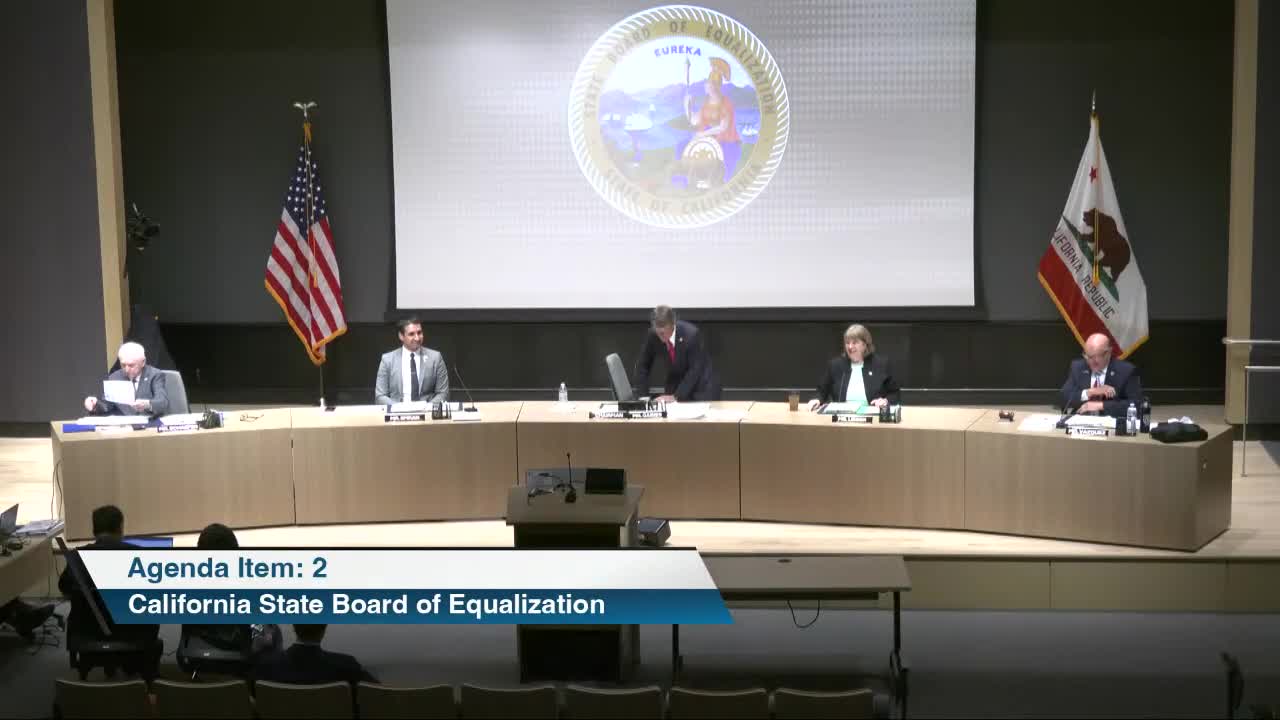
Summary
An informational BOE hearing explored how California’s property‑tax welfare exemption could be used to expand affordable housing, with recommendations for clearer guidance, a BOE liaison, processing time targets and regulatory guardrails for projects using the exemption.
An Aug. 20 informational hearing at the State Board of Equalization examined whether and how the property‑tax “welfare” exemption can be used to reduce the cost of affordable housing and speed approvals for construction or acquisition of affordable units.
“There are 2 ways, 2 main ways that the welfare exemption supports affordable housing,” said Sarah Karlinsky, director of research and policy at the UC Berkeley Turner Center for Housing Innovation, opening the session. She described programs in California and other states that pair a limited public finance investment with a property‑tax exemption to generate deed‑restricted affordable units.
Karlinsky told board members the exemption has been applied in several California pilot programs: the California Municipal Finance Agency (CMFA) grants a $10,000 subsidy plus a 30‑year deed restriction; the Bay Area Housing Finance Agency provides a $5,000 grant and a 55‑year restriction; and the Housing Authority of the City of Los Angeles offers subordinate loans and long‑term regulatory agreements. Those programs have supported hundreds to thousands of units but also revealed recurring barriers, she said.
“The process of securing the exemption can be quite lengthy — it can take up to a year and a half — and owners must recertify annually,” Karlinsky said. Interviewed developers cited two recurring issues: the cost and time needed to verify tenant incomes and the fact that units can lose their exemption if occupant incomes rise beyond a statutory threshold.
Speakers and staff recommended concrete changes to make the exemption easier to use for affordable projects while protecting public value. Karlinsky’s report urged clearer guidance for applicants and assessors, a BOE or county liaison to answer application questions, a shot‑clock for application review, and modest affordability guardrails such as requiring rents at least 10% below market and regulatory agreements that protect existing rent‑stabilized tenants.
Justin Yato of the California Housing Partnership said the BOE’s role in authorizing nonprofit organizational clearance is important but county assessors make final property determinations, producing uneven outcomes across jurisdictions. He recommended the BOE publish model procedures, concrete examples and standardized forms so developers and counties start from the same baseline.
Both speakers suggested expanding the exemption’s use to support infill projects that qualify for state streamlining (for example, under SB 423) and recommended regional or state finance agencies—BAHFA, CMFA or CalHFA—offer nominal financing or regulatory agreements to secure affordability over decades.
Why it matters: The welfare exemption reduces a recurring operating cost (property tax) that improves project feasibility for affordable housing. Panelists emphasized that adoption at scale will require process speed, consistent county implementation, and safeguards so the public receives affordability in exchange for foregone tax revenue.
Board members thanked presenters and directed staff to consider the recommendations; no formal board action was taken at the informational hearing.