
Board schedules September hearing on workforce housing developed by public agencies
Get AI-powered insights, summaries, and transcripts
Sign Up Free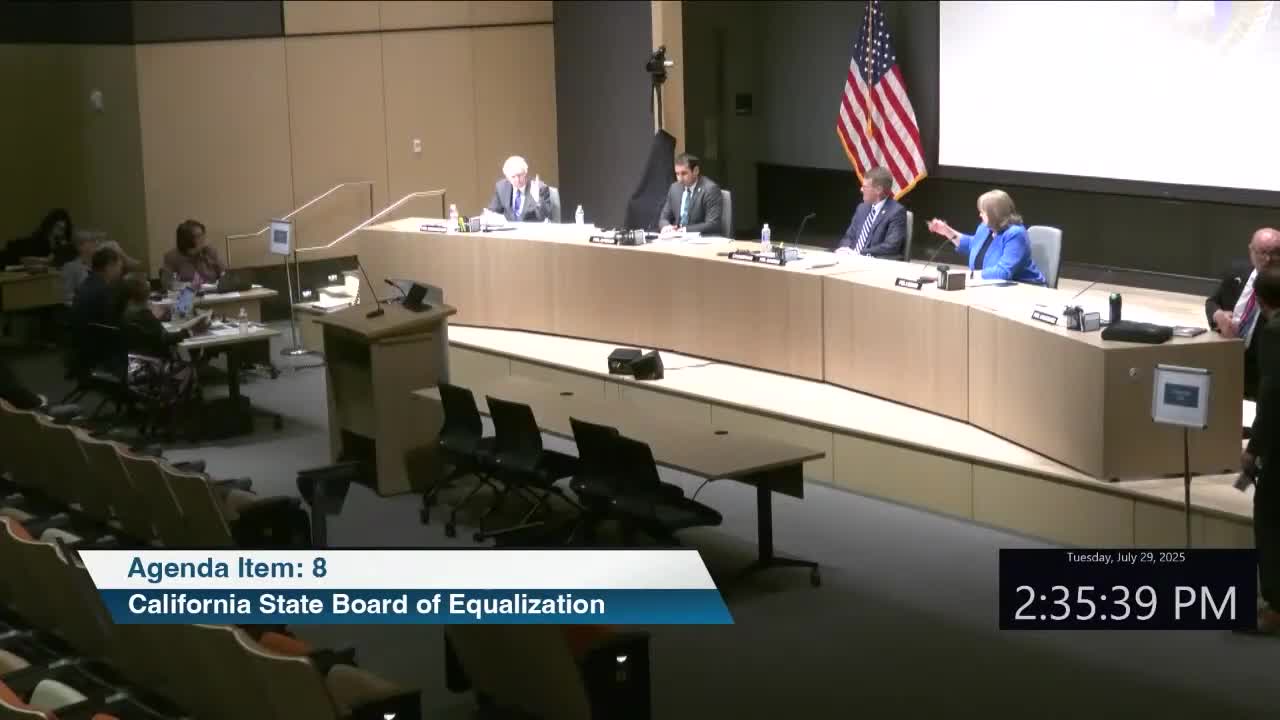
Summary
The board approved an informational hearing for Sept. 16 to explore property taxation and development options for workforce housing by public agencies; presenters cited federal programs such as HUD’s Good Neighbor Next Door and state programs for first‑time buyers while urging inventorying public properties for reuse.
The California State Board of Equalization voted July 23 to hold an informational hearing on September 16 to examine tax implications and opportunities for workforce housing developed by public agencies.
Member Schaeffer introduced the item, describing it as focused on developing new housing stock for working families and public employees. "We're requesting an informational hearing on property taxation implications of, of an opportunities to develop workforce housing by public agencies," Schaeffer said, proposing a Sept. 16, 10 a.m. to noon time slot.
Why it matters: The board and members framed workforce housing as a potential tool to keep essential workers—transit employees, public hospital staff, first responders and others—housed near their workplaces. The item asked the board to examine tax rules and programs that might facilitate new construction rather than only rehabilitation of existing units.
Discussion and examples: Schaeffer referenced HUD’s Good Neighbor Next Door program, which allows qualified buyers (teachers, firefighters, law enforcement and EMTs) to purchase eligible existing homes at a discount with a required occupancy period and a second mortgage to preserve the discount’s public purpose. He also cited California programs such as the California Heroes and First‑Time Buyer programs that operate at the state level and emphasized that those programs primarily address existing housing rather than creating new units.
Multiple board members urged staff to consider public property inventories as part of the hearing, including surplus school district land or underutilized municipal property. Vice Chair Lieber suggested looking at federal surplus properties and partnerships for veteran housing. Member Vasquez pointed to school district inventories as a place to find underused parcels that might be repurposed for workforce housing.
Action: Member Schaeffer moved to approve the informational hearing for Sept. 16; Vice Chair Lieber seconded. The motion passed by roll call (ayes recorded by Chair Gaines, Vice Chair Lieber, Member Vasquez, Member Schaeffer and Deputy Controller Amaron). No public comments were received for the item.
Next steps: Staff will schedule witnesses and assemble materials for the Sept. 16 hearing and coordinate with the requester’s office on speakers and focus areas.