
Board hears experts on using property-tax welfare exemption to speed affordable-housing financing
Get AI-powered insights, summaries, and transcripts
Sign Up Free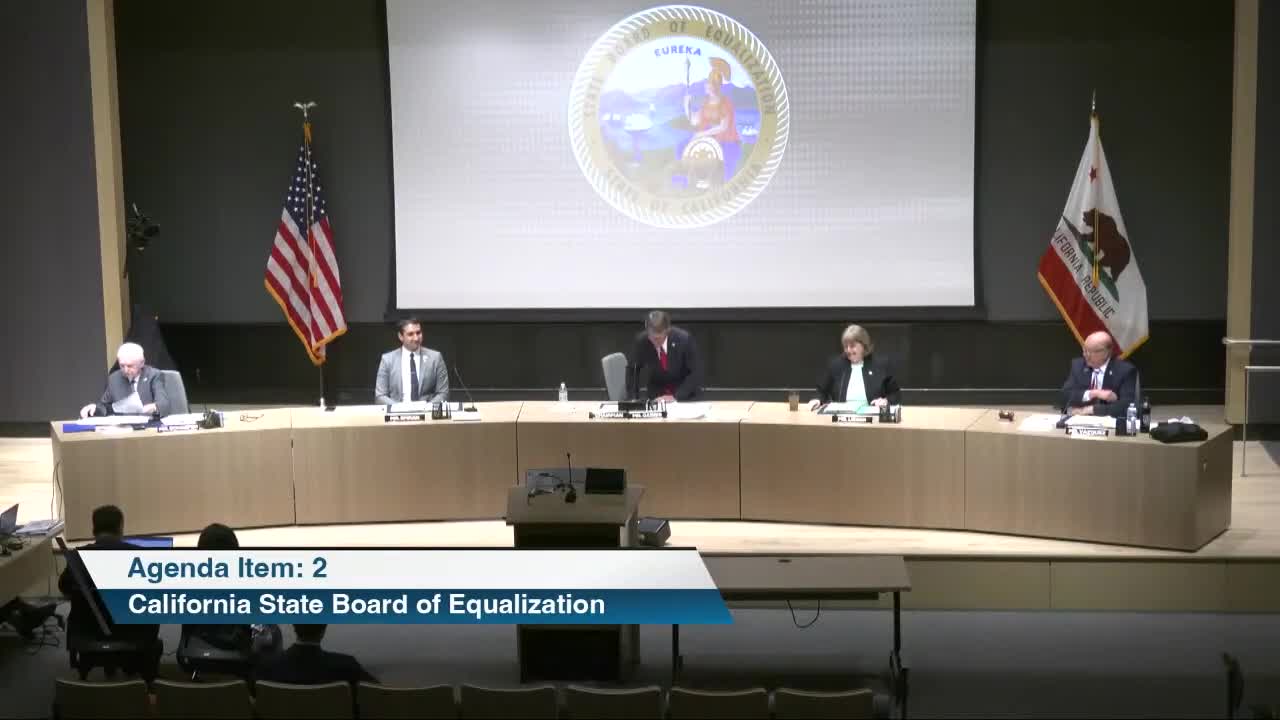
Summary
The California State Board of Equalization held an informational hearing on using the property tax welfare exemption to support affordable housing financing and to help streamline approval processes.
The California State Board of Equalization held an informational hearing on using the property tax welfare exemption to support affordable housing financing and to help streamline approval processes. Member Terence Vasquez opened the session and said the board would “consider options for how the property tax welfare exemption can contribute to California's new efforts to streamline the affordable housing financing approval process and increase affordability.”
The hearing assembled academic and industry speakers who described both how the exemption is already being used and where the process breaks down. Sarah Karlinsky, director of research and policy at the UC Berkeley Turner Center for Housing Innovation, summarized lessons from California programs and other states and warned that “the process of securing the exemption can be quite lengthy … it can take up to a year and a half.” Justin Yotta, associate director of housing finance at the California Housing Partnership, added that “the BOE is the group that certifies the organization, but it's the assessors who certify the properties,” and said that county-by-county variation creates delays and uncertainty for developers.
Why it matters: the welfare exemption reduces property-tax liabilities on units restricted to lower-income households, which can be a meaningful part of the financing stack for acquisition and sometimes new construction. Panelists described programs that pair the exemption with nominal public financing or long deed restrictions as a way to preserve affordability in exchange for the tax benefit.
Key facts and examples presented - California Municipal Finance Agency (CMFA) program: $10,000 grant paired with a 30‑year deed restriction; panelists said CMFA had supported 17 projects (seven new‑construction projects) totaling 1,800 units as of August 2024. - Bay Area Housing Finance Agency program: $5,000 grant paired with a 55‑year deed restriction; described as supporting nearly 800 units as of May 2025 and requiring rents at least 10% below market for covered units. - Housing Authority of the City of Los Angeles (HACLA) program: subordinate loans and regulatory agreements; panelists reported roughly 950–1,150 units supported in the pipeline (figures described in testimony as "9 50" and "11 50" and treated here as those reported values).
Speakers and stakeholders identified several consistent challenges: - Tenant income verification is time consuming and voluntary: owners must collect signed tenant statements and other documentation; noncooperation can delay or prevent qualification. - Annual recertification and income growth can remove units from exemption status if households exceed statutory thresholds (panelists noted some exemptions terminate if incomes rise beyond 100% of area median income unless covered by other programs). - Government financing frequently carries programmatic or labor requirements that can offset tax‑exemption value. - Administrative delays at county assessor offices — sometimes a year or more — create financing risk for developers.
Recommendations offered to the board and counties - Clearer statewide guidance and a single, searchable set of instructions for applicants and assessors to reduce county variation. - Designated welfare‑exemption liaisons at the BOE and at county assessor offices so applicants have a known contact for questions and status updates. - A statutory or administrative “shot clock” for assessor processing of exemption applications to create predictable timelines. - Guardrails to ensure public benefit in return for tax revenue foregone: examples included minimum rent discounts (panelists proposed at least 10% below market), limitations on rent increases tied to local ordinances or AMI and regulatory agreements to honor existing rent stabilization rules. - Expand the exemption to support multifamily infill and projects eligible for state streamlining under SB 423, including a possible presumption of qualification for projects already eligible for streamlining. - Broaden income‑flexibility rules used for LIHTC properties (maintain exemption if income later rises to 140% AMI) to non‑LIHTC projects and explore tenant self‑certification or reliance on participation in other entitlement programs (for example, CalFresh) as proof of income.
Board reaction and follow up Board members asked detailed questions about tradeoffs — in particular the potential lost property‑tax revenue for local special districts and schools — and sought more data on processing times and examples of county practice. Vice Chair Lieber and other members supported work to engage assessors and regional housing finance agencies and to collect case examples for a BOE website FAQ.
Decision status: informational hearing only. No formal action or rule change was taken at the meeting; members directed staff to continue outreach and indicated interest in further work with assessors and finance agencies to operationalize some of the recommendations.
What to watch next: panelists and members identified several follow‑ups that could be handled administratively or by the Legislature — clarifying guidance from BOE staff, development of liaison roles, and whether the income standard for non‑LIHTC properties should be changed by statute to mirror LIHTC rules. The board also discussed sharing examples and model deed restrictions for use by regional finance agencies that pair minimal financing with long regulatory terms.