Get Full Government Meeting Transcripts, Videos, & Alerts Forever!
Get email alerts on the K 12 Budget topic
No spam. Unsubscribe anytime.
Prosser School District proposes roughly $2 million in cuts to close 2025–26 shortfall
Summary
District finance staff told the school board the 2025–26 budget as written would end in a $628,000 deficit and recommended about $2 million in temporary and immediate reductions across substitutes, overtime, supplies, building budgets and travel to restore a positive fund balance.
Delise, a district finance staff member, told the Prosser School District board at a study session that if the district makes no changes it will “end the 25–26 full year in with a negative fund balance of $628,000.”
The presenter laid out a package of proposed reductions that she said would bring the district back toward a sustainable fund balance. “We have to figure out where to cut $2,000,000 in our budget,” Delise said, summarizing the scale of the shortfall and the district’s options.
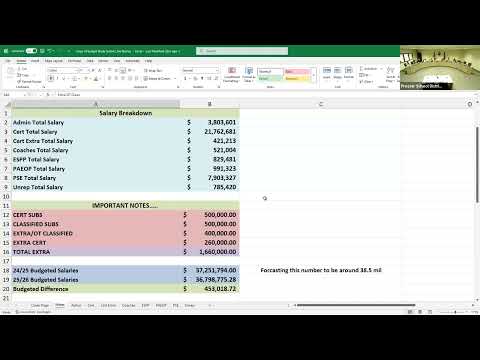
The proposals target several areas: cutting substitute teacher costs and tightening absence coding in the Frontline system; reducing overtime and extra-time pay for classified and certified staff; trimming building discretionary budgets and centralizing supply purchasing; restricting travel; and reducing stipends and extra certified time. The presenter said salaries are the largest portion of the district’s spending: the board’s salary budget is listed at about $37.2 million of a roughly $46.05 million total budget, with an August forecast of up to $38.5 million in salary costs.
Why it matters: the district expects lower revenues tied to falling enrollment and reductions in some federal and state program funding, the presenter said. She told the board the revenue outlook is down by about $1.5 million and noted one-time savings from negotiated, one-year changes will not necessarily recur in 2026–27; for example, an MOU that temporarily reduced enrichment hours provides about $400,000 in single‑year savings but is not permanent.
Details of proposed reductions
- Substitutes and absence coding: The presenter said the district spent about $1,000,000 on substitutes in the year under review (roughly $500,000 for certified subs and $500,000 for classified). She proposed cutting sub costs “in half” by removing non-contract absence reasons from Frontline, requiring administrative approval for district‑initiated leave and tightening how Frontline and Skyward connect so absences charge to the correct funding source.
- Overtime and extra time: Classified overtime this year was about $400,000 (excluding comp time), and extra certified time was about $260,000. The proposal would cap and reduce overtime and extra-time budgets, with suggested target savings of roughly $340,000 for classified overtime and $200,000 for extra certified time.
- Supplies and building budgets: The district’s supply code spending totaled about $1.4 million for the year. Delise proposed cutting roughly $750,000 from that code and reducing individual building allocations from the current practice to about $30,000 per building, with centralized ordering for common items to reduce duplicate purchases.
- Travel and professional development: Travel spending is about $150,000 (registration excluded). The presenter proposed cutting travel by $100,000, leaving about $50,000 for the year and limiting out‑of‑district travel.
- Athletics and ASB funds: Coaching stipends and related coaching costs were identified as a significant levy expense; the presenter said cuts to coaching budgets would still leave athletics costs on the levy at about $521,000. Board members discussed using Associated Student Body (ASB) funds or fundraising to cover some enrichment activities so basic education funds could be preserved.
Constraints and legal/contractual context
The presenter repeatedly warned that collective bargaining agreements and previously negotiated MOUs limit the district’s flexibility. She said some pay and benefit structures (referred to in the session as “Veeva” costs, identified by the district’s consultant) total about $805,000 annually and that outside counsel and the district’s legal team should review whether current practices comply with state rules (she referenced RCW language and a potential WAC/RCW interpretation). She also cited L&I (Labor & Industries) rules as a constraint on simply refusing to pay accrued overtime that employees submitted.
Board response and next steps
Board members and the superintendent signaled support for pursuing the proposed cuts and tighter controls. The superintendent voiced support for the plan’s feasibility: “Absolutely. They’re absolutely feasible,” the superintendent said when asked whether the district could operate within the proposed budgets.
Delise asked the board for direction to refine the proposals and return with more detailed figures at the next study session. The board agreed to move forward with developing the reductions and to continue the discussion at a follow-up study session. A district staff member announced a potential study session on August 20 at 5 p.m. in the boardroom and a regular board meeting on August 27 at 6 p.m. that could include budget approval.
What was not decided
No formal motion or vote to adopt the cuts was recorded in the transcript. The board’s comments amounted to direction to staff to develop more detailed proposals; the transcript contains no adoption of a final budget or specific line‑item approvals. Several district staff and board members stressed some of the reductions would be temporary and that the district would revisit allocations when the fiscal picture improved.
Ending
District staff said they will provide more detailed, named reports (the presenter offered to send payroll-level reports with names to board members) and refine coding and approval processes for substitutes, overtime and extra time. The board set a timeline for additional study and possible action at upcoming meetings. The presenter closed by reiterating that the recommendations are options to bring the district back to a positive fund balance and that the work will require district‑wide changes in practice and new approval controls.