
Virginia Beach school board hears options after surprise jump in 2026 health premiums
Get AI-powered insights, summaries, and transcripts
Sign Up Free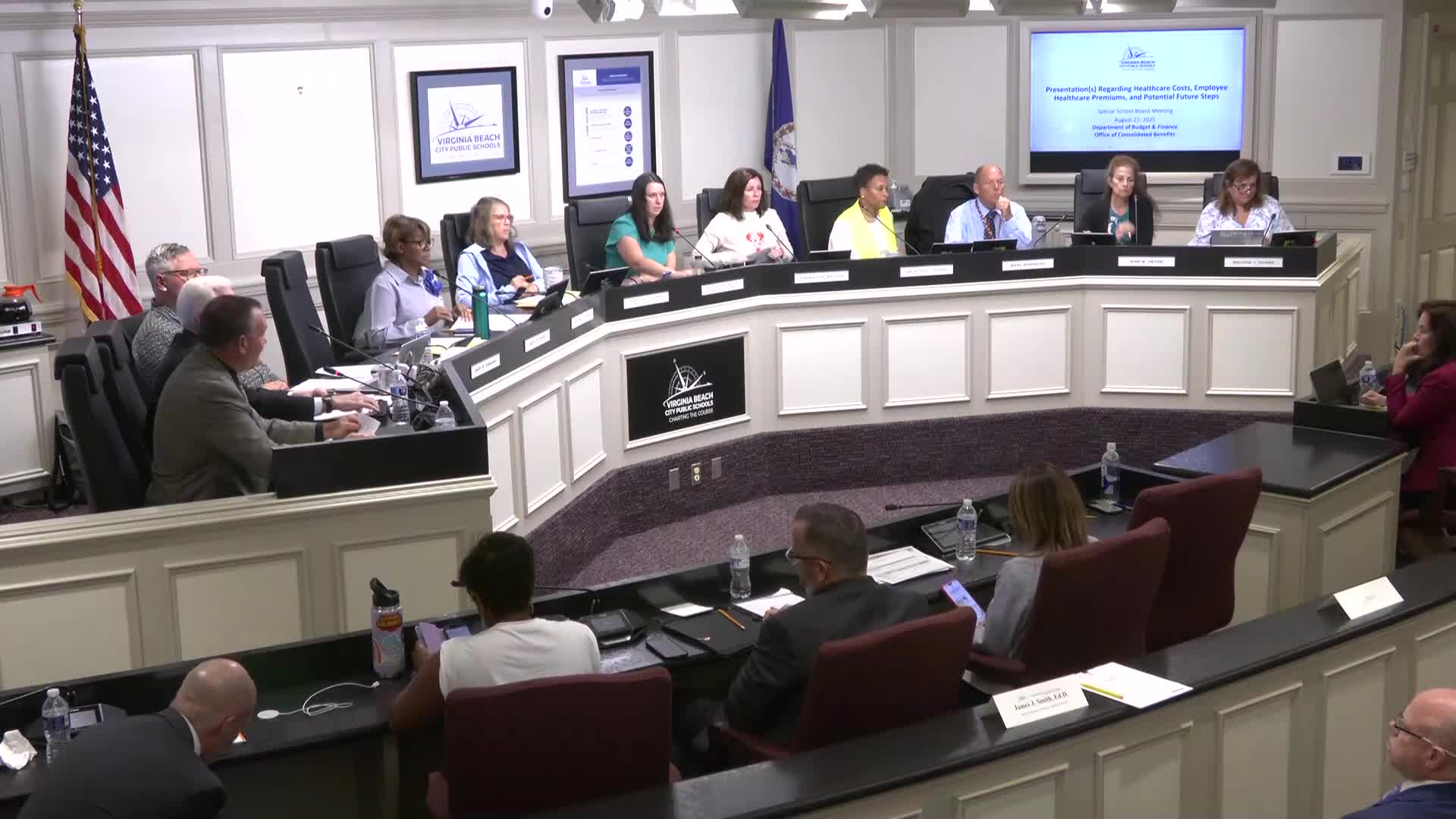
Summary
School officials and consultants outlined why projected 2026 health insurance costs rose sharply, reviewed funding history and alternatives (including two employer-subsidy scenarios), and discussed next steps; no change to premiums was adopted at the meeting.
Chair Kathleen Brown opened a special meeting of the Virginia Beach City School Board to review projected 2026 employee health insurance premiums and potential next steps after staff and Mercer consultants reported a large, unexpected increase in projected plan costs.
The presentation detailed how actuarial trend changes, prescription drug costs and an increase in high-cost claimants produced a projection that prompted administrators to return premiums to levels similar to 2019–22. Mercer principal David Keogh told the board that those cost drivers are consistent with statewide and national trends: “this is not unique to Virginia Beach City Public Schools.”
Why it matters: health benefits are the district’s second-largest operating expense after salaries. Administrators said the health fund that previously smoothed employee premiums will no longer cover ongoing increases without either higher employee contributions, new employer funding or other changes to plan design. That gap has implications for school budgeting, compensation packages and open enrollment communications ahead of the plan’s January 1, 2026 effective date.
Board members heard a detailed timeline of modeling and communications. Administration said updated claims experience and a jump in assumed medical trend from 7% to 9% during spring and summer 2025 drove successive increases in projected gross plan cost — from about $105.8 million in earlier modeling to roughly $135.6 million in the June update. Staff and Mercer showed three funding scenarios: the originally released proposal that would largely restore 2022 premiums (an average ≈97% increase over 2025 employee contributions in aggregate), an alternative that reduces the employee share (labeled a 75% scenario) requiring roughly $2.3 million in additional employer funding, and a larger employer subsidy (a 50% employee‑increase scenario) costing roughly $4.3 million in additional employer funding. Mercer also showed that a single year’s high‑cost claimants and specialty drug costs were major contributors to the trend.
Administrators described how the district has used reserves and employer contributions in prior years: Crystal Pate, the district chief financial officer, said the division has invested about $171 million in salary and wage increases and about $27.5 million in employer health contributions over the past five fiscal years to support recruitment and retention. Pate also recapped that the board allocated roughly $32.1 million to salaries and $11 million to keep health rates flat for 2024–25 and that the 2025–26 budget included additional compensation investments.
On the fund balance, Mercer and benefits staff reported two figures tied to different reporting dates: a May 2025 estimate of approximately $19.1 million and a fiscal year‑end balance reported later in the presentation of $16,855,045 as of June 30, 2025. Staff said best practice is to hold approximately two months of claims in reserve (projected at $21.5 million for FY2026 or $22.6 million for the 2026 plan year). Even with the proposed premium adjustments, staff showed the health fund could be depleted by calendar year end 2026 under the initial proposal unless additional funding or other changes are made.
Board members asked about prior communications, the RFP and procurement process that led to re‑awarding the district’s third‑party administrator to Sentara, and whether elected board members could participate on the joint benefits executive committee with city staff. Administration said the committee is a working executive committee of school and city staff; board members are not automatic members of that committee, but staff said the idea of appointing a liaison could be considered. The procurement officer and the Virginia Public Procurement Act were identified as the oversight route for RFP compliance; staff said some procurement documents are proprietary and may not be public.
The board debated pacing and risk. Several members said they were reluctant to adopt a large long‑term subsidy quickly because the health fund could go negative if trend continued worse than projected. Multiple board members asked staff to look at alternatives that would provide targeted relief to employees without creating an untenable ongoing liability. Administration agreed to model additional options, including a potential one‑time stipend or other limited, targeted support that could be paid after open enrollment if the board chose to do so. No motion to change premiums or to provide an immediate stipend passed at the meeting.
Chair Brown and several members praised benefits and finance staff and Mercer for the presentation and asked that the board receive more frequent, timely projections (staff said quarterly Mercer reports and Sentara reviews are available on request and that the budget office is building timeline checkpoints into the fall budget calendar). Administration noted an operational deadline to finalize enrollment platform configuration (Benefitfocus) that made rapid rate changes difficult after late July; staff said the practical cut‑over deadline to avoid errors in open enrollment materials was about September 10.
Mr. Cummings announced he would recuse himself from the board discussion and votes on this topic because of his work with Sentara Health Plans; he remained in the room but did not participate. The board recessed to closed session under the Virginia Freedom of Information Act for litigation consultation and later certified that the closed session complied with Code of Virginia requirements. The meeting ended without any vote to set or change 2026 premiums; follow‑up modeling and options were requested of staff.
Ending: Board members said they would continue to explore employer subsidy options and alternative cost‑containment measures and requested more frequent financial updates before the district’s open enrollment period starts in late September. Administration offered to return with supplemental scenarios, and staff posted a FAQs and contact information on the Consolidated Benefits office website for employees.
Quotes used in this article are attributed only to speakers who spoke in the meeting and appear in the attached speaker list and provenance section.