Get Full Government Meeting Transcripts, Videos, & Alerts Forever!
Get email alerts on the Community Choice Aggregation topic
No spam. Unsubscribe anytime.
Montgomery County public hearing highlights local push for community choice aggregation
Summary
Supporters told the County Council that expedited bill 27-25 would let the county purchase cleaner electricity at scale; some business representatives warned about opt-out enrollment and small-commercial impacts. No council vote was taken; the public hearing closed.
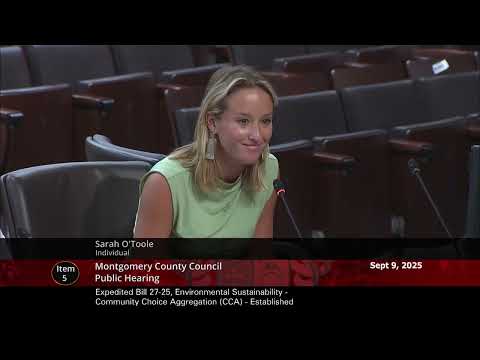
Montgomery County Council held a public hearing Sept. 9 on expedited bill 27-25, a measure that would establish a county-run community choice aggregation (CCA) program to allow the county to become the default electricity supplier for residents and small businesses while utilities continue to handle delivery, billing and maintenance.
Supporters said the program would increase the share of renewable energy in local electricity supply and help the county meet its climate goals; opponents representing some commercial property owners warned that using opt-out enrollment for small commercial accounts could cause administrative burdens or higher costs for businesses.
The bill would formally establish a CCA pursuant to enabling legislation passed by the Maryland General Assembly in 2021 and place oversight with the Montgomery County Department of Environmental Protection, according to testimony.
Sarah Kogelsmucker, climate change officer for Montgomery County, speaking on behalf of County Executive Eldridge, said the program is “a long standing priority of the county executive” and that CCA "is crucial to meeting our climate change goals." She told the council that CCA would allow the county to offer electricity with a higher percentage of renewable content than the default utility and to do so cost-competitively by aggregating demand. Kogelsmucker also urged the council to adopt minor language changes to give the implementing department clarity.
Laurie McGilvray, representing Climate Coalition Montgomery County, said the county’s 2021 climate action plan identifies CCA as the single most important energy action to reduce community greenhouse gas emissions and urged "speedy passage of bill 27 25." Mark Posner, speaking for the Montgomery County Sierra Club, described CCA as a multi-step process that will culminate in an aggregation plan returned to the council and then the Maryland Public Service Commission for approval.
Cody Hovin, executive director of Lean Energy US, cited national CCA performance figures and told the council that "CCAs save on average of 2 to 25% of costs for their customers" and that communities can tailor programs to local priorities such as rooftop solar or support for disadvantaged communities.
Not all testimony was uniformly in favor. Brian Anlu, representing the Apartment and Office Building Association (AOBA), said association members support stabilizing energy costs and increasing renewable supply but are concerned that small commercial accounts could be mistakenly enrolled under an opt-out default. "This could lead to Aoba members being mistakenly enrolled in the CCA when their contracts expire," Anlu said, and urged the council to exempt small commercial accounts or require opt-in for that class.
Jorge Aguilar of Food & Water Watch and several other speakers urged passage, saying CCA would return energy purchasing decisions to local control and help implement county climate goals. Scott Schneider, a long-time Silver Spring resident, also testified in support and urged the council to implement the program quickly.
No vote on the bill was taken at the hearing; the council closed the public hearing and will consider the bill in committee and future calendar items. Supporters and several speakers said further technical work will be needed on the aggregation plan and on coordination with the Maryland Public Service Commission and state and federal advocacy to address interconnection and regulatory constraints.
Council members and staff will receive written testimony and suggested edits noted during testimony; the county executive’s office and Department of Environmental Protection staff indicated they will continue to work with committee staff on implementation language.
The public hearing record for expedited bill 27-25 is closed.