Get Full Government Meeting Transcripts, Videos, & Alerts Forever!
Get email alerts on the School Facilities topic
No spam. Unsubscribe anytime.
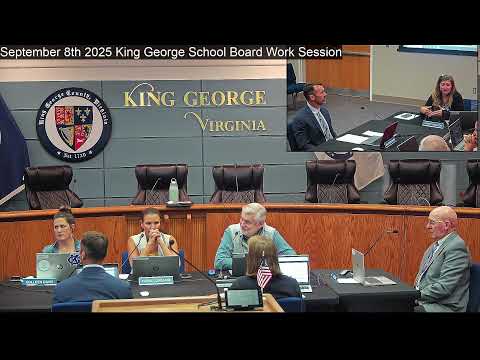
King George school board prioritizes two‑story vocational center; preschool and fourth elementary remain secondary
Summary
School board members agreed to prioritize building a two‑story vocational (VOTEC) center to address high‑school overcrowding, and asked staff to develop a 10‑year plan that would include preschool placement at elementary schools and consideration of a fourth elementary.
The King George County School Board agreed in a working discussion to prioritize construction of a two‑story vocational education center and to present that priority to the Board of Supervisors, while continuing planning for preschool placement at elementary schools and a possible fourth elementary school.
School division staff opened the discussion by walking board members through a facilities timeline and enrollment data dating to 2018 and earlier, and said current enrollment trends show the high school as the only building currently over capacity. "As of today, we have 1,511 students enrolled at the high school," a school staff presenter said, adding the high school's capacity is 1,500. The staff member also reported 1,066 students at the middle school (capacity 1,538) and provided elementary counts: King George Elementary 592 K–5 students plus 120 preschool students; Potomac Elementary 540 (capacity 751, including modulars); Sealston Elementary 681 (capacity 717).
Why it matters: the board faces competing capital priorities tied to a community referendum on an elementary/preschool project and a separate feasibility study for the vocational building. Board members repeatedly said they wanted a clear, prioritized request to take to the Board of Supervisors in upcoming joint meetings and during the CIP/budget process.
On the vocational center, the division shared options from its feasibility work. Board members voiced support for the two‑story option because it would increase program space and could shift some high‑school students into vocational programs, alleviating pressure on the high school. Cost estimates discussed for the two‑story options ranged in the discussion from roughly $17 million to just under $20 million for construction; the presenters noted equipment, specialized utilities and instructional positions would add to total project costs. One slide cited an $85,000 site demolition line included in a roughly $19 million estimate for the two‑story option; board members also referenced a prior $57 million figure tied to a community referendum for a fourth elementary school/preschool project.
Board members asked staff to prepare a concise recommendation to bring to two‑by‑two meetings with the Board of Supervisors: (1) make vocational center construction the division's immediate capital priority, (2) advance planning so preschool can be placed at each elementary school as facilities allow, and (3) continue to develop a proposal and timeline for a fourth elementary school as a subsequent priority. Several members stressed the importance of longer trend data and demographic studies (Weldon Cooper was specifically mentioned as a data source) to defend any funding request.
The board also discussed short‑term and building‑level levers to ease capacity strains, including modular classrooms and potential grade‑reconfiguration (for example, moving a grade to the middle school). Several board members and the staff presenter cautioned that grade moves (for example, moving fifth grade to the middle school) present educational and social challenges and should not be treated as a first‑choice solution. Potomac currently uses modular classrooms as part of its capacity; King George Elementary has modular units on site that are slated to be removed.
Board members asked staff to follow up with the firm that completed the feasibility work for more detailed cost and program‑mix estimates for the two‑story VOTEC option and to prepare a 10‑year capital plan that staff can present to supervisors during the budget/CIP cycle. The board discussed using fund balance and supervisor support as likely funding paths but acknowledged that final costs for equipment and program startup remain to be determined.
The meeting did not record a formal vote to adopt a capital project resolution. Members concluded the facilities discussion by agreeing to prioritize the vocational center in outreach to the Board of Supervisors and to develop more detailed materials and demographic context for the December meetings and the CIP process.
Board business concluded with a motion to adjourn that passed by voice vote.