Get Full Government Meeting Transcripts, Videos, & Alerts Forever!
Get email alerts on the Zoning Basics topic
No spam. Unsubscribe anytime.
Planning commission receives comprehensive briefing on zoning authority, variances and special uses
Summary
Commissioners and staff reviewed fundamentals of zoning law for non‑home‑rule municipalities, including notice requirements, variances, conditional uses, subdivision and plan‑development rules, and legal risks such as takings and federal civil‑rights exposure.
The Pingree Grove Planning & Zoning Commission heard a training presentation from village staff on the fundamentals of local zoning authority, procedures and legal risks during a meeting that opened with roll call and approval of minutes.
The presentation, delivered by a village staff member identified in the record as Michael, spelled out how a non‑home‑rule municipality derives zoning power from the Illinois Municipal Code and the Illinois Constitution, and reviewed how that power is implemented through a comprehensive zoning ordinance, a zoning map, text amendments and map amendments. "The staff and I thought it would be a good opportunity for us to go over some basic zoning concepts," Michael said at the start of the discussion.
The session outlined several points commissioners should weigh when reviewing applications or drafting ordinances. It emphasized that: the Illinois Municipal Code is the source of zoning authority for non‑home‑rule municipalities; a comprehensive zoning amendment normally requires publication notice but courts have required individual notice where changes will adversely affect a particular group of owners; and that counties and other regional bodies may in some circumstances have authority that supersedes a municipality's home‑rule actions. The presenter cited an appellate decision involving the City of Zion as an example that individual notice may be required when a comprehensive amendment substantially reduces previously permitted uses for specific owners.
The presentation explained the difference between text amendments (changes to the ordinance language) and map amendments (rezonings of specific parcels), and described the comprehensive plan as advisory rather than legislative. Michael said courts give weight to a well‑prepared comprehensive plan when reviewing zoning decisions. The County of DeKalb was cited as an example where the plan supported a denial of residential subdivision zoning.
Commissioners heard how objections to map amendments can be raised: if owners whose property fronts the parcel in question file a valid petition totaling 20 percent frontage, a higher threshold is required for approval (the presenter said the village requires a two‑thirds vote of trustees in that circumstance). Separately, a municipality itself may file an objection to a county conditional use; that action can trigger a three‑quarters vote requirement at the county level.
The presentation covered variance law and standards: a variance is extraordinary relief from the ordinance and applicants must demonstrate practical difficulties or unique physical characteristics of the property. The presenter emphasized that self‑created hardships and purely personal circumstances do not typically justify a variance; findings of fact are required by statute and should be specific so that future applicants cannot treat the decision as a precedent.
Special or conditional uses (sometimes called conditional use permits) were described as uses that require a public hearing and may carry reasonable conditions to mitigate impacts, such as traffic or buffering. The presenter cited the Illinois case City of Chicago Heights v. Living Word (2008) to explain that if a municipality lists a use as allowable as a conditional use in a zoning district, it cannot categorically deny every qualified applicant: if an applicant meets the ordinance criteria, the municipality must grant the conditional use subject to any reasonable conditions.
Plan developments (PUDs) were presented as a tool that can allow departures from strict zoning standards in exchange for a coordinated plan and public benefits; the presenter noted that courts and practitioners sometimes treat PUD approvals as quasi‑contractual commitments between a developer and the municipality.
The briefing also addressed covenants and homeowners associations. The presenter noted that private covenants are separate from the village code; a village permit that allows a use does not erase an owner's obligation under private covenants, and enforcement of covenants typically remains a private matter. The presentation warned that villages are sometimes asked to enforce covenants and cautioned about that practice.
Nonconforming uses and amortization were discussed: a use that was lawful when established generally may continue as a legal nonconforming use, and courts are generally reluctant to force termination without careful legal basis. The presenter recommended caution when attempting to phase out longstanding uses and observed that enforcement and political will are practical constraints.
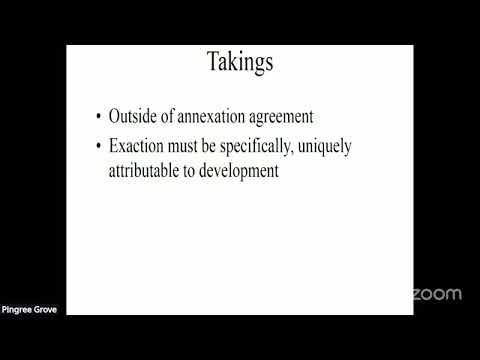
The presenter closed by describing takings and regulatory takings risk: a municipality changing zoning or imposing new requirements may face claims that regulatory changes amount to a taking of property rights, and courts evaluate whether a loss is substantial and whether the impacts are specially attributable to the regulatory change. The presentation cautioned that litigation and attorney's‑fees exposure can be significant and that staff and elected officials should weigh those risks when drafting regulations or conditions.
"If there's no other questions, thanks, gentlemen. Thanks everyone for listening," Michael said as the session ended. Chairman McDowell thanked the presenter.
No formal motions, votes or ordinance adoptions related to zoning were recorded in the transcript of the training segment.