Get Full Government Meeting Transcripts, Videos, & Alerts Forever!
Get email alerts on the Tax Increment Financing topic
No spam. Unsubscribe anytime.
Pingree Grove holds public hearing on proposed Heritage District TIF as consultants find conservation-area eligibility
Summary
SB Friedman presented findings that the proposed Heritage District qualifies as a TIF-eligible conservation area and outlined a redevelopment plan with up to $40 million in reimbursable project costs; board did not vote on TIF items and will consider three TIF ordinances at its next meeting.
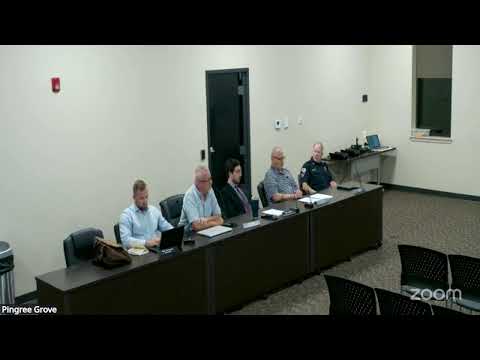
The Village of Pingree Grove opened a public hearing Aug. 18 to hear SB Friedman’s eligibility study and redevelopment plan for a proposed Heritage District tax-increment financing district. SB Friedman senior associate Lily Vander Zanden told the board and the public that TIF "is an economic development tool that allows for, municipalities to divert property taxes, from growth and development in that area to target and support redevelopment efforts." She said the firm concluded the Heritage District qualifies as a conservation area under the TIF Act, with 84% of primary structures more than 35 years old and four of 13 statutory factors ‘‘meaningfully present and reasonably distributed.’’ The consultants documented the district as 93 parcels — 80 improved parcels, nine vacant parcels and four parcels listed as right-of-way — and presented a redevelopment project budget that sets an upper reimbursement cap of $40,000,000. Vander Zanden said that the largest anticipated uses of TIF reimbursements would be public works and infrastructure improvements, including street, stormwater and water-main work. Nick (village staff) reminded the board and speakers that "there is no voting on TIF related items at this meeting" and that the three required TIF ordinances will appear on the next village board agenda for formal consideration. Public commenters raised concerns about property takings, tax impacts and past infrastructure work. Scott Matts asked, "what does in general terms, what's going on here?" and expressed worry that property could be taken; village staff replied repeatedly that there was no plan to condemn properties and that litigation is not a development tool. Long-time resident Derek Strissel told the board he was worried about demographic and tax effects on fixed-income residents, saying, "I see a lot about what we own, but there's no consideration of who lives there." Other commenters described ongoing flooding and water-quality problems in parts of the district. SB Friedman and village staff described the eligibility evidence the firm collected: parcel-by-parcel field surveys (December), building age, building-permit activity, a memorandum from Fairgram documenting utility and sanitary-system conditions, and a 2015 village comprehensive plan. The consultants reported that surface deterioration (streets, sidewalks, parking areas) was the most common deterioration observed and that Fairgram’s memo found approximately 54% of improved parcels within the proposed area had utility conditions that did not conform to current village codes (including unlooped water mains north of Public Street and inadequate fire-flow capacity for some parcels). On vacant parcels, SB Friedman said a Fairgram flooding study found runoff from those parcels drains to Tyler Creek and contributes to flood concerns in the watershed. The consultants concluded that without public investment the redevelopment objectives are unlikely to be realized and that TIF funding could help leverage private investment. The public hearing was opened and closed by motion. After a June 10 joint review board meeting that reviewed the public record and draft ordinances, the village will present three TIF ordinances to the board for consideration at the Sept. 2 meeting. If the board later adopts the ordinances and the district is created, the governing law calls for a frozen base equalized assessed value and a 23‑year TIF term in which increments above the frozen base can be captured and used for eligible reimbursements; SB Friedman emphasized that, if adopted, the frozen-base mechanism is intended to return increased EAV to taxing bodies once the TIF expires. The hearing provided extensive public comment and technical explanation but produced no final action on TIF designation. Staff said written questionnaires and staff follow-up are available for residents with specific property questions.