University Heights committees advance changes to weeds ordinance; remove references to "trees"
Summary
A joint meeting of University Heights committees continued work on Ordinance 2024-64 (codified ordinances chapter 10.84, “weeds”), approving removal of references to trees and debating how to treat native-pollinator landscapes, permitting, and sight-distance safety near corners and driveways.
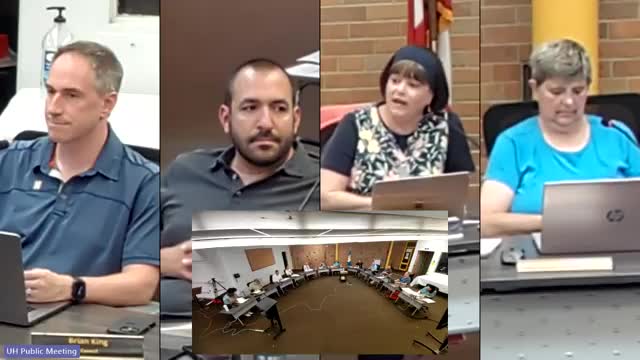
A joint meeting of the Service and Utilities Committee and the Building and Housing Committee of the University Heights City Council continued discussion of Ordinance 2024-64, which would amend chapter 10.84 of the city code (weeds) and clarifies how the city treats native plantings and “pollinator” yards.
The committee voted to remove references to “trees” throughout the draft ordinance. The motion was seconded by Councilman Rock and passed by voice vote; individual roll-call tallies were not specified in the transcript.
The change follows extended public comment and committee debate about how the ordinance should distinguish traditional turf lawns from yards intentionally converted to native-plant, pollinator-friendly landscapes. Don Vicarrel, a volunteer with Friends of the Walt and Friends of the Bradford Cinder Path, told the committees that the term “weed” is commonly undefined and suggested a homeowner-driven permitting approach. “A weed is any plant that you don't want to be there,” Vicarrel said, arguing that the city should allow landowners to submit a planting layout that lists intended species and species to be removed during a conversion from turf to native plantings.
Committee members and staff raised practical questions about inspection and enforcement. Service Director Alan Pennington said sight-distance requirements are set by the Ohio Department of Transportation’s location and design manual and noted safety concerns where tall vegetation could block visibility at intersections and driveways. “Sight distance . . . is determined through the Ohio location and design manual,” Pennington said.
The discussion covered several recurring proposals: creating a preapproval or permitting process for native-pollinator yards, maintaining a city species list to guide acceptable plantings, engaging certified reviewers (for example, master gardeners on a subcontract basis) to evaluate plant lists, and using the Board of Zoning Appeals (BZA) as the appeals venue for denied permits. Committee members also debated whether the ordinance should bar plants with foliage between 30 inches and 10 feet in the public right-of-way and whether that restriction should apply citywide or only near intersections and driveways where sight distance is a safety concern.
Supporters of native plantings urged flexibility. Councilman Ryan King and others said common pollinator species such as milkweed often exceed 30 inches and that requiring strict height limits would undermine efforts to attract pollinators and create visible natural landscapes. Several members proposed narrowing the 30-inch limit so it applies primarily at corners, intersections or within a specified distance of a driveway, rather than to every tree lawn.
Committee members also discussed administrative details: removing repeated references to a single “director” as the determiner of native or invasive species, instead relying on published lists (for example, the Ohio Department of Agriculture’s invasive-species lists and extension-service guidance) and allowing the city to maintain species lists for residents. Staff and council members flagged enforcement costs and the need to prevent “neglect posing as progress,” recommending a plan review and a process for homeowners to update approved plans as gardens mature and conditions change.
The committee did not complete final language for remaining definitions and sections; members assigned follow-up work, asked staff to prepare revised wording and examples, and invited Vicarrel to return to finish outstanding points at a later meeting. The joint committee adjourned after scheduling a follow-up date by doodle poll.