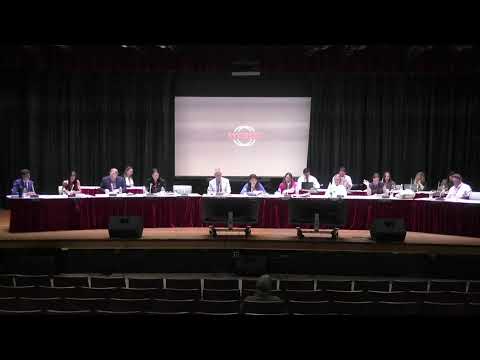
Syosset BOE holds first reading of revised Code of Character as district outlines statedistraction-free schools law implementation
Loading...
Summary
The Syosset Board of Education held a public hearing and first reading of revisions to Policy 5,300 and discussed how it will implement New York—s new —distraction-free— (bell-to-bell) law including exemptions for medical and special-education needs, a filtered student guest network for BYOD and new family communication tools.
The Syosset Board of Education held a public hearing and first reading of revisions to Policy 5,300, the district—s Code of Character, Conduct and Support, and heard extended staff explanation of how the new statewide "distraction-free schools" law will be implemented in Syosset schools.
Assistant Superintendent David Steinberg presented the proposed policy changes and said the updates "set clear expectations for behavior, and it outlines protections against discrimination, bullying, and harassment." He told the board the policy updates also clarify the board—s role in short- and long-term suspension appeals and that the policy text (more than 45 pages) is summarized in plain-language summaries posted on the district website for different stakeholder groups.
Superintendent Dr. Rogers described the new state requirement—commonly called a bell-to-bell ban—and said, "This is a law that's going to require, a lot of changes at the school district." He explained the district—s interpretation: students may not use personal internet-connected devices while instruction is in session (from the start of the instructional day until the end of the instructional day), noting that how that looks will vary by level. District-issued devices—for example Chromebooks—are exempt. Smartwatches are considered internet-enabled devices under the law and will be covered by the ban.
Rogers and staff laid out how the district will implement the law in practice: - Elementary: students will generally leave personal devices silenced and stored in backpacks or cubbies, consistent with current practice. - Middle schools: students will be required to keep personal devices in lockers during the school day; previously limited restrictions allowed use in non-instructional times. - High school: personal devices must be stored in student lockers from arrival until dismissal; the district will permit authorized educational use through a separate, filtered student guest network.
To preserve instructional uses for students, the district worked with Nassau BOCES to create a student guest network that will permit authenticated access for authorized educational purposes (research, teacher-led work) while blocking messaging apps, social media and VPNs. Rogers said students will authenticate with unique credentials and that privileges may be revoked for misuse. He emphasized that the district will not install monitoring software on personal devices: "We are not going to install any sort of software on a personal device," and that the guest network enforces filtering at the network level.
Staff addressed exemptions and accommodations. Rogers said the law allows exemptions for medical needs (for example, continuous glucose monitors that transmit to an app) and for adaptive technology required by a student's IEP or Section 504 plan. He noted the confidentiality challenge these exemptions create and said exemptions authorize device use only for the specific medical or accommodation purpose ("you can't... monitor your diabetes, and also play games on your phone"). Families are advised to contact building administrators if they believe an accommodation is needed.
The board asked practical questions about communication. Rogers said families can contact students by telephone through school offices and that the district maintains district email accounts for students in grade 8 and above that accept external messages; students in grade 8 and up will have both incoming and outgoing external email access. The district will also launch ParentSquare as its main family-communication platform; Rogers said ParentSquare complies with privacy requirements and will allow teacher-to-family and teacher-to-student communications and logistics such as coordinating team practices without granting general student-to-student messaging.
On discipline, Rogers said the new law specifically bars suspension "solely for cell phone use" but that typical code-of-conduct provisions (for example, insubordination or abusive behavior toward staff) remain applicable: if a device-related confrontation escalates into inappropriate conduct, the resulting discipline would be under the code of conduct, not the device rule itself. Rogers told the board the district intends to emphasize education and progressive responses (first mistakes handled more gently than repeated violations) and will publish a Syosset-specific FAQ before the start of school.
Steinberg said the change to Policy 5,300 that the policy committee approved clarifies the Board of Education—s role in suspension appeals: the board will "review the record of the suspension proceeding and determine whether 1, the suspension decision was based upon competent and substantial evidence that the student participated in the objectionable conduct, and 2, whether the sanction imposed was proportionate to the severity of the offense." Tonight was the first reading; the second reading and adoption are scheduled for the board's Sept. 15 meeting. Between meetings the district is accepting public feedback via the linked form and district website.
Board members asked whether BYOD will apply to laptops/tablets: Rogers said the filtered guest network is being launched only at the high school for grades 9— and will allow students to use personal iPads, notebooks or laptops for approved academic work on the guest network. He said the BYOD guest network was tested with BOCES and staff are confident it is ready to deploy when school opens.
Officials also confirmed technical and privacy points: district email is archived and accessible to administrators under district policy and law; the district will not inspect or install software on personal devices; and when students go home the devices operate on home networks with no district monitoring.
The board held no vote on adoption tonight; the revisions were presented as a first reading and the policy will return for action Sept. 15. The district will post policy text, plain-language summaries and the FAQ on its website and communicate details to families prior to school opening.