
Trophy Club commission backs ordinance to regulate community homes, assisted-living and nursing facilities
Get AI-powered insights, summaries, and transcripts
Subscribe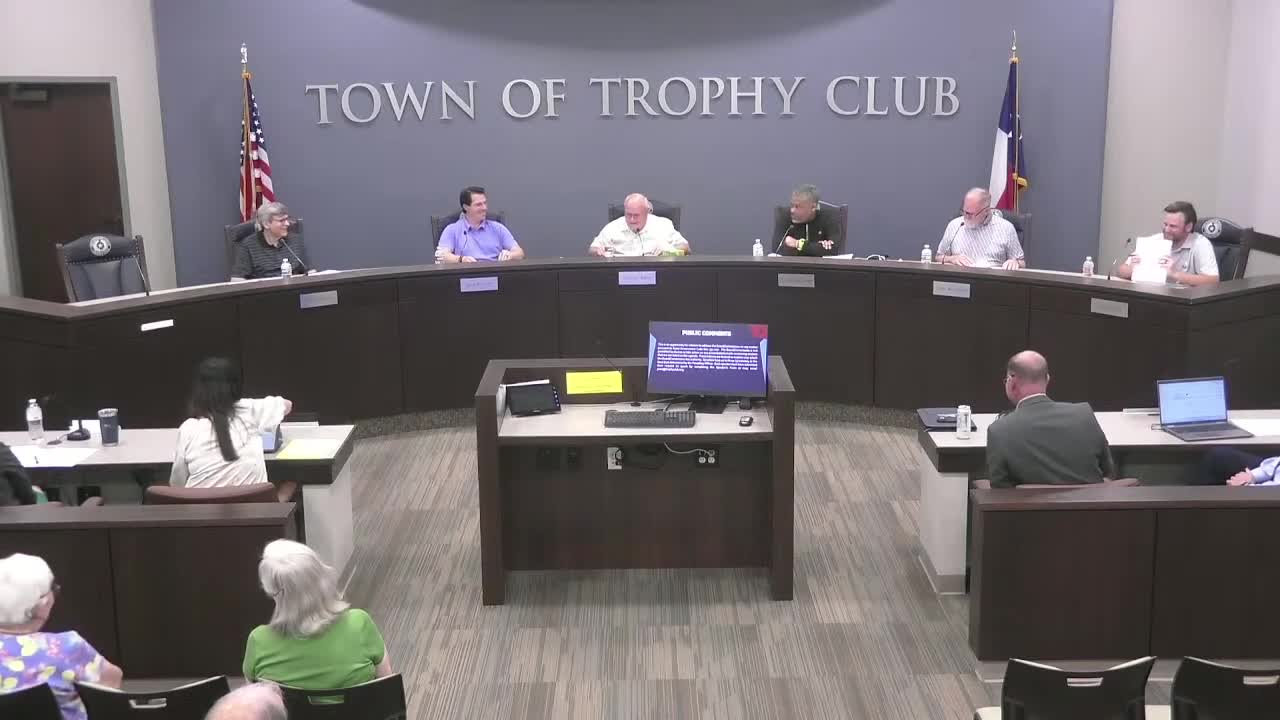
Summary
The Planning and Zoning Commission voted to recommend a zoning ordinance update to the Town Council that would require local registration, inspections, parking limits and other controls for community homes, assisted-living facilities and nursing homes after residents raised concerns about traffic, trash and safety at converted residences.
Trophy Club Planning and Zoning Commission members voted Sept. 4 to recommend that the Town Council adopt an amendment to Chapter 14 of the town code that would update definitions, the use table and supplementary district regulations for nursing facilities, assisted-living facilities and community homes.
The amendment codifies an annual local registration and inspection program, parking limits, a requirement to comply with state medical-waste rules, and a fee schedule that lists a $300 permit application fee, $150 inspection and $150 reinspection fee. Town staff said violations of state law would be reported to the Texas Department of Aging and Disability Services and that failure to comply could result in revocation of a certificate of occupancy.
The change follows public concern and a months-long review process that included joint meetings with the town council and Planning & Zoning Commission, an August resident input session and staff legal review. Tamara Smith, the town staff presenter, told commissioners the draft ordinance incorporates council and resident feedback on parking, inspection protocols, community notification, property restrictions, and an inspection fee schedule.
Residents at the meeting urged stronger neighborhood protections. Pat Keefer, a Fresh Meadow Drive resident who said she has lived in Trophy Club since 1984, asked the commission to expand the areas covered by the draft (including plan development districts and some commercial parcels), to add a category of “neighborhood violations,” and to give the town clearer enforcement tools. "We actually voted to incorporate the town of Trophy Club so that we would have control of our zoning," Keefer said, and she described traffic, increased trash volume and parking on Oak Hill that neighbors say made streets difficult for school buses and emergency vehicles.
Christine Scheig, a Seminole Drive resident, told the commission she opposed treating residences as commercial enterprises and suggested higher fees and background checks on staff. "Let's keep Trophy Club safe and special by preventing unnecessary traffic," Scheig said.
Town staff and legal counsel explained limits set by state and federal law. "The Texas Human Resources Code ... requires those to be permitted by right in all residential districts," Rachel (town staff) told the commission, and she said the Americans with Disabilities Act and the Fair Housing Act also constrain local regulation because these facilities serve people with disabilities. Rachel and staff further explained that some protections (for example, background checks of employees and many safety standards) are enforced at the state licensing stage, and the local program is intended to provide "boots on the ground" oversight and a mechanism to report license violations to the state.
Key provisions in the draft ordinance discussed by staff and the public include: - Parking: Assisted-living facilities and nursing homes must use off-street parking and may use on-street parking only directly adjacent to the property front lot line; community homes are limited in vehicle numbers tied to bedrooms under state law language incorporated in the draft. - Distance/density: The draft references the Texas Human Resources Code requirement that community homes not be established within one-half mile of another community home. - Registration and inspections: Annual registration with the Community Development department is required; inspections may occur at registration renewal, certificate of occupancy applications, or upon complaints. - Waste disposal and safety: Facilities generating medical waste must comply with state disposal regulations (cited in the draft as 26 TAC §553); violations of state law are reportable. - Fees and enforcement: Draft fees listed by staff are $300 for permit application, $150 for inspection and $150 for reinspection; municipal fines for zoning violations remain subject to municipal court (zoning fines can be up to $2,000, per the town’s zoning enforcement process discussed at the meeting).
Several residents pressed for additional measures — for example, limiting total occupants, prohibiting conversion of garages, mandating on-site unloading for deliveries and faster cure times for neighborhood violations — and staff said some of those elements are limited by state or federal law or by the town's ability to enforce without exceeding reasonable fee authority. Sarah Beniatis, an Oak Hill resident, recounted daily vendor visits and deliveries near the former Silverleaf property and urged that required on-site parking actually be used: "Please make sure they use them," she said.
Commissioners discussed whether to add explicit instructions to Town Council asking for tougher parking regulation under House Bill 2464 and for consideration of fees tied to ambulance calls and on-premise loading/unloading. Some commissioners warned that overly prescriptive rules (for example, trying to regulate routine deliveries such as Amazon or FedEx) could be subjective and difficult to enforce.
After additional deliberation the commission approved a motion "to approve as presented" and the chair announced, "Motion carries." The transcript does not record a roll-call vote or the names of the motion-maker and seconder.
The commission's recommendation will go to the Town Council for final action; staff and commissioners signaled the ordinance could be revisited later if operational problems appear once multiple facilities operate under the new rules.