Get Full Government Meeting Transcripts, Videos, & Alerts Forever!
Get email alerts on the Technology Overlay District topic
No spam. Unsubscribe anytime.
Goochland officials present draft Technology Overlay District, collect resident feedback; no decisions made
Summary
Goochland County staff presented details of a proposed Technology Overlay District (TOD) and a companion Technology Zone at a public meeting at Goochland High School and collected resident feedback; no vote or formal decision was taken.
Goochland County staff presented details of a proposed Technology Overlay District (TOD) and a companion Technology Zone at a public meeting at Goochland High School and collected resident feedback; no vote or formal decision was taken.
County Administrator Jeremy Raley opened the meeting and said, "there's no vote. There's no recommendation," emphasizing the meeting's informational and consultative purpose. Deputy County Administrator for Economic and Community Development Sarah Worley led the presentation of the draft ordinances and supporting maps.
The draft TOD would overlay existing zoning in selected areas of the county to permit targeted technology uses—examples cited by staff included data centers and advanced manufacturing—and would add development standards the county says are intended to protect adjacent residential properties. Worley said the proposed TOD boundary covers about 2% of the county and roughly 21% of the county's East End designated growth area.
Why it matters: County leaders said they are pursuing the overlay and incentives to diversify the commercial tax base, reduce the share of county services funded by residential property taxes, and concentrate growth in areas with existing infrastructure. Raley said Goochland currently receives about 18.65% of its revenue from commercial sources and the county has a multi-year goal to raise that to roughly 30%.
Key elements explained by staff
- Allowed uses: The TOD would identify three classes of uses (by-right, conditional and accessory). By-right technology uses described include data centers and advanced manufacturing. Utility generating stations and energy storage were retained in the draft but limited to specified locations and conditions.
- Energy generation limits: Staff said potential utility-generating uses would be restricted to two narrow northern areas (shown on the county map) and would be limited to either a small modular reactor (SMR) or a gas peaking plant. These uses would have to be at least 1,500 feet from residential zoning and the county line. Energy storage (battery) uses would be limited to locations no closer than one-quarter mile from Route 288 or I‑64, require a siting agreement and must meet a county specification on battery type.
- Noise controls: The draft would limit operational noise to a maximum of 65 A-weighted decibels during daytime hours and 60 dB at night measured anywhere within an adjacent residentially zoned property (not just at a property line). Worley said projects must submit a third‑party noise study with the conceptual master plan, demonstrate engineering mitigation, submit a second field study within three months after startup, and be subject to up to four additional studies annually at the zoning administrator's request. Generator testing is limited to two hours per day between 10 a.m. and 5 p.m.
- Height, setbacks and buffers: Staff proposed variable height allowances (illustrated by 60‑, 80‑ and 120‑foot examples) tied to progressively larger setbacks. For data centers Worley cited an increased perimeter approach: a 300‑foot setback and a 250‑foot planted buffer in the current draft; taller buildings could be permitted with setbacks up to 600 feet and specified buffers (the staff presentation contrasted these proposed buffers with existing by‑right development standards in West Creek Business Park).
- Design and mitigation standards: The TOD would require a conceptual master plan, plan of development, building design standards (fenestration and materials), dark‑sky lighting, screening of accessory equipment, and dense, layered vegetative buffers. Staff said existing wooded areas would be preserved where present and supplemental plantings would be required only where natural cover is inadequate.
- Technology Zone incentives: Separately, the Technology Zone is described as a tool for the county and the Economic Development Authority to offer targeted incentives (for example, reduced utility connection fees or reimbursement of certain construction or utility charges) after a return‑on‑investment calculation. Staff said incentives would be offered case‑by‑case and would require buyers/owners to be within the TOD to qualify.
Balloon test and visibility
Staff described a balloon test conducted at several vantage points and showed photographs taken from Reeder's Branch and Mosaic subdivisions. Worley said the engineering firm flew the balloon to planned setback distances and that, at most vantage points photographed during the test, the 120‑foot marker was not visible at ground level. Staff noted some circulated photos show the balloon at greater height while the balloon was being positioned by a drone and cautioned those images can be misleading.
Public questions and staff responses
The meeting turned into an extended Q&A session. Common resident concerns staff logged included noise, buffer width and height limits, visual impact, traffic and road capacity, water supply, the possibility of small nuclear reactors, and whether the county is pursuing a by‑right approach rather than conditional review. Raley and Worley repeatedly stated there were no active projects and no timelines for construction; staff said they were not aware of any developer applications at this time.
On process and next steps
Staff emphasized that the TOD and Technology Zone are proposals. Raley and Worley outlined the near‑term schedule: a Planning Commission public hearing on Sept. 18 at 6 p.m., a District 5 town hall Sept. 22 at 6 p.m., and a Board of Supervisors public hearing currently scheduled for Nov. 6 at 6 p.m. Raley said private landowners will have until Oct. 10 to indicate whether they opt in to the TOD map if the process stays on the current schedule. Staff will publish a frequently asked questions document and post the presentation on the county website.
No formal action taken
The meeting produced no motions, votes or formal board actions; staff said any ordinance change would require a public hearing, a motion, a second and a vote at a Board of Supervisors meeting before becoming final.
Quotes
"There is no vote. There's no recommendation," County Administrator Jeremy Raley said, underscoring that the session was informational. Deputy County Administrator Sarah Worley said, "The TOD will provide additional ... protections for adjacent residentially zoned properties that would not otherwise exist," as she described required buffers, noise studies and design standards.
What residents asked for
Residents urged larger buffers (comments ranged from 500 feet to 1,000 feet), lower operational noise limits than the draft, limits on by‑right approvals or a shift to conditional permits, prohibitions on diesel generators near homes, and clearer guarantees about water and emergency planning for any future energy generation. Staff recorded the suggestions and said they will be part of the record and considered in revisions.
Background in county planning
Speakers noted the county's long history of planning for east‑end economic growth (West Creek Business Park was rezoned in 1987 and the county adopted a comprehensive plan through 2035 in 2015). Staff said the TOD proposal would be added to the county's 2035 comprehensive plan as a new land‑planning category before consideration by the planning commission and board.
Next public hearings and how to participate
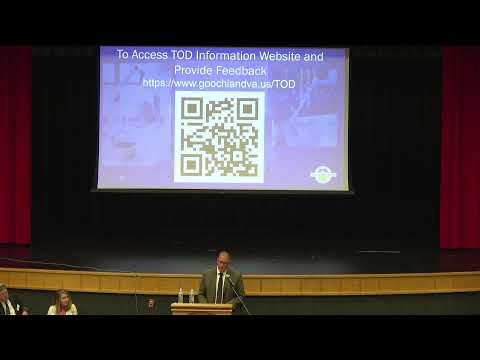
Staff encouraged residents to fill comment cards, submit comments through the county website, and attend the Planning Commission public hearing (Sept. 18, 6 p.m.) and the Board of Supervisors hearing (Nov. 6, 6 p.m.). The county said it will post the presentation and a FAQs document online and will continue to accept emailed comments.
(Reporting note: No project applications, motions or votes were recorded during the meeting; all timing and map decisions remain proposals subject to future public hearings.)