
Guichlen County reports strong cash position while exploring early payoff of TCSD debt
Get AI-powered insights, summaries, and transcripts
Subscribe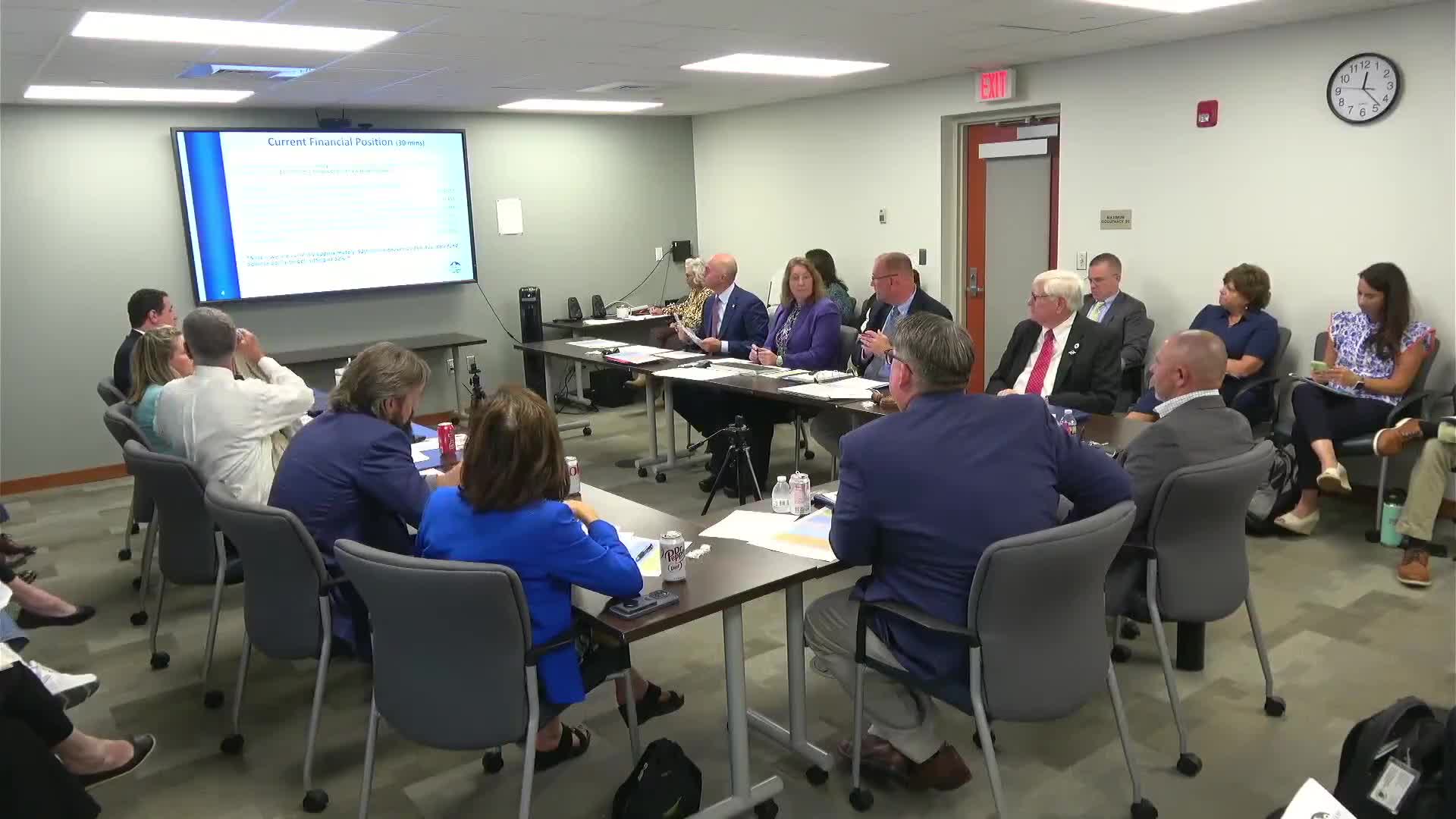
Summary
County staff told the Board that the county is in a strong cash position (unaudited fund balance ~ $65 million) and outlined options to prepay tax district debt; staff recommended weighing bond and financing choices while keeping service priorities in view.
Guichlen County officials told the Board of Supervisors at a work session that the county is in a strong cash and fund-balance position and outlined options to accelerate payoff of a neighborhood tax district debt that currently drains the general fund. County finance staff said the unaudited fund balance will be about $65,000,000 at year end and described pots of money available for capital projects and debt payoff.
Why it matters: Paying the tax-district debt early would remove an annual transfer that has ranged recent years between about $2.8 million and just under $4.0 million, freeing money that could be used for county operations or capital projects. Board members discussed whether to use new revenue from economic development to retire that debt faster, or to convert part of it to countywide debt so the whole county shares the cost.
Carla, a county finance staff member who presented the numbers, said the county is “in a very strong cash position right now” and that the unaudited fund balance at June 30 is projected at about $65,000,000. She told the Board that about $32,000,000 of the county’s fund balance is currently assigned to known future projects and that roughly $17,000,000 of assigned funds are intended for capital projects. In addition, the county has about $29,000,000 in unassigned funds and was meeting its fund-balance policy targets — staff reported the county’s available fund balance at roughly 52 percent of next year’s budgeted expenditures, above the 35 percent target the county uses for planning.
Staff also reviewed other revenue sources available for capital work. The county holds zoning proffers (developer contributions) that can be spent on eligible CIP categories; staff said about $100,000 sits in a general proffer account and about $900,000 in East End fire-related proffers (roughly $1,000,000 combined) that could be applied to fire-station projects.
On tax-district debt: staff said the county’s outstanding district debt is approximately $78,000,000. Finance staff described a defeasance transaction completed in December 2024 that prepaid about $18,000,000 of callable debt and moved the district’s projected payoff date forward from the scheduled maturity to an earlier date (staff said the model now estimated payoff in the early 2030s rather than the 2040s). Staff emphasized the payoff schedule depends on assessed-value growth and on any decision the Board makes about using new assessed value from development to accelerate payoff.
Board members discussed the fairness and mechanics of different approaches — keeping the tax district’s debt on the district rolls, accelerating payoff from new assessed values generated in the district, or converting the debt to countywide obligation so that the county as a whole would share servicing costs. Board members also asked for metrics showing how much new assessed value would be required to move the payoff date forward by each year; staff provided examples showing hundreds of millions in new assessed value would be required to materially change near-term payoff dates.
Staff cautioned that while the county’s AAA/strong rating and current interest environment are advantages, borrowing decisions have trade-offs. Staff noted that the county can still borrow additional general-obligation funds within policy — the county’s current debt burden (debt service measured against next year’s budgeted expenditures) was reported well under the county’s 10 percent target — but tapping that capacity increases annual debt-service obligations. Carla reminded the Board that borrowing authorized by referendum must be drawn down by legally required dates (staff noted the referendum-authorized funds must be drawn by January 2029).
Discussion-only items: Board members generally agreed the county should consider options to retire district debt early, but no formal financing decision was made. Several supervisors stressed they would not want an early payoff approach to reduce spending on public safety, schools or transportation.
Next steps: staff offered to provide refined financial scenarios that compare (a) accelerating payoff using new assessed value in the district, (b) converting some or all of the district debt into countywide debt, and (c) keeping the current schedule while reserving incremental revenue for CIP. Staff also committed to showing a schedule of how much new assessed value (or new revenue) would be required to advance the payoff to specific target years so the Board can weigh options alongside service trade-offs.