
Louisa Planning Commission OKs ordinance requiring conditional-use review for humanitarian shelters after extended public comment
Get AI-powered insights, summaries, and transcripts
Subscribe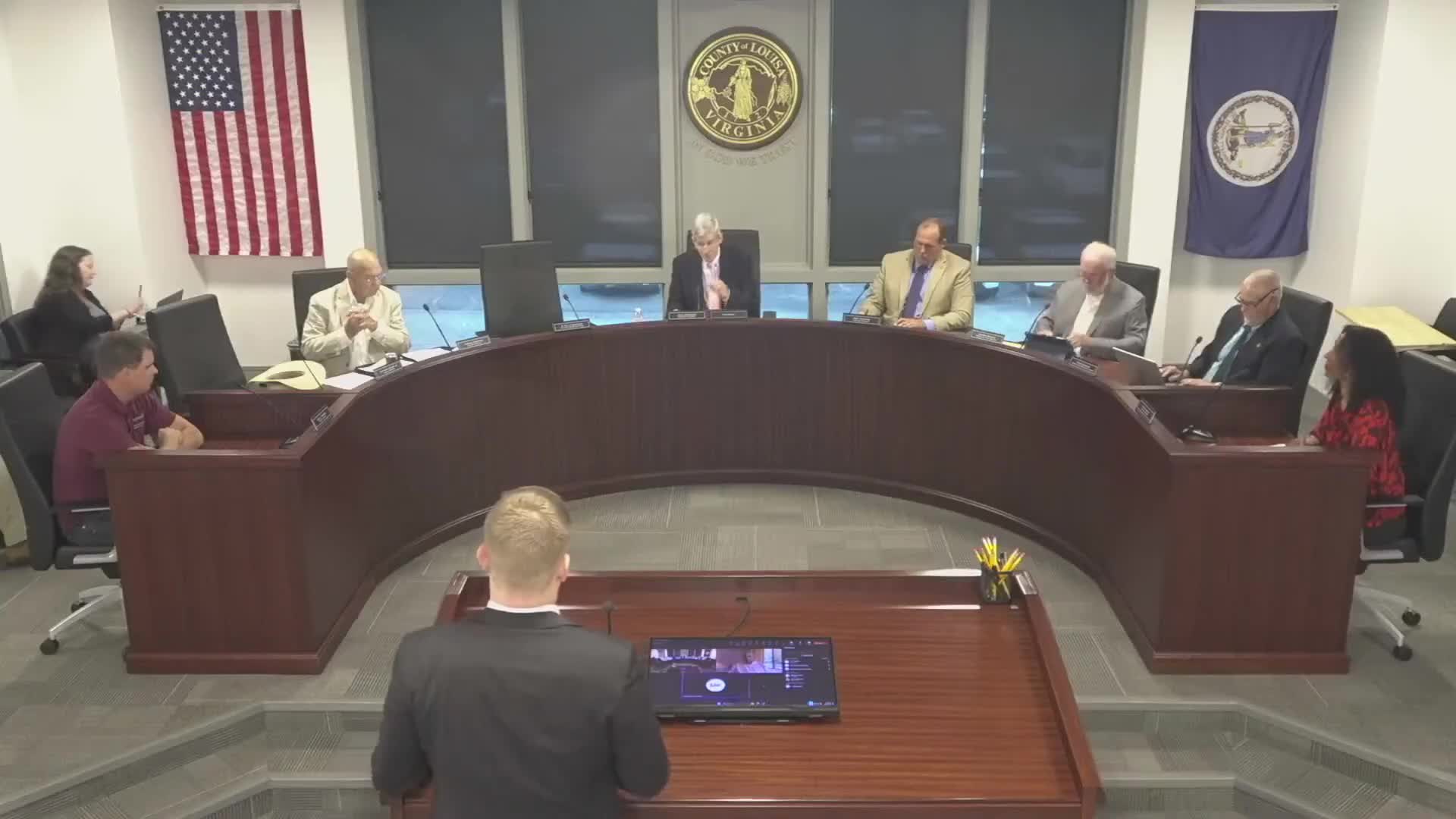
Summary
The Louisa County Planning Commission voted unanimously to forward to the Board of Supervisors a proposed amendment to Chapter 86 that defines "humanitarian shelter" and requires a conditional use permit, after hours of public comment from clergy, service providers and residents.
LOUISA COUNTY, Va. — The Louisa County Planning Commission voted unanimously to approve and forward to the Board of Supervisors a proposed amendment to Chapter 86 of the county land development regulations that defines "humanitarian shelter" and requires conditional use permits for that use, Commissioner Goodwin said as he moved the ordinance forward.
The change, proposed by county staff and discussed at a public hearing on the August planning commission agenda, replaces the prior 2019 "emergency shelter" language with a broader humanitarian-shelter definition; expands the kinds of people who can be served (including families); removes a requirement for leases or occupancy agreements because the use is temporary; sets uniform minimum CUP submission requirements; and allows the use in nearly all zoning districts except RD, county staff said.
County staff told the commission the CUP process provides public notice, transparency and a standard path for review. "Since 2019, the county has required a CUP for emergency shelters," a staff member said, and the proposed amendment is intended to "clarify, be fair, and encourage community engagement." The staff presentation also noted technical support: the Thomas Jefferson Planning District Commission (TJPDC) offered up to 160 hours of help for town-hall meetings and other assistance, and staff estimated a typical CUP process takes about 90 to 120 days from first contact to final board action.
The hearing drew extensive public comment, mostly from clergy and church members who urged that religious assemblies be exempt from the CUP requirement. Speakers described direct experience sheltering people and said additional permitting will deter lifesaving church efforts. "Why should a church or anywhere else have to prove to the county that they're connected to social services just to provide overnight shelter?" said Sue Franklin Strait of the Patrick Henry voting district. Several speakers recounted providing motel rooms, rotating church shelters or other ad-hoc support for people experiencing homelessness, and warned a CUP requirement would make such efforts harder to execute quickly.
Religious leaders framed the issue as both a pastoral and practical one. Reverend David McWilliams of Zion United Methodist Church told commissioners that a CUP "places the authority of the church into the hands of the local government and the local community rather than on the prayerful discernment of the church and its ordained leaders." Alicia Ford, a Mechanicsville church member who said she experienced homelessness as a teenager, said church-led sheltering helped her family recover and urged an exemption so churches could act without waiting for permits.
Several speakers raised safety and confidentiality concerns tied to making shelter locations public through the CUP process. "I cannot promise what the abusers would be doing," said Reverend Alan Smith, who noted clergy confidentiality and the risk that public records could expose shelter guests fleeing domestic violence. Reverend Laura Cabo, lead chaplain for the sheriff's office, urged the commission "not to exempt churches, but to not even mention churches in your legislation," citing frequent late-night calls when deputies found people with nowhere to go and the practical need to let churches act quickly.
A civil-liberties perspective also reached the commissioners: Dwayne Surgeon, representing the Louisa Homeless Coalition, read a letter delivered by the Rutherford Institute that warned the CUP requirement could impose "unnecessary delays, costs, and procedural hurdles" on churches and cited statutory and constitutional protections (the letter specifically referenced RLUIPA and the Virginia Religious Freedom Restoration Act). "When government regulations ... risk closing the doors of refuge on the very people most in need," the letter said, "they do more than create red tape."
Commission discussion focused on legal and land-use distinctions. Commissioner Goodwin summarized the commission's work and legal review, stressing the difference between an ordinance (a countywide land-use rule) and a conditional use permit (a parcel-specific approval that can carry conditions). Goodwin also said the proposed language was developed iteratively with staff and legal review and stated his intent to support forwarding the ordinance. "From the beginning, this topic has been fraught with misunderstanding, misconception, and misinformation," Goodwin told the commission. He asked that his final report be included in the package sent to the Board of Supervisors.
Before the vote, commissioners also agreed to minor typographical corrections to the draft ordinance as noted in the meeting record. Miss Johnson conducted a roll-call vote; commissioners voted yes and the motion to forward the amended Chapter 86 language to the Board of Supervisors passed. The motion was moved by Commissioner Goodwin; the seconder was recorded at the meeting but not clearly identified in the transcript. Vote responses called in at the roll call included Commissioner Brooks, Commissioner Pinkney, Commissioner Gisisway, Commissioner Pauls, Commissioner Goodwin and Commissioner Kersey.
The ordinance before the planning commission does not itself adopt a final local rule — that step belongs to the Board of Supervisors, which will receive the commission's recommendation and Goodwin's report. The record and public comments from the meeting will be forwarded with the packet. The timeline for the board's review and the ordinance's effective date were not specified at the meeting.
Discussion versus decision: commissioners made a formal decision to forward the ordinance. The meeting record and public comment showed sustained discussion of confidentiality, legal exposure, the practical burden on volunteer-run shelters, and how to balance neighborhood concerns against humanitarian need. Staff and some commissioners said the CUP requirement creates predictable requirements and a consistent review path; many clergy and advocates argued the requirement would create delays and potential legal and safety problems for people seeking shelter.
Next steps: the planning commission's approval sends the amended Chapter 86 language and Commissioner Goodwin's final report to the Louisa County Board of Supervisors for their consideration and ultimate decision.