
Director: Utah in full drought, state advances water plan, expands cloud-seeding research and outreach
Get AI-powered insights, summaries, and transcripts
Subscribe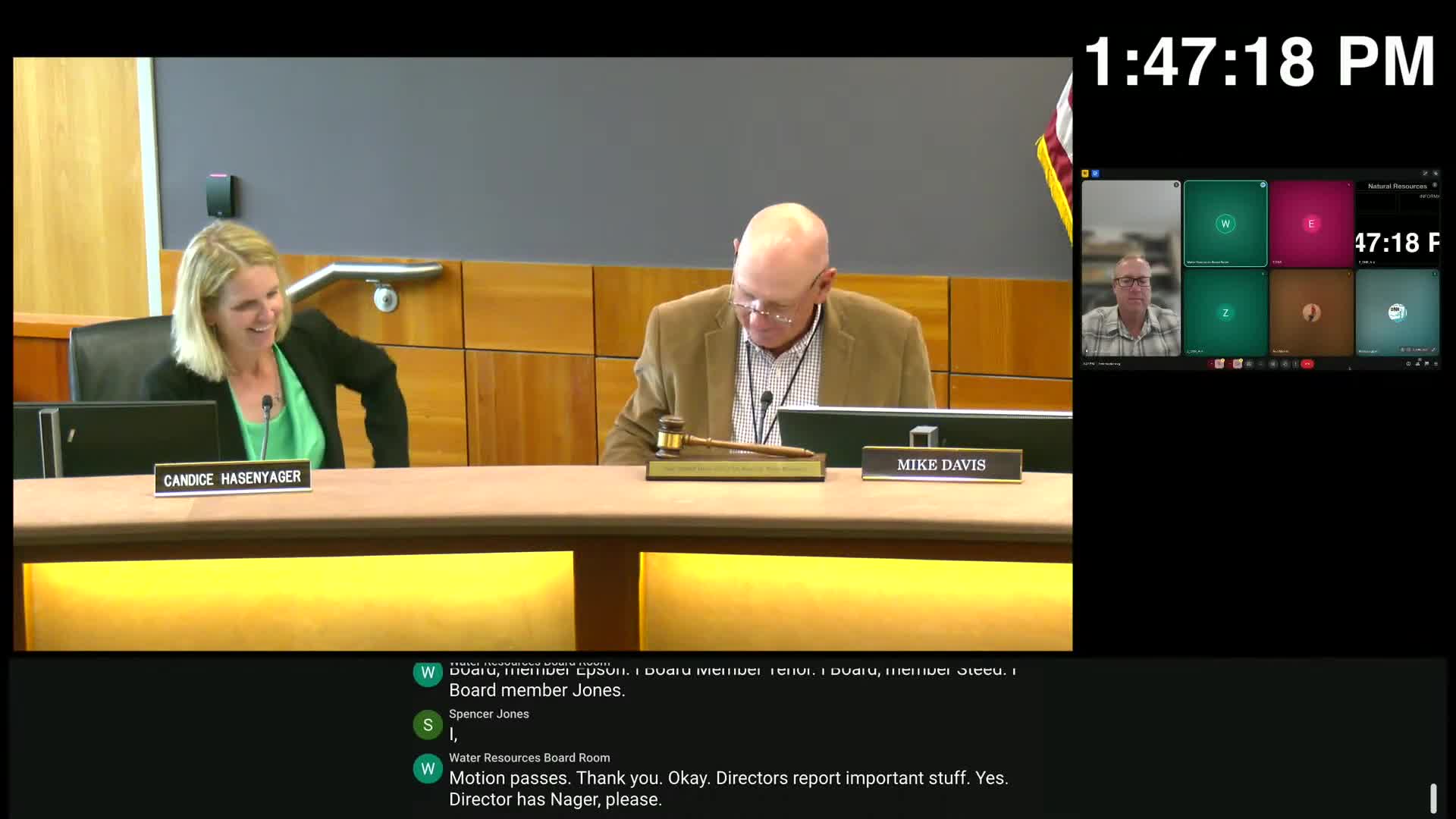
Summary
Division director reported 100% of Utah in drought, noted reservoir declines, summarized state water plan timeline and announced expanded cloud-seeding research and an operational program; the board was briefed on conservation programs and upcoming public meetings.
Director Candace Hasneger told the board that 100% of Utah is currently in drought, with a large portion in severe or extreme categories, and that reservoir storage declines between June 1 and Aug. 1 were roughly double a typical year (about a 19% drop vs. the usual 8% drop).
Hasneger said the Division submitted two budget requests to the Legislature—one for ongoing dam-safety needs and another proposing incentives to encourage water-wise landscaping in new construction. She reviewed outreach and planning timelines for the state water plan due in 2026 and said public scoping meetings (branded “water talks”) will begin August 28 and continue through October; she encouraged board participation and said the agency aims for an agency-partner draft review by Jan. 1, 2026.
On conservation, Hasneger said state programs and partners converted about 3.2 million square feet of turf (reported during the meeting as “3,200,000 acre square feet” in the transcript) during fiscal 2025; she emphasized programs are implemented with district partners and division staff. She also summarized ongoing work on the Great Salt Lake Basin Integrated Plan, the unified water infrastructure plan (due March), and a planned online project portal pilot to collect and manage candidate projects.
On cloud seeding, Hasneger described an expanded research and operational program. The state will work with the University of Utah, Utah State University and the National Center for Atmospheric Research to study seeded-precipitation-to-runoff relationships and environmental impacts; an operational cloud-seeding program expansion in the Bear River Basin was funded at $3,000,000 in the recent legislative session and the program is set to begin Nov. 1. The director said Jonathan Jennings, the division meteorologist, will present more detail at a future board meeting.
Hasneger also briefed the board on ongoing Colorado River negotiations among the seven basin states, noting deadlines for an agreement in principle by Nov. 11 and a finalized agreement expected by Feb. 14; staff said the outcome could affect interstate options and federal actions.
The director’s report included several upcoming outreach events and an update that staff continue to update the weekly lawn-watering guide and review submitted conservation plans. Hasneger closed by noting continued heavy workload and urging participation in public water-plan scoping.