
Lawrenceburg work session backs preparing $70 million levee grant; council asked to pledge $4.2 million match
Get AI-powered insights, summaries, and transcripts
Subscribe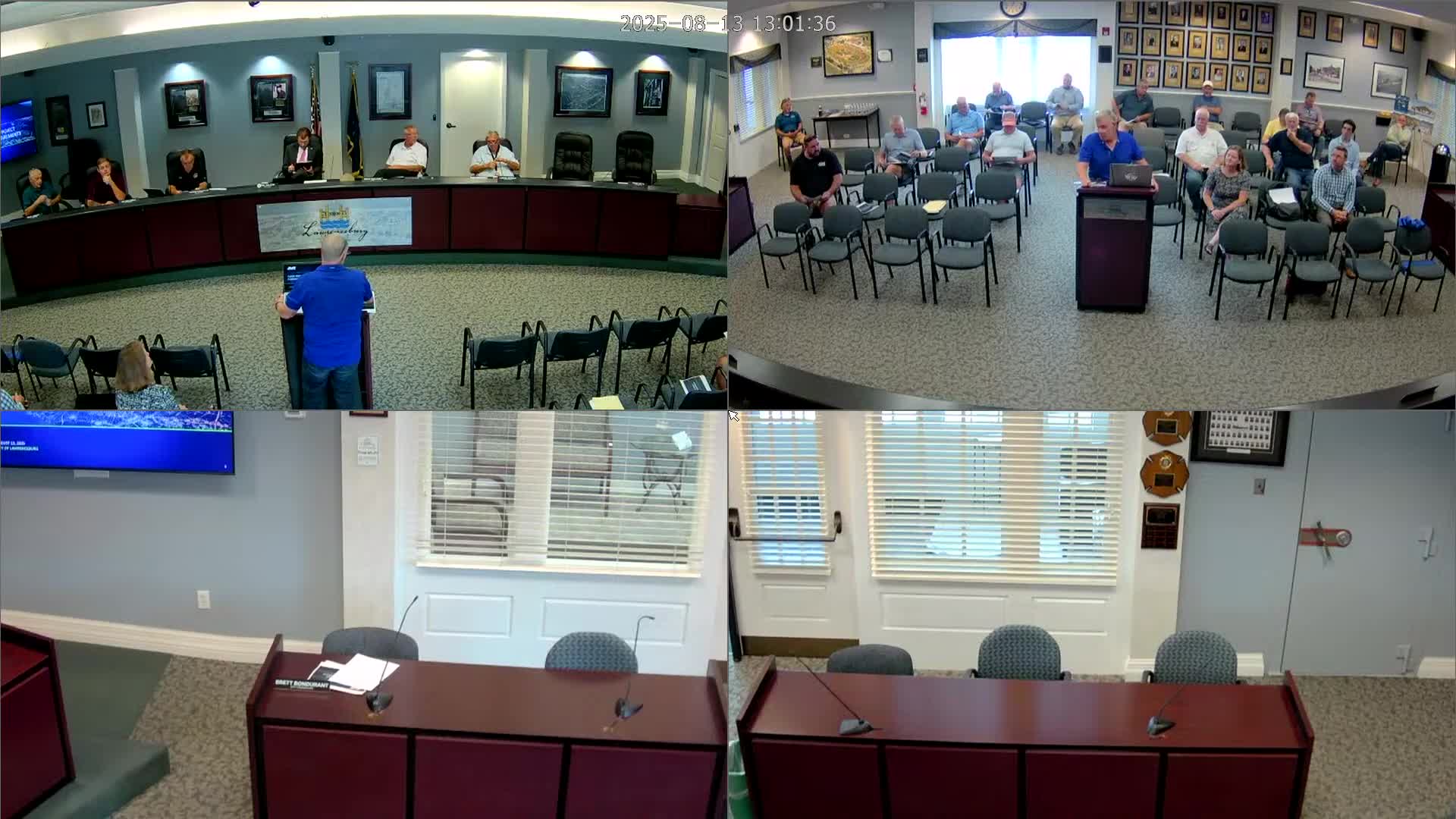
Summary
At a Lawrenceburg City work session on Aug. 13, consultants and local flood-control officials outlined a plan to seek roughly $70 million in federal grant money to complete engineering, permitting and construction on the combined Lawrenceburg–Greendale levee system and asked the City Council to consider committing $4.2 million as its share of a 25% local match.
LAWRENCEBURG, Ind. — At a Lawrenceburg City work session on Aug. 13, consultants and local flood-control officials outlined a plan to seek roughly $70 million in federal grant money to complete engineering, permitting and construction on the combined Lawrenceburg–Greendale levee system and asked the City Council to consider committing $4.2 million as its share of a 25% local match.
Consultant Jennifer Ray, senior grant writer with JMT, told council members the project “requires about a $16,800,000 match, 25% match. It's about a $70,000,000 project.” Ray said the conservancy and the city of Greendale already passed resolutions committing $4.2 million each and urged Lawrenceburg to adopt a matching resolution now so the group is prepared when short federal funding windows open. “We are here. We're ready to go. We have everything in line, and we can apply,” Ray said.
The work session discussion centered on why the match and a signed resolution are needed before an application and on which grant programs to pursue. FEMA Region 5 has reinitiated updated flood mapping that will treat Lawrenceburg and Greendale as a single system; Ray and technical consultants said obtaining the levee upgrades is critical to maintain provisional accreditation with the National Flood Insurance Program. Without accreditation, officials warned, properties could be required to carry flood insurance and redevelopment prospects could be affected.
Technical details and costs
Mondell Group and JMT engineers described the primary components expected in the project. Luke Johnstone of the Mondell Group said the Lawrenceburg work would focus on relief-well replacements and a slurry wall on the levee’s north slope. Andrew Birmingham of JMT described key Greendale items as freeboard correction where the levee crest is 6–12 inches low in places and a stormwater pump-station retrofit and relocation to improve hydraulic connection and pump efficiency.
Consultants estimated $67.7 million–$70 million in today’s dollars (presented as a $70 million round figure) and said they baked a 25% contingency into the preliminary estimate because the design is at an early stage (roughly 10% design). The consultants said final design and permitting work would be funded through the grant if awarded and that projects of this scale typically are phased; grant programs also vary on which pre-application costs they allow.
Funding and legal mechanics
Ray and other presenters emphasized that most eligible federal grant programs require a local match (commonly 25%) and that a binding resolution showing funds are accounted for is more competitive than a nonbinding statement of support. The Lawrenceburg Conservancy District (LCD) and the City of Greendale have signed binding resolutions committing $4.2 million each; Dearborn County has not yet acted. Presenters said Greendale’s $4.1 million is being built up in a redevelopment/TIF account and that those funds were earmarked across multiple years and placed in certificates of deposit.
Several speakers described how Greendale structured its commitment: redevelopment allocated $4.1 million over four years (including $2.0 million already budgeted in late 2024) and council supplied an additional $100,000. Presenters said any local commitments could be made contingent on an interlocal agreement that would disburse funds only after a grant award and that the draft resolution the LCD and Greendale used is available for Lawrenceburg to adopt with similar language.
Grant landscape and schedule
Presenters reviewed potential federal funding sources. They said the BRIC (Building Resilient Infrastructure and Communities) program had previously been a primary target but was subject to executive-order disruption and litigation; the U.S. Army Corps of Engineers can contribute only to Corps projects and its funding is limited. The Water Resources Development Act (WRDA) and other federal programs were discussed as supplementary options, but presenters said WRDA funding (for pumps and pumping stations) was limited and often years away. Consultants said hazard mitigation funding remains possible but program rules are shifting and that the local hazard mitigation plan and a benefit-cost analysis must be finished to pursue certain grants.
Letters of support and local outreach
Presenters said they have a packet of institutional letters and 152 individual letters from property owners supporting the project; named supporters in the packet included Hollywood Casino and MGP Ingredients and the local school system. They also said LCD, Greendale and project partners met with Corps staff and state hazard-mitigation officials; the state hazard mitigation officer (Ashley Steed) is seen as a necessary supporter for federal hazard-mitigation grant applications.
Council action and next steps
Councilmembers did not adopt a resolution at the work session. Instead, council members and staff agreed to prepare a resolution (with the city attorney's review) and place it on the agenda for the first Lawrenceburg City Council meeting in September for formal consideration. A city official said the resolution can state a $4.2 million match is allocated and that detailed budgeting and documentation could be completed before any grant application is submitted. Presenters warned that notice-of-funding-opportunity windows are short (often two to four weeks) and that having a signed resolution and required analyses in place is essential to be competitive.
Other procedural notes
Presenters and council members discussed TIF-eligibility questions and whether redevelopment/TIF funds can be used for improvements that also benefit Lawrenceburg. Consultants said the levee system functions as an interconnected system and that improvements in Greendale would support the broader protection area, but legal counsel and the county would need to review fund-source legality. Dearborn County representatives attended previous briefings but had not yet scheduled a county vote; presenters said they planned to pursue county support after Lawrenceburg's action.
No formal financial commitment was approved at the meeting. The council did vote later in the session to adjourn; that procedural motion carried by voice vote.
Ending
The immediate next step is placement of a draft resolution on the City Council agenda for the early September meeting, with legal review and follow-up coordination with LCD, Greendale and Dearborn County. Consultants reiterated that the group needs signed local-match commitments and finalized benefit-cost analysis and hazard-mitigation documentation to be competitive when federal grant notices are issued.