Get Full Government Meeting Transcripts, Videos, & Alerts Forever!
Get email alerts on the Municipal Budget topic
No spam. Unsubscribe anytime.
St. Pete Beach reviews tentative budget, recommends 35% reserve and reclassifies $5.8 million to resiliency fund
Summary
ST. PETE BEACH, Fla. — The City Commission reviewed a tentative fiscal-year budget and a package of financial policies at a workshop on Aug. 26, where staff recommended establishing a 35% operating reserve and moving $5.8 million previously recorded as a coastal vulnerabilities balance into a resiliency fund.
ST. PETE BEACH, Fla. — The City Commission reviewed a tentative fiscal-year budget and a package of financial policies at a workshop on Aug. 26, where staff recommended establishing a 35% operating reserve and moving $5.8 million previously recorded as a coastal vulnerabilities balance into a resiliency fund.
Devin Schmidt, the city’s finance director, told commissioners the Finance Budget Review Committee reached consensus on the tentative budget and on a set of recommended changes to bring back to the commission. “This budget book is aligning with the Government Finance Officers Association best practices,” Schmidt said, adding the annual comprehensive financial report was completed July 31 and the $5.8 million was already on the balance sheet rather than a newly found source.
The move to a 35% reserve is a two-part recommendation: a 25% unassigned fund balance for emergency and liquidity purposes plus an additional 10% hurricane emergency contingency. Schmidt said the recommended reserve equals roughly $9 million under the proposed budget calculations and is intended to improve the city’s ability to respond to storms and other emergencies.
Why it matters: Commissioners and staff said the changes affect how the city budgets for capital projects, grant matches and storm recovery. Commissioner Maldonado raised concerns about the timing and formality of changing the previously established coastal vulnerabilities fund, saying the fund and related resolutions had been discussed in prior years and asking for more clarity on the legal and procedural changes. “It kind of doesn't really answer my my concern…how can we change it?” Maldonado said during the meeting.
Schmidt and other staff described the proposed reclassification as a cleanup to align fund names with the comprehensive plan and to reduce operational inefficiencies in emergencies. The city manager and staff said they will provide additional documentation to show how the prior coastal vulnerabilities reserve relates to the proposed resiliency fund.
Policy and budget highlights
- Quarterly reporting: The Finance Budget Review Committee asked staff to clarify which quarterly reports will be regularly provided to the commission, specifically balance sheets, income statements, fund balance reports and budget-to-actuals comparisons.
- Reserve policy: The draft financial policies would set a minimum unassigned general fund balance of 25% of operating expenditures plus a recommended 10% hurricane contingency, yielding a 35% target that staff will review annually.
- Performance pay: The tentative budget includes changes to performance-based pay. The packet estimates a 2.6% cost-of-living adjustment (COLA) factored into the budget; staff proposed linking COLA distribution to a new performance-evaluation program with sample tiers described by Schmidt: employees who meet minimum performance receive the COLA, stronger performers could receive COLA plus 1% and the top roughly 20% of employees could receive COLA plus up to 2%. Schmidt said leadership is continuing to develop the plan and that underperforming employees could be placed on improvement plans before receiving increases.
- Reappropriations and capital projects: Staff listed multiple reappropriation projects bridging fiscal years, including building improvements, Fire Station 22, VA shuffleboard rebuilding, right-of-way median improvements, Gulf Boulevard utility undergrounding, Eagan Park site improvements, dune walkover replacements and community center seawall replacements. Fire Station 22 funding was increased by $2 million for fiscal 2026 compared with the prior workshop; staff said much of the capital program is being aligned with the proposed resiliency fund and grant opportunities.
- Deferred vehicle purchases: Staff recommended delaying replacement of several Code Department vehicles—originally planned as electric models—because they are not currently suited for emergency response; those replacements would be held at least one fiscal year.
Revenues and budget totals
Schmidt stated the city’s consolidated budget summarizes all governmental and proprietary funds. He clarified total expenditures were shown as about $112 million (inclusive of capital). Ad valorem (property) tax revenue in the general fund was shown at roughly $15.1 million; Pinellas County’s preliminary tax roll indicated a 3% decline in taxable value for the city, a reduction that Schmidt said corresponds to about $400,000 in lower ad valorem receipts under the current assumptions. Staff emphasized they are using conservative assumptions, including anticipated take-up rates for early-payment discounts.
Schmidt also noted the city completed its annual comprehensive financial report on July 31; to avoid last‑minute changes to the tentative budget in future cycles, staff plans to align audit timing with the budget process by completing audited numbers in March.
Community input and next steps
Schmidt said staff had received at least four written inputs from residents and that the budget book is posted on the city website. He described possible future engagement steps such as a budget town hall or a more informal public forum earlier in the process. Several commissioners urged earlier public engagement in future budget cycles so the public sees proposals before workshops and hearings.
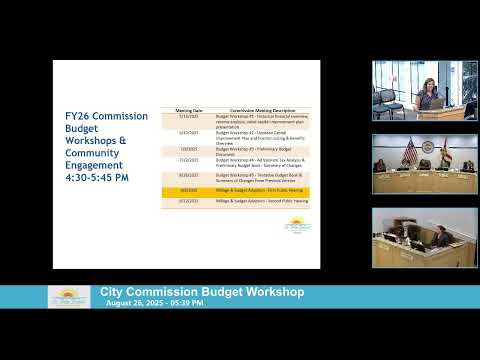
The tentative budget schedule: the commission will hold the first public hearing and first reading of the millage and tentative budget on Sept. 8 and the second public hearing and final budget hearing on Sept. 22, staff said.
What was not decided
No ordinance adoption or formal votes were taken at the workshop. Schmidt presented recommendations and the Finance Budget Review Committee signaled consensus, but the commission must consider formal adoption at the September hearings. Staff also said fee studies for enterprise funds (reclaimed water, wastewater, parking) are underway and any fee changes would come back by ordinance after those studies.
Ending
Staff asked for commission feedback and said it will incorporate requested clarifications—particularly documentation tying the prior coastal vulnerabilities balance to the proposed resiliency fund—before the Sept. 8 hearing. The commission closed the workshop with a schedule confirmation for the two September hearings and adjourned.