Get Full Government Meeting Transcripts, Videos, & Alerts Forever!
Get email alerts on the Teacher Pay And Recognition topic
No spam. Unsubscribe anytime.
District staff outline Teacher Merit Award pilot under Senate Bill 173 and timeline for first statewide awards
Summary
District officials described participation in a state pilot (Senate Bill 173) to recognize high‑performing teachers. Granite will submit top 25% of eligible teachers; statewide awards begin in October 2026 with $2,000–$10,000 tiers that double in high‑poverty schools.
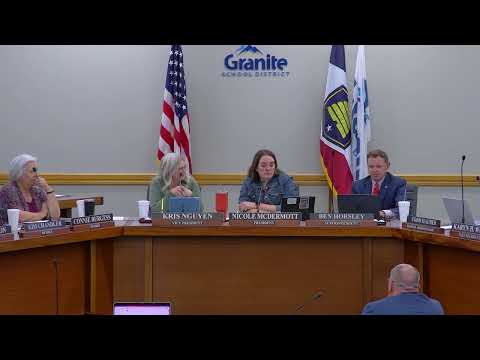
Dr. Flanagan, representing the district’s leadership, briefed the Granite School District board on the state pilot known locally as the Teacher Merit Award (TMA) program under Senate Bill 173 and explained how Granite will participate.
The program, which the presenter called “excellence in education leadership supplement program, also known as senate bill 173 or teacher merit award,” will ask local education agencies to submit their top 25% of eligible teachers for a statewide comparison administered by Utah State University. Dr. Flanagan said the district has chosen three measures: 75% student growth/achievement, 20% professional evaluations and 5% student surveys.
Key points and timeline: Using district modeling from the 2023–24 school year, staff found top‑25% teachers appear across most schools; the district will submit ranked teachers for state consideration and will not see statewide awards until October 2026. Award tiers include $2,000, $5,000 and $10,000; awards double (for example, $10,000 becomes $20,000) if the recipient works in a high‑poverty school, Dr. Flanagan said.
Eligibility and limits: Dr. Flanagan said eligible teachers are licensed educators in active classroom assignments and that, for the pilot, the program is limited to testable subjects (state assessments such as Acadience, math/reading assessments or Utah Aspire Plus). The district and state committee discussed expanding eligibility to non‑tested subjects in the future, but USU indicated doing so would require developing approved assessments and tools that were not ready for the pilot.
Why the district is participating: Staff said the district’s prior incentive program (HB212) helped retain teachers in high‑poverty schools and that participation in the TMA pilot is intended to continue recognition and retention efforts while shaping state implementation.
Ending: Dr. Flanagan said the district will continue to provide information and outreach to teachers and principals as the pilot proceeds; board members asked follow‑up questions about subject coverage, funding timing and whether the pilot replaces the district’s existing “big check” program for this school year.