Get Full Government Meeting Transcripts, Videos, & Alerts Forever!
Get email alerts on the School Boundaries And Programs topic
No spam. Unsubscribe anytime.
Granite board agrees to continue study of population-analysis plan that would close two neighborhood schools and reshape programs
Summary
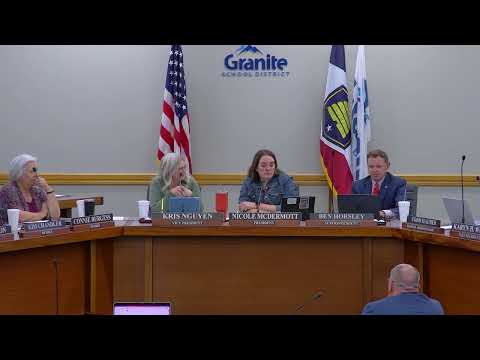
The Granite School District board voted Sept. 2 to continue study of a Population Analysis Committee proposal that would close two boundaried elementary schools, consolidate some specialized programs and create new program emphases after additional public meetings this month.
The Granite School District board voted Sept. 2 to accept a PAC recommendation to continue study of a set of boundary and program changes that would close two boundaried elementary schools and concentrate several specialized programs at other sites while holding public meetings this month for further feedback.
The recommendation from Steve Hogan, the district’s director of planning and boundaries, would: combine Eastwood Elementary boundaries into Oak Ridge; close Morningside as a boundaried school while converting its French dual‑language immersion (DLI) to a standalone magnet; consolidate east‑side Advanced Learning Centers (ALC) into Woodstock; and create or expand program emphases at Rosecrest (an arts emphasis) and Cottonwood (a whole‑child, project‑based focus). Hogan identified the Skyline/Olympus feeder network as the study’s central area.
Why it matters: Hogan said the proposals aim to raise building utilization to a healthier level, reduce duplicated programs across short distances, and create district‑initiated programs intended to attract families back to Granite schools. He told the board the process is not final and emphasized the plan is intended to be refined with public feedback at two large meetings scheduled for Sept. 22 at Olympus High and Sept. 23 at Skyline High.
Most important facts and context: Hogan told the board the PAC studied enrollment, facility condition, feeder patterns and program articulation and compiled more than 1,040 pieces of public feedback. The pack’s draft maps and projections show Oak Ridge with space for about four additional classrooms and estimate Driggs Elementary would gain about 150 boundaried students under proposed changes. The presentation projected Rosecrest would gain students and that Morningside’s French DLI could operate as a K‑5 standalone magnet: “We believe we could have some excellent results here,” Hogan said of the magnet proposal.
Program and equity details: The PAC recommended consolidating two east‑side ALC locations into Woodstock to preserve program fidelity and reduce what Hogan described as uneven distribution: “we have students that are fantastic … yet they really don't qualify technically according to the standards for the ALC program,” he said, arguing consolidation would restore fidelity to the program’s testing thresholds. Hogan said approximately 250 students currently participate in Morningside’s DLI and that Morningside’s building capacity could accommodate more if it becomes a magnet.
Questions and clarifications raised by board members and staff: Board members asked how many families were affected by earlier boundary moves, whether students currently enrolled in ALC would be guaranteed spots if the program moves, and how priority or lottery rules would be set for a standalone French DLI magnet. Hogan and district staff said currently enrolled ALC students would be offered places at the receiving site; priority rules for a new magnet were not finalized and would be developed during implementation planning.
Operations and next steps: Superintendent Horsley and Hogan said additional small meetings and two large public meetings are planned before the board considers a first reading or initial approval later this fall, with potential final action in December and implementation the following fall. The board’s motion accepted PAC’s recommendation to continue study (motion carried). Hogan reminded the board that any final recommendations could change as the district incorporates public feedback.
Ending note: The board emphasized the process remains iterative. As one board member put it after the vote, “I have some concerns and conflicting feelings about some of the programs we’re talking about here, but I’m totally fine with continuing to study and see where we go.”