Get Full Government Meeting Transcripts, Videos, & Alerts Forever!
Get email alerts on the Water Wastewater Capacity Fee topic
No spam. Unsubscribe anytime.
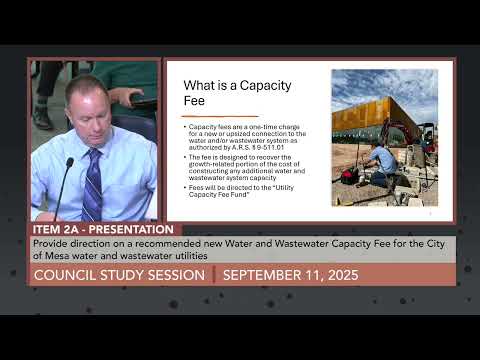
Mesa staff propose one‑time water and wastewater capacity fee to make growth pay for growth
Summary
City staff presented a plan to start a one‑time capacity fee for new connections to pay for roughly $400 million in growth projects identified in the city's integrated master plan, with ordinance introduction planned in November and possible implementation on Jan. 1 if adopted.
Mesa City Council staff detailed a proposed water and wastewater capacity fee at a Sept. 11 study session, saying the one-time charge on new connections would make new development pay for the incremental infrastructure it requires. City staff said the fee would fund roughly $400 million in growth-only projects identified in the city's recent integrated master plan and could be introduced as an ordinance Nov. 17, with a council vote Dec. 1 and an effective date of Jan. 1 if adopted.
Why it matters: Staff said Mesa currently has no mechanism to require new development to pay for system expansion, so existing ratepayers now shoulder those costs. The city's presentations said that without a capacity fee, the utility rate base bears the expense and that growing demand forced the city to accelerate a $15 million Gilbert McKellops relief sewer project and defer other rehabilitation work.
City staff said the proposed capacity fee would be a one-time connection charge for new development or redevelopment that increases meter size. Water and wastewater staff cited national guidance and state law in crafting the proposal: the American Water Works Association manual M1, the incremental-cost method, and the statute staff referenced as ARS 9-5-11(o)(1). The fee is intended to pay capital costs only, not routine operations and maintenance, and staff said a separate fund would hold fee revenues and not increase the general-fund transfer.
How the fee would be set: Staff explained the fee uses an "incremental cost" approach: total capacity-related capital needs over a 10-year horizon are divided by the added capacity (gallons per day) those projects will provide to produce a unit cost per gallon per day. That unit cost is multiplied by a defined service unit (a 3/4-inch meter was used as the lowest‑common denominator) and scaled for larger meters. Staff showed an example estimate for a 3/4-inch meter around $9,500 that combines water and wastewater components and compared the result to other Arizona cities.
Numbers discussed: Staff said the integrated master plan identified about $400 million in growth projects over 10 years (about half for Signal Butte plant expansion), and cited that the city has deferred roughly $180 million in rehabilitation and life-cycle work in recent years. In staff's example calculation they used roughly $320 million of capacity cost divided by about 60 million gallons per day added capacity to derive a unit cost (about $20 per gallon per day in that example). Using development trends from the master plan, staff estimated the fee could generate roughly $18 million per year at current build-out pace.
Legal and technical guidance: Staff said the approach follows the AWWA Manual M1 methodology and that the city engaged Black & Veatch as a consultant to review methods and provide a letter of endorsement. Staff also said Maricopa County permitting requirements create a timing pressure because the county will not allow new development to be placed into service without a certification of capacity.
Council questions and staff clarifications: Council members asked how the fee treats different meter sizes and whether larger meters would pay proportionally more. Staff replied that the methodology charges the same cost per gallon, so a larger meter (able to deliver more gallons) pays more because it purchases more gallons of capacity. Staff also said the capacity fee pays capital costs only; operating costs and staffing associated with new facilities are recovered through rates. Several council members pressed for tables showing how many meters of each size exist; staff said those tables are in backup material for the rates discussion and that they would provide them again.
Timeline and next steps: Staff said the council's intent would be to post a notice of intent for rate and fee changes in late September, introduce a capacity-fee ordinance Nov. 17, possibly adopt it Dec. 1, and set an effective date of Jan. 1 if the ordinance is adopted. Staff told council they'd model the revenue and show side-by-side forecasts of utility-rate changes with and without a capacity fee to demonstrate the potential rate impact for existing customers.
A separate council discussion about utility rates followed the capacity-fee presentation. Staff emphasized the fee's purpose is to create a separate revenue source to pay growth-driven capital projects and to protect existing ratepayers from shouldering those capital costs indefinitely. "Growth paying for growth" was repeatedly cited as the guiding philosophy.
Ending: City staff said they will return with detailed fee tables, the draft ordinance, and updated rate projections; council members asked staff for additional modeling on how different fee levels and assumptions would affect developers, larger commercial customers and multiunit meters before the Nov.–Dec. decision window.