Get Full Government Meeting Transcripts, Videos, & Alerts Forever!
Get email alerts on the Wastewater Infrastructure topic
No spam. Unsubscribe anytime.
St. Pete Beach staff flag rising chloride levels in sewer system; city to present remediation plan
Summary
City staff and commissioners discussed rising chloride concentrations entering St. Petersburg's Northwest Water Reclamation Facility, traced to saltwater intrusion and inflow/infiltration; staff will present a comprehensive CCTV and capital-improvement plan at the next meeting.
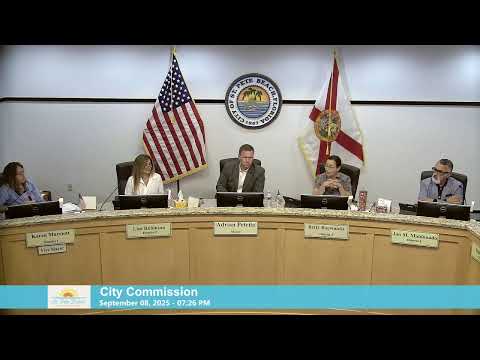
City staff told the commission on Sept. 8 that chloride concentrations entering the St. Petersburg Northwest Water Reclamation Facility from St. Pete Beach's collection system have trended upward since 2018 and exceeded the city's contractual limit by 2021, reducing the partner utility's ability to produce reclaimed water. The city manager summarized a chart provided by St. Petersburg showing a dotted contractual limit and a solid red line of measured chloride levels; the manager said the numbers show chloride levels have “essentially quadrupled” over recent years and that the city has opened coordination with St. Petersburg to determine causes and remedies. Camden Mills, public services director, and city staff described the likely primary cause as saltwater intrusion through inflow and infiltration (I&I). A prior 2016 study found many collection-system pipes and manholes in compromised condition; Mills said the city is now preparing a systematic camera (TV) inspection program that will inspect laterals and mains and is included as part of the city's proposed wastewater capital-improvement plan. Staff said the TV project will be executed in the coming months and will identify breaches. The city has established biweekly coordination meetings with St. Petersburg's engineering team to share data and to agree on remediation timing and investment. Mills told the commission that the city operates 20-plus lift stations and that chloride sampling can be performed at individual pump stations to help localize infiltration. Commissioners and staff discussed potential consequences if the problem is not addressed, including reduced reclaimed-water production by St. Petersburg, damage to the intergovernmental relationship, and potential contract remedies by the receiving utility. St. Petersburg representatives, according to staff, have been cooperative; staff said legal or operational remedies are options if an agreed timeline to fix the problem cannot be reached. Staff committed to return with a comprehensive presentation at the next commission meeting with project timing, funding needs and options. Commissioners asked for detail on how long repairs could take, which areas of the island are most affected, and whether chloride monitoring can be performed at individual pump stations to pinpoint infiltration.