Provo TMAC urges code cleanup, education after months-long micromobility debate
Summary
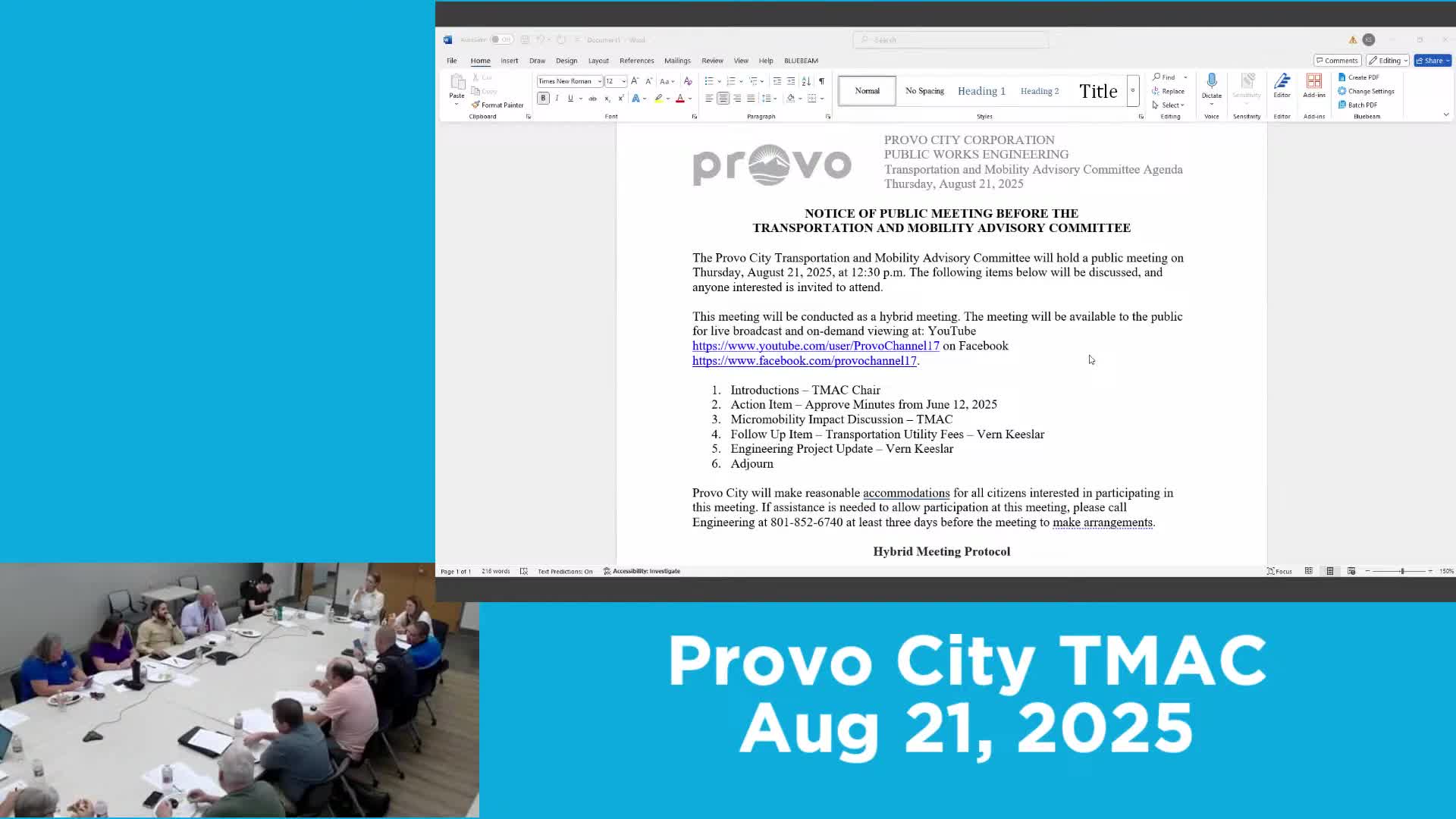
At its Aug. 21 meeting, the Transportation Mobility Committee (TMAC) reviewed conflicts in Provo’s micromobility ordinance, discussed aligning city code with Utah law, and directed members to submit recommended edits by Sept. 5 for formal review at the next meeting.
Provo’s Transportation Mobility Committee met Aug. 21 to review the city’s micromobility ordinance, identify internal inconsistencies and gaps with state law, and direct staff and committee members to prepare proposed code changes and an education plan.
The discussion focused on public safety, enforceability and clarity. TMAC Chair Beth Provence said she did not support an outright ban on micromobility devices and instead favored “active management” and clearer rules. The committee agreed to collect written recommendations from members by Sept. 5 and return the item to a future agenda for drafting ordinance language.
Provence summarized the conflicts TMAC found in the city draft: one local provision restricts sidewalk speeds to 10 miles per hour while another provision appears to ban micromobility devices on sidewalks in certain areas; a separate section would restrict rental operators unless they contract with the city in a way that could unintentionally prohibit ordinary in-person bicycle rentals; and the map-based downtown boundary (cited as 400 North) is outdated and inconsistent with current downtown zoning. “I would not recommend banning micromobility,” Provence said, noting the mode’s role in first‑ and last‑mile connections.
Committee members and staff identified several specific problems: - Speed and sidewalk rules: Provo City Code text in the packet references a 10 mph sidewalk speed limit, while members said state law uses a different numeric threshold, creating an enforcement mismatch. City staff acknowledged the inconsistency and flagged it for cleanup. - Rental-operator language: A provision that makes it unlawful for companies to provide micromobility rentals on city streets unless done “on behalf of the city pursuant to a contract” was raised as overly broad; members said ordinary local rentals (for example, a bike shop lending a bike for several days) could be unintentionally prohibited. - Downtown boundary mapping: The ordinance references a downtown border at 400 North, but staff said the city now commonly treats downtown as extending to 500 North; TMAC recommended referencing the current DP‑2 or other zoning boundary rather than a hard-coded street line. - Age limits and supervision: Committee members reviewed Utah state code language that places age restrictions on some electric‑assist devices (examples discussed in the meeting: no motorized operation for certain classes under ages 15, 14 and 8 except under “direct supervision”). TMAC members highlighted that the state code defines “direct supervision” in the context of motorized off‑road vehicles (a visual‑contact definition within 300 feet appears elsewhere in state law) but that the micromobility sections do not consistently define the term. Staff noted the city may repeat or reference state rules in local code to improve officer access and internal clarity, while recognizing that residents are unlikely to read code and that education is essential.
Public‑safety and ADA compliance concerns were cited repeatedly. Committee members said injuries have risen in places where these devices proliferated and that inconsistent parking and sidewalk blocking create ADA issues. Provo police representation said the rapid evolution of device power and speed — members noted examples of high‑power electric bicycles capable of 50 mph in other markets — has blurred lines between bicycles and motor vehicles, complicating visual enforcement.
Committee direction and next steps: TMAC asked staff to prepare a clean draft that: - Removes the internal contradictions (speed vs. blanket sidewalk bans), - Clarifies rental‑operator language to exempt ordinary in‑person bicycle rentals, and - References applicable Utah state statutes (rather than verbatim pasting of all state text) while highlighting key age and supervision rules for local enforcement and public education.
Members agreed to email recommended language and edits to the chair by Sept. 5; staff said they would compile the submissions and aim to return a consolidated draft for discussion at a subsequent meeting. The committee also recommended an educational push (materials for schools and households) to accompany any code changes.
Why it matters: The committee framed the issue as balancing safety, ADA accessibility and first/last‑mile mobility without unnecessarily restricting lower‑cost transportation options. TMAC members repeatedly emphasized that many infractions occur because families and device owners are unaware of existing rules and that enforcement will be difficult unless the rules are clear and public education is robust.
Ending note: The committee did not adopt any ordinance language at the meeting. Instead, TMAC set a Sept. 5 deadline for member input and asked staff to prepare drafting options for the next meeting.