
Jefferson County adopts vehicle excise surtax and wheel tax, prompting split 4-3 vote and public concern over timing and "stacking"
Get AI-powered insights, summaries, and transcripts
Subscribe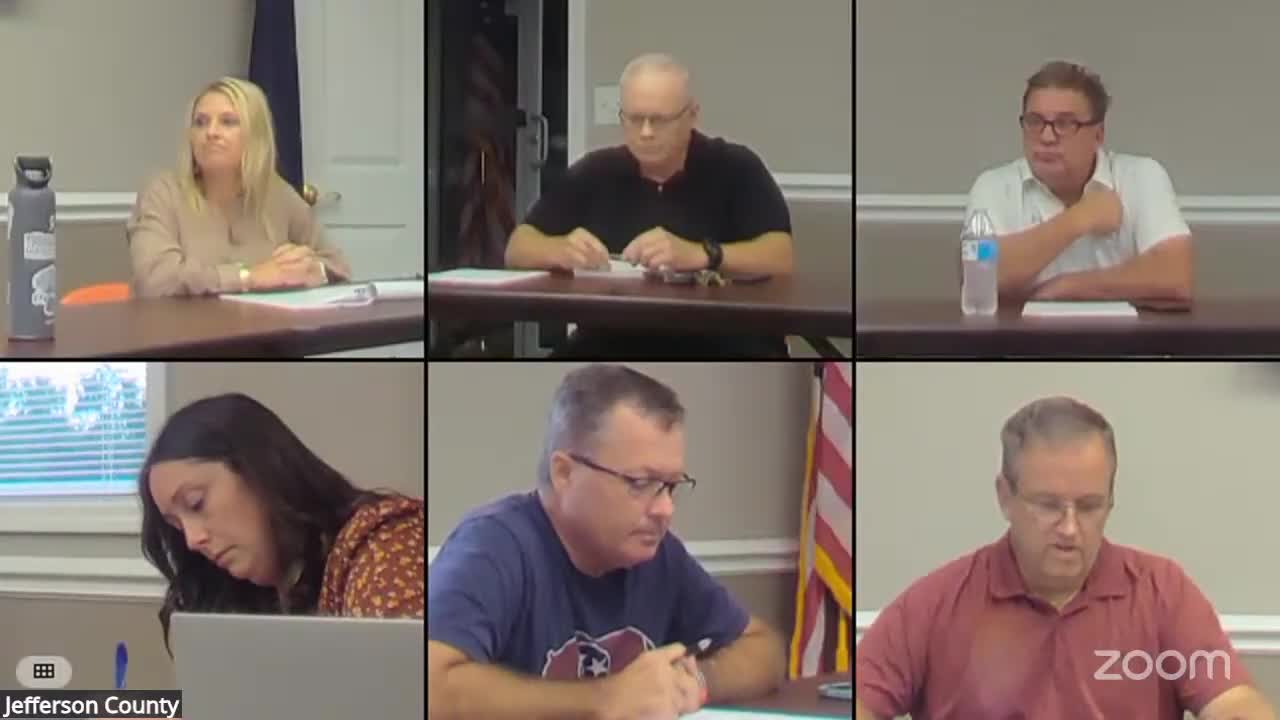
Summary
Jefferson County Council approved Ordinance 2025-007 to impose a county motor vehicle excise surtax and a county wheel tax effective Jan. 1, 2026. The measure passed 4–3 after public comment raised concerns about rushed timing, reduced Community Crossings grant caps, and overlapping city taxes.
The Jefferson County Council voted 4–3 to approve Ordinance No. 2025-007, creating a county motor vehicle excise surtax and a county wheel tax to fund road and bridge work, the council read and approved during a public meeting. The ordinance sets a $7.50 annual excise surtax on most passenger vehicles and a $5 wheel tax on certain heavier vehicles, both effective Jan. 1, 2026.
The ordinance establishes two nonreverting funds to receive revenues from the Bureau of Motor Vehicles and the Department of Motor Vehicles and limits use of those funds to road- and bridge-related activities such as construction, reconstruction, repair or maintenance and county contributions to obtain grants from the local road and bridge matching grant fund under Indiana Code 8-23-30.
The vote follows the passage of House Act 1461, which the council said changed the state road-funding formula and created a new statutory environment that counties may respond to by adopting local vehicle taxes. “This was not an easy decision,” the presiding council member said after the vote. “Without the money, the roads will deteriorate.”
What the ordinance does - Excise surtax: The ordinance imposes a county excise surtax effective Jan. 1, 2026, at the rate of $7.50 annually on passenger motor vehicles, motorcycles, motor-driven cycles, collector vehicles, certain trailers, light trucks and military vehicles as defined in the act. - Wheel tax: Also effective Jan. 1, 2026, the county wheel tax is set at $5 per vehicle for nonexempt buses, recreational vehicles, semi-trailers, heavy trailers (gross weight above 9,000 pounds) and trucks/tractors above 11,000 pounds. - Uses and accounting: Revenues will be deposited into county surtax/wheel tax funds that are nonreverting. Funds may be used to construct, reconstruct, repair or maintain streets and roads under county jurisdiction and to provide county matching contributions for the community road-and-bridge matching grant program. The ordinance directs the treasurer to provide an estimate of surtax revenues to the county council on or before Oct. 1 each year for budgeting purposes and to file a copy of the ordinance with the Bureau of Motor Vehicles and the Indiana Department of Revenue as required by the act.
Public comment and council debate Members of the public and several council members pressed the council on timing, outreach and the risk that city and county taxes could be “stacked.” A resident criticized the pace of the ordinance and said the rush was not justified by guaranteed grant losses: “This rush to have to pass this tax right now because we’re gonna lose money is not true,” the resident said during public comment.
Council members and staff said the county faced a changing state funding environment. The ordinance references House Act 1461 (signed by Gov. Braun), which the council said alters grant priorities and encourages local units to share road-network costs. A council member asked the county highway superintendent, Jason, how many road miles the county maintains; Jason replied, “530.”
Speakers and several commenters noted changes to the Community Crossings matching grant program. The public record at the meeting included these points, described by commenters and staff during discussion: - The maximum per‑unit Community Crossings grant was described as being reduced from $1,500,000 to $1,000,000 per state fiscal year under the recent law changes. - For smaller local units (fewer than 50,000 people), the matching percentage cited in discussion was reduced from 25% to 20%. Council members said those grant changes and the county’s declining discretionary matching funds (including reduced casino proceeds) made a dedicated local revenue stream desirable to qualify competitively for grants.
Concerns about “stacking” and coordination with Madison Multiple speakers urged a coordinated approach with the City of Madison to avoid residents within city limits facing multiple local charges for road funding. Council member Heather (first name only, role as county council member noted in the meeting) said she tried to avoid the word “double” but acknowledged the political and practical concern that city and county levies could add up for residents. Commenters urged the council to hold joint sessions with the city and to improve public outreach. One resident said the county was “ramrodding” the ordinance and that drafts were not posted on the council’s website before the reading.
Implementation and next steps The ordinance allows future repeal or rate changes only in accordance with the state act; it also requires the treasurer’s annual revenue estimates by Oct. 1. The council also instructed the treasurer to file required copies with state agencies. The presiding council member and other council members indicated they would continue to press state legislators on provisions that lead to stacking, and some members urged residents to contact state lawmakers about Senate Bill 1 and other pending measures that could shift tax burdens.
Vote and procedural notes The motion to approve Ordinance No. 2025-007 was made and seconded during the meeting; the council approved the ordinance by a recorded vote of 4 in favor and 3 opposed. The ordinance’s effective and enforcement date begins after passage and publication as required by law.
Why this matters County officials said the fund will support maintenance and larger bridge projects that require multi-million-dollar investments and long-term planning. “If we do not keep our roads safe and have road repair, that’s an infrastructure that we can’t do without,” a council member said, describing winter damage, flood repairs and bridge needs as factors in the decision.
What the meeting record leaves unclear The meeting transcript includes claims about grant amounts and statutory mechanics that several speakers described as changing in recent months; speakers and at least one council member described conflicting information received from state sources earlier in the summer. The transcript does not provide a full breakdown of annually projected surtax/wheel-tax revenue, nor does it include a line-by-line vote roll call naming which council members voted yes or no. The ordinance text, as read at the meeting, specifies the legal mechanics and annual treasurer reporting requirement.
Ending Council members and the public concluded the meeting with calls for improved public notice of future drafts, more intergovernmental coordination with Madison and continued outreach to state legislators about provisions the county finds harmful to equitable local funding.