Get Full Government Meeting Transcripts, Videos, & Alerts Forever!
Get email alerts on the Impact Fees Water Wastewater topic
No spam. Unsubscribe anytime.
Leesburg staff present proposed doubling of water and wastewater impact fees after consultant study
Summary
City staff presented a consultantimpact-fee study showing proposed increases to water and wastewater connection impact fees, explained the methodology and recommended using Floridaextraordinary-circumstances provisions to implement a one-time increase rather than phasing over four years.
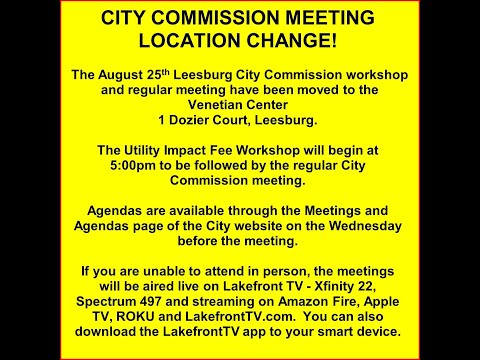
City staff presented findings from a recent impact-fee study at the Aug. 25 meeting of the Leesburg City Commission, saying the study supports substantially higher water and wastewater impact fees and recommending a one-time increase under FloridaImpact Fee Act extraordinary-circumstances provisions.
The consultantreviewed fixed assets and the city's five-year capital improvement plan, separated water and wastewater enterprise funds, and applied the city's level-of-service standard (100 gallons per day per residential equivalent unit for water and 250 gallons per day for wastewater) to estimate capacity needs and plant replacement values, staff said. The presentation showed the current combined impact fee (water plus wastewater) at roughly $3,600 and proposed a combined fee of $6,606 (water $2,039; wastewater $4,567).
The study inventoried existing assets, monetized current infrastructure and planned five-year capital projects — including $56 million in water projects and $71 million in wastewater projects, with a large portion of wastewater funds tied to a phase 2 expansion at the Turnpike Wastewater Treatment Plant — and produced per-ERU fee recommendations. Staff noted the cityis still low compared with some neighboring municipalities even after the proposed increase.
Staff outlined two implementation options: use the maximum statutory increases phased evenly over four years, or seek a one-time increase under the statuteextraordinary-circumstances provisions. Staff recommended the extraordinary-circumstances path, citing rapid growth and increased materials and labor costs in construction as the primary reasons.
Next steps outlined by staff: complete the two required workshops under the statute, introduce and adopt the proposed impact-fee ordinance at two commission readings (the next two commission meetings), and implement a 90-day grace period after the second reading before collections begin to comply with the Florida Impact Fee Act.
No formal vote on adoption was taken at the meeting; staff said the commission would consider the ordinance at forthcoming meetings.