
Commission approves zoning amendments to align ADU, tobacco and sign rules with state law and council direction
Get AI-powered insights, summaries, and transcripts
Subscribe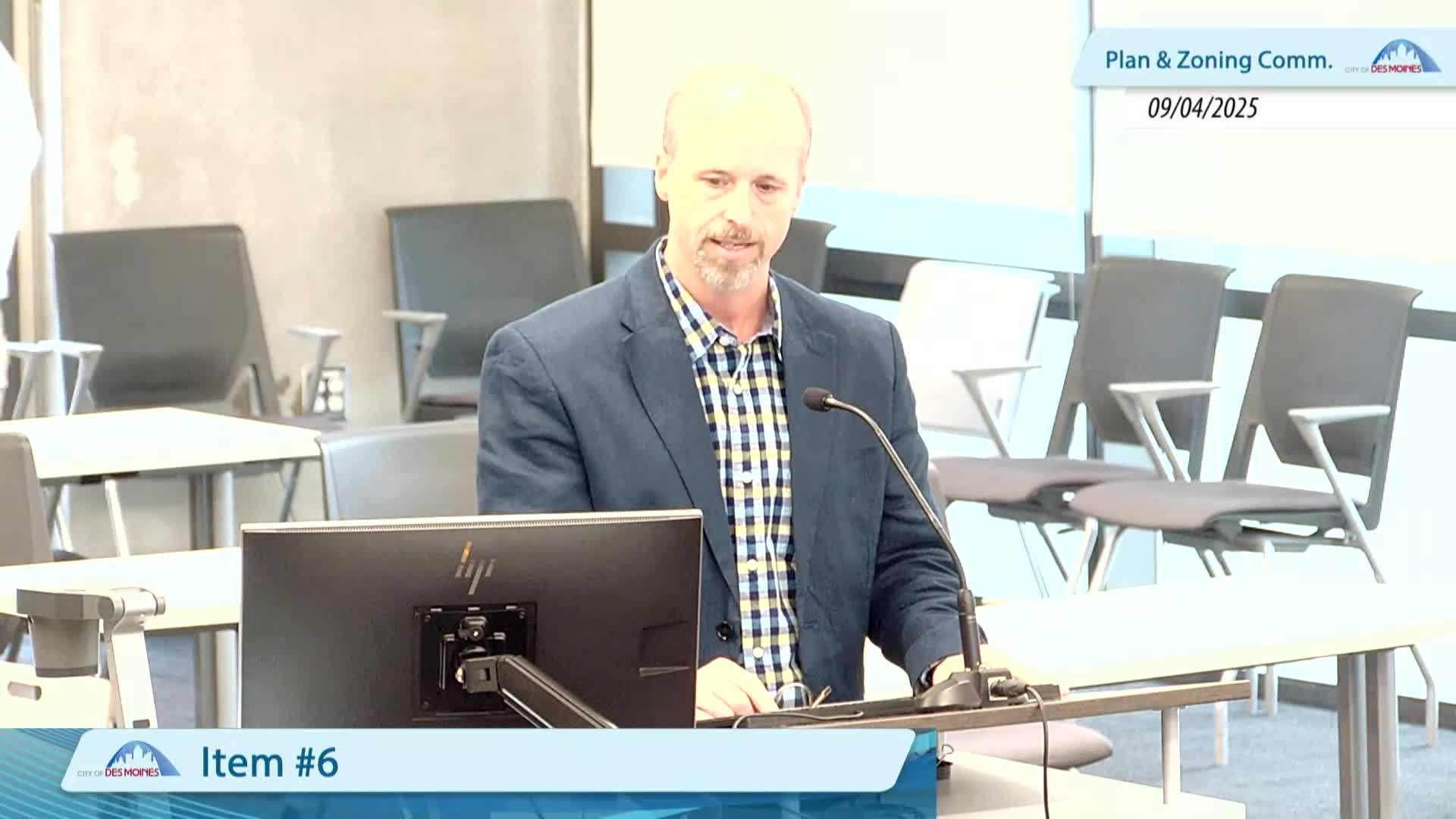
Summary
The Planning and Zoning Commission voted to send several zoning changes to implement state ADU law, add tobacco‑store separation rules and adjust poll‑sign nonconforming allowances and variance language.
The Des Moines Planning and Zoning Commission on Sept. 4 approved proposed amendments to chapters 134 and 135 of the Des Moines Municipal Code that implement state law changes for accessory dwelling units (ADUs), revise liquor and tobacco retail rules, update poll‑sign nonconforming provisions and change variance test language.
Jason Van Essen, planning and design administrator, told the commission the package responds in part to recent state legislation that narrowed local regulatory authority over ADUs and required a consistent standard for dimensional variance requests. “There was a bill that was passed that narrows down what local governments can regulate with regard to accessory dwelling units,” Van Essen said, and staff updated the city’s zoning and planning code language to conform.
Key changes described by staff include removing local owner‑occupancy and minimum parking requirements for ADUs to match state law, clarifying ADU size limits to the state standard, and simplifying design standards so ADUs cannot be subject to more restrictive requirements than the primary house. Van Essen also described a change in variance language to apply a “practical difficulty” standard for dimensional (numeric) regulations in line with state statute.
On liquor and tobacco, staff said the amendments create clearer definitions distinguishing tobacco stores from alcohol outlets, add vapor products to the code consistent with state law, and introduce a 500‑foot separation standard that would prevent new tobacco stores from opening within 500 feet of certain uses, including other tobacco stores, schools and parks unless relief is granted.
On poll (pole) signs, staff proposed allowing modest flexibility for legal nonconforming pole signs — for example, permitting up to a 15% increase in area and up to 12 square feet of digital display for certain gas‑station‑style signs — while retaining limits intended to encourage long‑term reduction of pole signage in the community.
Commissioners asked procedural questions about whether the city council had already taken positions; Van Essen said council workshop direction had informed the draft language but the commission’s recommendation and the detailed code text are part of the formal adoption process. After brief discussion the commission moved to approve the amendments for transmittal to city council; the motion passed on a voice vote at the meeting.
What happens next: the code amendments will proceed through the city’s formal adoption process (staff indicated the commission was making a recommendation for council consideration). The amendments change local review standards for ADUs, tobacco stores and certain signs, and modify the municipal code to align with state law and council direction.