
Commission approves design exception for 3850 Dixon warehouse facades
Get AI-powered insights, summaries, and transcripts
Subscribe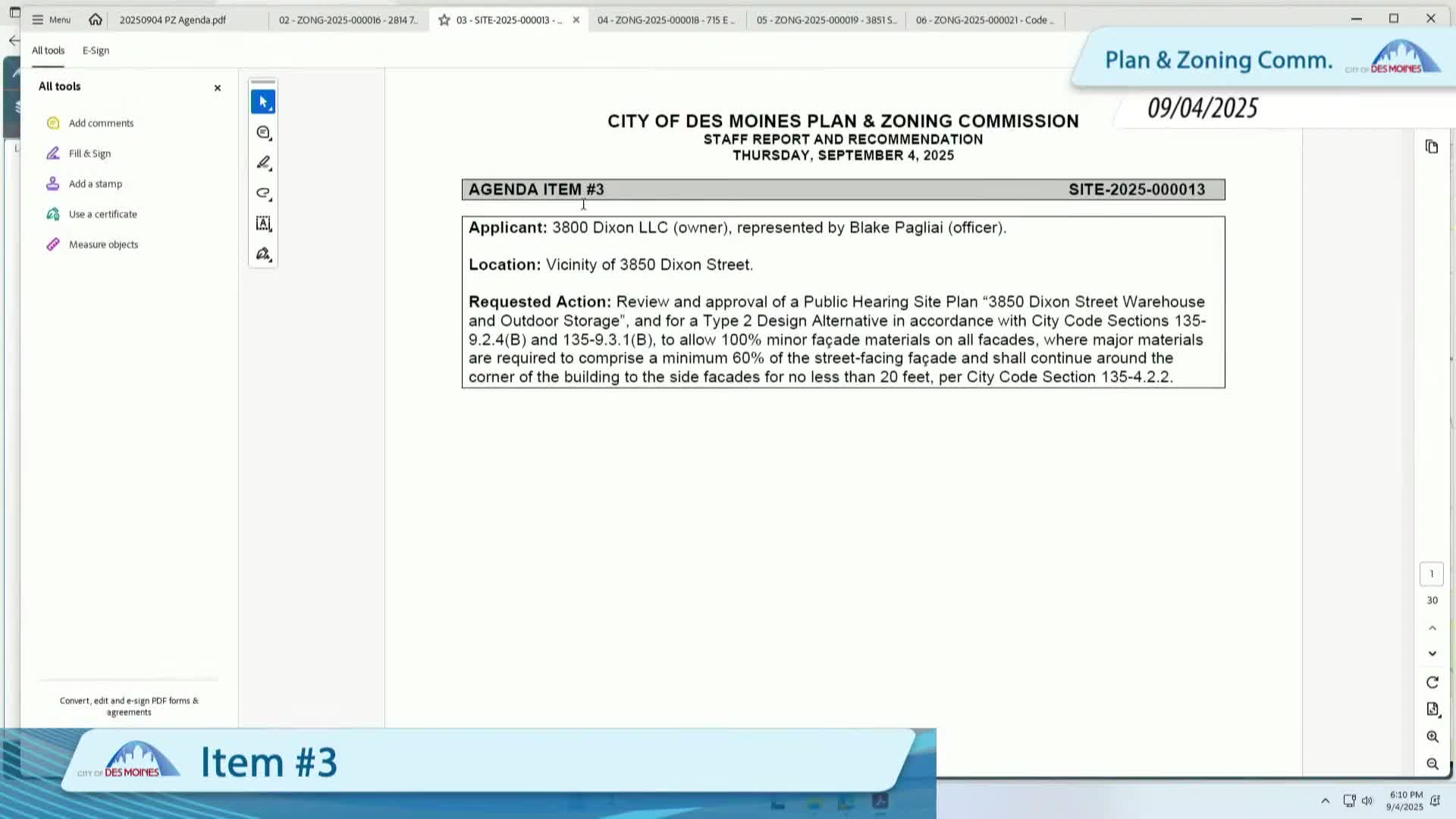
Summary
The Des Moines Planning and Zoning Commission on Sept. 4 approved a design alternative allowing a warehouse at 3850 Dixon St. to use larger metal panels on its facades than staff recommended, after debate over material durability, veneer thickness and consistency with the zoning code.
The Des Moines Planning and Zoning Commission on Sept. 4 approved a type 2 design alternative for a proposed 30,000‑square‑foot warehouse at 3850 Dixon Street that lets the applicant use predominantly metal wall panels on street‑facing and side facades instead of the higher percentage of brick, stone or concrete staff had recommended. The commission’s vote followed staff presentations, a rebuttal from the applicant’s designer and a wide-ranging commissioner discussion about durability and neighborhood context.
The matter mattered because the zoning code requires “major materials” such as brick, stone or concrete to make up a minimum percentage of street‑facing facades; staff said the applicant’s original submittal proposed about 80% metal on the primary façade and therefore failed to meet the code’s material standards. Jillian Summer, planning staff, said the code requires a minimum of 60% major materials on the street‑facing facade and limits metal to no more than 40% of any facade, and that a two‑inch versus one‑and‑a‑half‑inch veneer could change whether the stone counts as a major material. “Major materials are generally brick, stone, concrete, concrete masonry units. Metal is not considered a major material. It’s considered a minor material, and it has additional limitations,” Summer said.
Architectural designer Emma Vanzanti, speaking for the applicant, defended the submitted design and the use of a two‑foot stone plinth wrapping the building base. “This is a very cohesive design. It wraps all the way around the building, so every facade can match, and it’s very well balanced because of this intentionally designed plinth,” Vanzanti said, describing the proposed adhered stone product and the factory local to the project area.
Commissioners split on whether to strictly apply the code or weigh project context. One commissioner said the ordinance is clear and signaled deference to staff’s interpretation; another said the industrial context and the distance of the primary façade from the street made the applicant’s approach acceptable. Commissioner Todd (first name only in record) raised maintenance and durability concerns, noting that adhered veneers “applied incorrectly…fall off” and that concrete bases hold up better near mower and equipment impacts. The commission discussed whether the applicant could specify a thicker veneer (2.5 inches) so the stone would be treated as a major material.
After discussion, a commissioner moved to approve the type 2 design alternative as submitted; the motion carried. The transcript records the final tally as “6‑3‑1.” The staff memo noted that, if the commission denied the applicant’s request, staff would instead recommend a modified type 1 approval with increased major material on the street facade (roughly 40% stone or other major material), a raised base on the side facades and material wrapping at corners.
What happens next: the applicant may proceed under the commission’s approval for the design alternative. Staff also indicated that if the applicant changes materials (for example, selecting a thicker adhered stone or substituting concrete), that could affect whether the product is treated as a major material under current code guidance.
Details drawn from the Sept. 4 Planning and Zoning Commission hearing include planning‑staff explanations of the city’s material rules, the applicant’s presentation of product samples and the commissioners’ debate over long‑term maintenance and neighborhood context.