Get Full Government Meeting Transcripts, Videos, & Alerts Forever!
Get email alerts on the Auto Repair Ordinance topic
No spam. Unsubscribe anytime.
Council reviews draft ordinance limiting home auto repairs, extends allowed inoperative time to 10 business days
Summary
At a nonvoting council work session, city leaders reviewed a draft ordinance to regulate automobile oil changes and repairs in residential areas, including spill prevention, disposal requirements, a 10-business-day limit for inoperative vehicles and discussion about enforcement and allowable hours.
City leaders reviewed a draft ordinance to regulate automobile oil changes and repairs in residential areas at a council work session; no vote was taken.
The draft, described by meeting speakers as an amendment to Ordinance 2025-3 (chapters 28 and 29) and to align with EPA stormwater guidance, would allow residents or an "authorized person" to change motor oil on a vehicle owned by the resident but would bar spills or discharge to ground, paved surfaces, storm drains, ditches or waterways. The draft requires used oil and related waste to be collected and disposed of in accordance with local, state and federal regulations and exempts newly licensed automotive facilities that comply with licensing and environmental requirements.
The draft includes a new time limit that would bar a vehicle in an inoperative condition on residential property for more than 10 business days (the drafter changed an earlier 7-day limit). It also sets permitted hours for maintenance and repairs (draft text currently says 7 a.m. to 7 p.m.), and council members discussed whether the end time should be moved later — to 9 or 10 p.m. — to accommodate residents who work daytime hours.
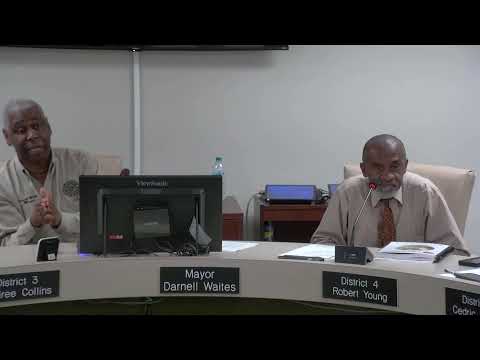
Discussion focused on enforceability and scope. Mayor (name not specified) opened the session and said the meeting was a work session and "we're not voting on anything," emphasizing that the council was gathering public input and refining the language. A council member who identified herself as Jackson said she had not "had a chance to fully assess it," but that the draft "allows for due process" and added that clearer definitions of "commercial activity," "illegal businesses" and "licensed repair operation" would help enforcement and reduce legal risk. Council member Young noted options for lawful disposal, saying residents can take used oil to retail drop-off locations such as AutoZone.
Speakers described enforcement as a key unresolved issue. One council member and the mayor said code enforcement would investigate complaints and that staff had sought or obtained a legal opinion confirming the ordinance's legal basis; speakers also said code enforcement generally will not enter private property unless a violation is established in the ordinance. Several council members and constituents urged clearer definitions and specific wording tying the stated intent — to target unlicensed, home-based auto repair operations that become de facto commercial businesses — to the ordinance language so it can be enforced and defended against legal challenge.
Other provisions discussed include prohibitions on excessive noise and obstruction of public right-of-way (for example, blocking sidewalks); restrictions on major automotive work such as engine and transmission rebuilding or dismantling outside an enclosed structure; and retention of existing penalty language in the ordinance as drafted. The draft would allow the council to grant extensions for repairs if more time is needed, and speakers said staff could refine language and consult the attorney on allowable hours and enforcement procedures before returning a final ordinance to the council for a public hearing and potential vote.
The work session included multiple council members and public comment. No formal action was taken on the ordinance at the session; subsequent steps described by speakers were refinement of draft language by staff and the city attorney, additional public input at a public hearing, and targeted follow-up by code enforcement on complaints.
The council adjourned by a voice motion at the end of the work session.