
Oldsmar outlines multi‑million dollar upgrades at Water Reclamation Facility and water plant to boost capacity and resilience
Get AI-powered insights, summaries, and transcripts
Subscribe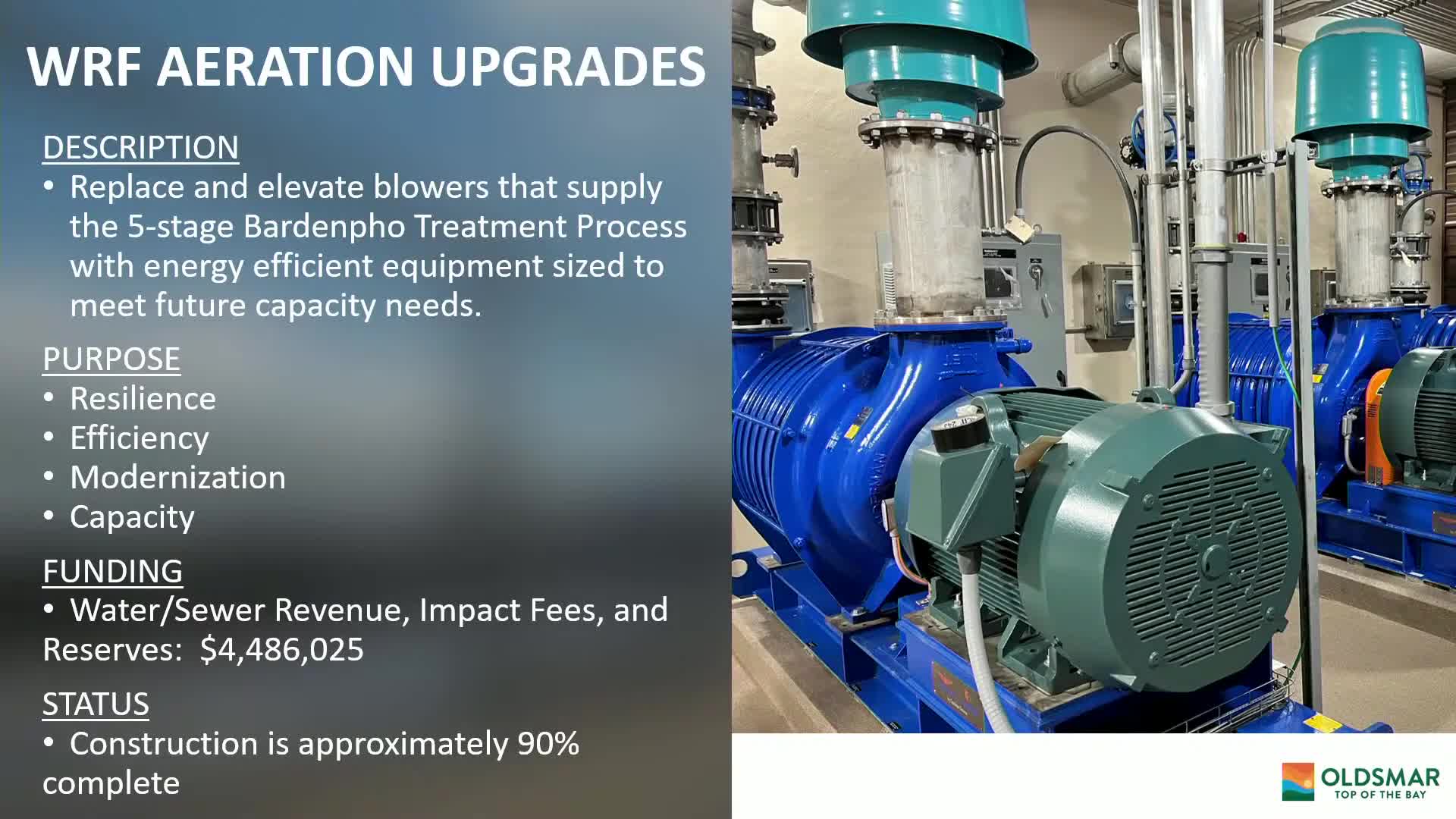
Summary
City staff described several ongoing and planned projects at the Water Reclamation Facility (WRF) and reverse osmosis plant, including aeration blower replacement, a new control building, a fourth filter bay and generator/load assessments intended to increase capacity and storm resiliency.
Public works staff told the council the city is midstream on several water and wastewater projects intended to increase capacity and resilience at the Water Reclamation Facility (WRF) and the reverse osmosis (RO) water plant.
At the WRF, Daniel Simpson said aeration blower replacements are roughly 90% complete and were budgeted at about $4,486,000. The WRF control building project, intended to raise the facility’s control room to meet current flood elevation requirements and harden electrical systems, carries a state grant of $2,150,000 and a water/sewer utility contribution of about $4,781,000 for a total project cost just under $7,000,000; Simpson reported the control building is approximately 16% complete.
Staff described a program of projects that together would allow the plant to be re‑rated to higher permitted capacity: aeration upgrades, construction of a fourth filter bay (budgeted at about $880,000) and related works such as internal pump replacements and generator/load assessments (a back generator assessment for the plant was budgeted at $250,000). Simpson said the fourth filter bay and aeration work are among the three projects required to raise permitted capacity.
At the RO water treatment facility, staff outlined multiple investments: rehabilitation of feed pumps and motors, carbon dioxide storage improvements to address intermittent supply issues, degasification stack media replacement and a program of well pump maintenance and acidizing recommended by the water supply plan. Staff budgeted several hundred thousand dollars across fiscal years for these items and included cybersecurity updates for RO plant controls.
Simpson summarized how the city estimates costs for large projects: "we add a 10% contingency, for unforeseen, things that might come up when you start digging on the ground," and then apply an uncertainty factor tied to scope and schedule. Staff cautioned that supply‑chain issues, tariffs and concurrent grant activity across the region have driven higher bid prices and larger contingencies.
Why it matters: WRF and RO plant upgrades affect regulatory compliance, plant capacity, resilience during storms and long‑term water reliability for customers. Several projects are already underway with grant support; others are scheduled pending funding.