
HRA authorizes grant application to add water and sewer on Third Street North, enabling several new homes
Get AI-powered insights, summaries, and transcripts
Subscribe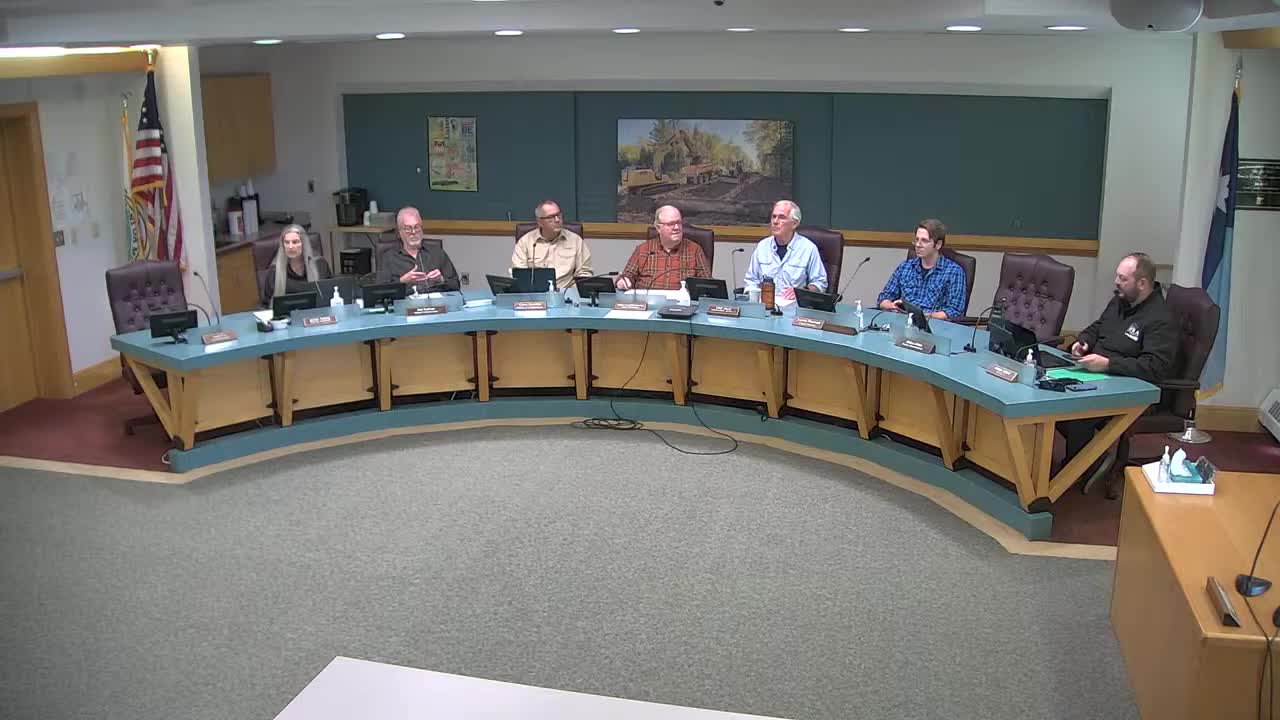
Summary
The Cook County Housing and Redevelopment Authority voted 3-2 to authorize Resolution 25-16 on a motion to submit an Iron Range Resources and Rehabilitation Board (IRRRB) grant application — up to $220,000 — to support developer John Petters’ plan to design, pay for and install water and sewer on Third Street North between Sixth and Seventh avenues in Grand Marais.
The Cook County Housing and Redevelopment Authority voted 3-2 to authorize Resolution 25-16 on a motion to submit an Iron Range Resources and Rehabilitation Board (IRRRB) grant application — up to $220,000, according to meeting materials — to support developer John Petters’ plan to design, pay for and install water and sewer on Third Street North between Sixth and Seventh avenues in Grand Marais.
The vote matters because installing water and sewer on that block would allow Petters and adjoining property owners to connect utilities and build housing on parcels that currently lack municipal services. "We are asking the city for a very simple thing, and that is to allow us to design, install, and pay for water and sewer on Third Street North," Petters said during the public-comment portion of the meeting.
Petters told the HRA he owns half of the block between Sixth and Seventh avenues and has a purchase-option on the adjacent half; his immediate plan is to build six ownership units on the lots he owns and to mirror that configuration if he completes the purchase, creating up to 12 units on the two sides of the block. Petters said that, under current zoning, development along the stretch could allow more additional units farther west and on neighboring rights-of-way if water and sewer are extended: "The benefit would be basically to allow up to 24 units according to current zoning to be built on that stretch," he said.
HRA discussion emphasized two competing concerns: urgency for local construction jobs and housing supply versus the HRA’s desire to ensure limited grant funds further the agency’s affordable-housing goals. Commissioner Chris O'Brien said he wanted clarity on how the installed infrastructure would benefit future development and whether the city had plans to install water and sewer independently. "Is there any plans in the city? Does the city have any plans to put in this water and sewer on their own absent this proposal?" O'Brien asked. Petters replied he did not believe the city would do the work on its own and described prior unsuccessful efforts by property owners.
Board member Nicola Moore said the request "has come on rather suddenly and needs a quick response," and that she prefers a slower, more comprehensive approach that includes the city and other stakeholders. Moore said she would be more comfortable if the effort supported a broader plan for municipal infrastructure and housing density.
Several speakers noted technical and financial details discussed in the meeting materials: the IRRRB grant under consideration is described in staff materials as approximately $220,000; HRA staff said the HRA would not necessarily need to provide a cash match if the developer’s existing equity position is recognized by the IRRRB. Petters also offered to assign benefits from an existing Minnesota Housing Finance Agency award that he said is in his name; during the meeting he referenced that award as about $290,000 and described conditions tied to homesteading. Those figures and offers were described by speakers during discussion and by Petters; the HRA did not adopt an additional agreement transferring any Minnesota Housing Finance Agency award at the meeting.
Members raised conditions and implementation questions. Commissioners noted that if the city participates it typically owns installed infrastructure and may assess adjoining property owners. HRA discussion included the point that the city could choose to extend pipe farther in a separate action and that any decision on public assessments would be a city matter. Petters said the city had signaled interest in coordinating and that, because of contingencies added to city work, construction is now likely next spring rather than this fall.
After debate and two failed procedural attempts earlier in the meeting, the HRA took a final vote on Resolution 25-16 authorizing submission of a grant application. The motion passed 3-2. The HRA did not specify further contractual conditions or require recorded guarantees tying the potential grant to unit affordability at the time of the vote; commissioners who voted in favor said they planned to continue negotiating conditions after authorization.
What was decided is an authorization to apply for IRRRB grant funds and to support Petters’ proposal to install water and sewer; it is not a spending approval beyond the grant application nor an assignment of Minnesota Housing Finance Agency funds. The HRA and Petters discussed continuing conversations about using the Minnesota Housing Finance Agency award to support homeownership or homesteading requirements; Petters said he would be willing to work with the HRA on assignment but no transfer was executed.
Next steps described in the meeting: staff will pursue the IRRRB grant application authorized by Resolution 25-16; HRA members said they expect additional follow-up to clarify affordability conditions, timelines and city coordination. Petters said delays could affect local construction schedules and local contractors lined up to perform the work.
Ending: The vote authorizes the HRA to pursue the IRRRB application and continues a period of negotiation among the HRA, the city and the developer over scope, timelines and any affordability conditions tied to grant funding.