
Page County outlines Virginia Literacy Act rollout, seeks reading specialists and approved interventions
Get AI-powered insights, summaries, and transcripts
Subscribe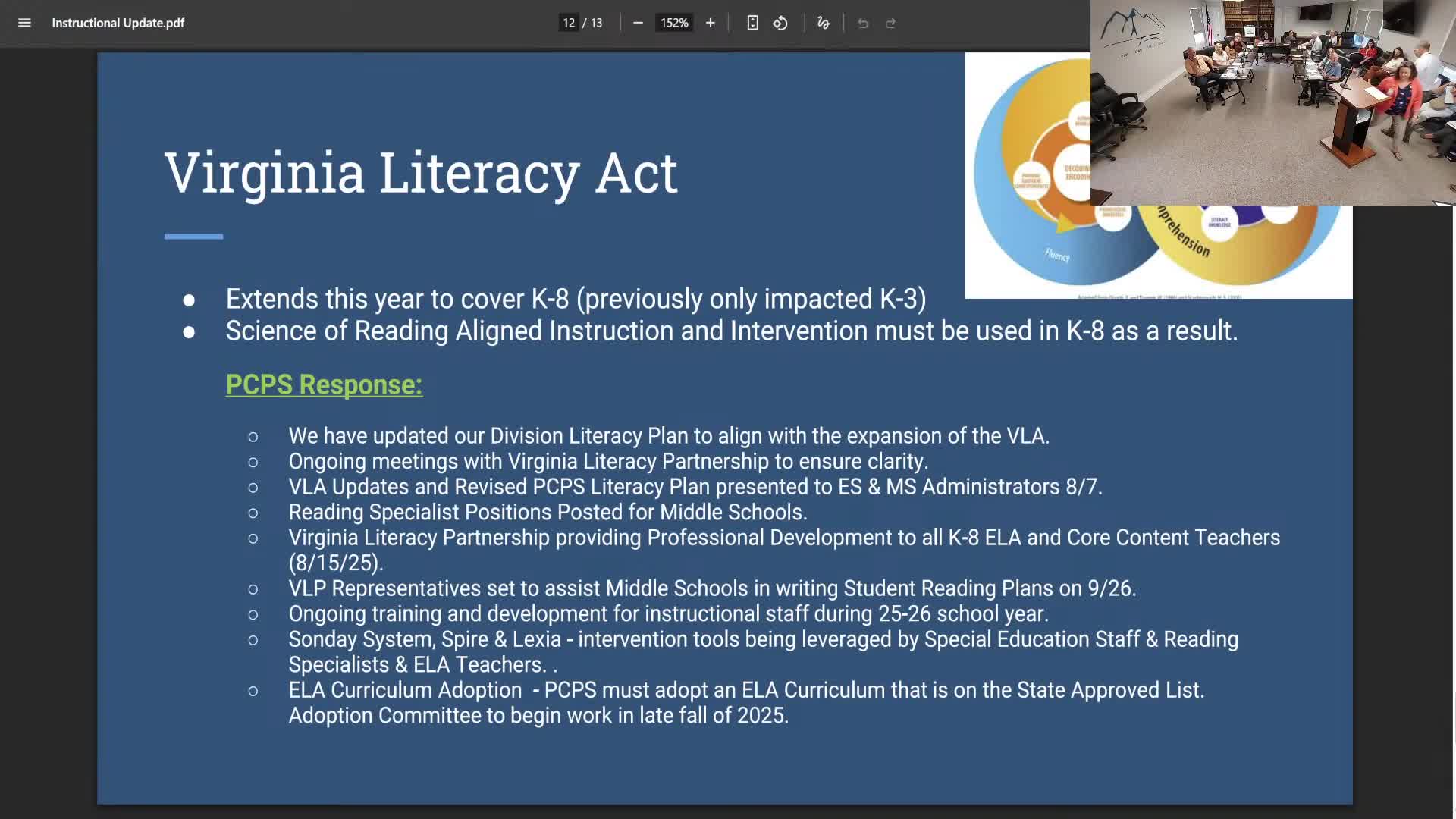
Summary
Division officials described how the Virginia Literacy Act will be implemented in Page County, including required screeners, intervention programs, a planned curriculum adoption and a push to hire reading specialists with a master’s endorsement.
Page County officials told the School Board they are moving quickly to implement the Virginia Literacy Act across the elementary and middle grades and to expand screening and intervention supports for students struggling with reading. Sarah Hamill, the division’s director of teaching and learning, described required materials, screening and the division’s steps to meet state expectations.
The literacy update matters because the law changes which instructional materials and interventions schools must use, requires targeted interventions and student reading plans for at‑risk learners, and will require additional staff capacity at the middle‑school level.
Hamill said the law, which focuses on the science of reading, expanded last year beyond kindergarten–third grade and now extends through eighth grade. "This is a piece of legislation that sort of went live last year and included the state's stance on the science of reading and leveraging what's called high quality instructional materials," she said. She told the board the division has updated its division literacy plan and submitted it to the state, and that building administrators have been briefed to lead implementation at the school level.
Hamill outlined concrete steps the division is taking: the division is using a state‑approved screening tool (referred to in the presentation as the Virginia language and learning screener, "VALS") to identify students at risk; the division will write individual student reading plans for students identified as at risk after fall assessments; and the Virginia Literacy Partnership, an implementation partner associated with the University of Virginia and the Virginia Department of Education (VDOE), will visit to support that work. "They are presenting multiple sessions to staff tomorrow," Hamill said of the Partnership representatives.
Hamill said the Partnership representatives for the region — named in the presentation as Ryan Dean and Maggie Hopper — will return on Sept. 26 to support middle‑school staff in writing student reading plans after assessments. She told the board that middle schools will need more intervention staffing than elementary schools and that Page County has posted reading‑specialist positions for the middle schools but has not yet filled them.
On staffing credentials, a board member asked whether the reading specialist role required a particular certification. A district staff member responded: "The reading specialist is a specific endorsement in Virginia, and it is a master's level," noting that teachers often return to graduate school for that endorsement and that districts sometimes pursue a "grow‑your‑own" approach while balancing classroom coverage.
Hamill listed the intervention programs the division is using and aligning to state guidance: SPIRE and Lexia were cited, and the presentation referred to the Sonday System as a program being leveraged in special education interventions. She said the division must select core, supplemental and intervention materials from the state‑approved lists and that a curriculum adoption committee will begin work in November to select high‑quality instructional materials that meet state criteria.
When asked whether the Virginia Literacy Partnership visit was a state mandate or an optional partnership, Hamill said the Partnership works in concert with VDOE and UVA. "I'm not sure I've read that it's an expectation that you have to work with the Virginia Literacy Partnership, but I think we've benefited from the support," she said.
The board did not take formal action on the literacy plan during the meeting; Hamill said the division has submitted its updated literacy plan to the state and will proceed with assessments, the Partnership visits and the November curriculum work.
— Ending: The division will monitor the fall screening results, aim to hire or develop reading specialists for the middle schools, and reconvene the curriculum committee in November to recommend state‑approved instructional materials for adoption.