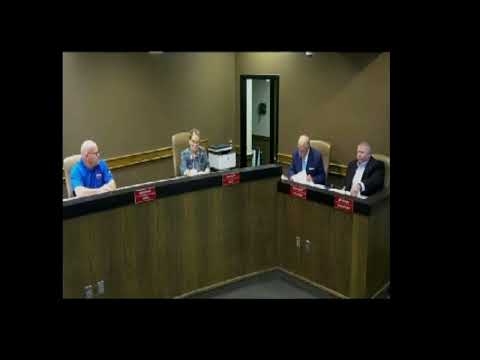
Yukon approves land sale and new zoning rules as data center proposal advances; water, power and transparency questions persist
Loading...
Summary
The Yukon Municipal Authority and City Council approved a purchase-and-sale agreement Aug. 13 with BLE Land Holdings LLC and enacted new zoning and development rules for data centers at the Frisco Road/Route 66 site, conditioned on negotiated water and electric agreements.
YUKON, Okla. — The Yukon Municipal Authority and the Yukon City Council voted Aug. 13 to approve a purchase-and-sale agreement with BLE Land Holdings LLC for two parcels near Frisco Road and Route 66, and to adopt companion zoning and ordinance changes designed to govern data-center development on that site.
Why it matters: Council members said the sale could bring a major utility customer and recurring city revenue, but residents and councilors pressed officials for written guarantees about water availability, wastewater capacity and long-term electric service before a project could proceed.
The votes and measures approved - Yukon Municipal Authority and Yukon City Council approved a purchase-and-sale agreement between the city entities (seller: Oklahoma Title 60 Public Trust) and purchaser BLE Land Holdings LLC for parcels identified in the agenda package at and near 3401 Frisco Road (legal descriptions in the city agenda packet). The City Council vote on the mirrored item (item 30) recorded: Wooten yes; Selby no; Shriver yes; Zimmerman yes; Gilmore yes. - The council approved rezoning for the site from agriculture to I-1 (light industrial) (item 20), a comprehensive-plan amendment to designate the site as high-intensity use (item 21) and a preliminary plat for the property (item 22). - The council adopted a new unified-development ordinance aimed specifically at data centers (ordinance 14-79) and related amendments to building-envelope and outdoor-lighting standards (ordinances 14-80 and 14-81). The council also voted to enact emergency clauses so the changes take effect immediately in most cases.
What council members and staff said about the sale and conditions City staff and council repeatedly described water and power agreements as conditions precedent to closing. Roger, a staff member who addressed legal and contract questions during the meeting, said: "If that water cannot be provided, then the buyer won't go forward." The sale agreement includes a multi-step diligence process and payment milestones for the purchaser; staff said milestone deposits include two payments of $100,000 and a third of $150,000 (city retention would total $350,000 if buyer withdrew before milestones became nonrefundable).
On water, staff and the city's engineering consultant Garver told the council they have studied wastewater treatment plant discharge and daily effluent volumes over five years as part of planning for reuse. City staff said the wastewater treatment plant currently handles average daily flows in the range of about 1 million to 3 million gallons and that the city is investing approximately $11 million — in part with ARPA and city funds — in plant improvements to increase rated capacity to roughly 4.5 million gallons per day. Staff said any gray-water or effluent reuse arrangement for a data center would be set by a separate water-and-sewer agreement that must be acceptable to both parties before the purchase closes.
On how effluent would be used, the staff explanation was technical but specific: water routed to cooling towers will evaporate during cooling and an estimated 20–40% of the water pumped to towers would return to the sewer/wastewater system for treatment and reuse or discharge. The city said state regulators (Oklahoma DEQ and the Oklahoma Water Resources Board) limit how discharge and temperature are handled; staff said returned water would be processed again through the plant and that any water and sewer agreement would include quality and volume terms.
Power and tariffs City staff and multiple speakers discussed the electric utility OG&E and the need for a long-term power arrangement between the data-center end user (or its developer) and OG&E. The mayor and staff told the council that the purchaser and likely end users must negotiate long-term power and that the electric utility will evaluate generation, transmission and distribution needs before allowing a large load to proceed. The council was told the likely end users for a half‑gigawatt project would be "hyperscalers" — very large data customers whose long-term power purchases and capital commitments factor into whether new generation and transmission are built.
Estimated local revenue and economic scale City estimates presented at the meeting put potential annual electric franchise-tax revenue from a large data-center operation in the rough range of $8 million to $12 million at long-term steady-state load; staff described the potential project as a large investment on the order of roughly $1 billion for a half‑gigawatt campus, though exact end-user commitments were not on the council table.
Public comment: water, power, environment, transparency More than a dozen residents questioned whether the city can protect private wells and the municipal water supply. Amy McAllister, a resident who said she uses a private well, told the council: "I don't think a handshake deal is appropriate." She and other residents pressed for written guarantees and asked whether citizens would see the final water agreement; the mayor and staff said the water-and-sewer agreement will be negotiated before closing and that the city will provide the agreement for public review before any final action.
Residents also raised concerns about air quality, diesel backup generators, noise, e‑waste and the possibility that a site could later generate its own on-site power. Stephanie Burdine told the council she was worried that changes such as Senate Bill 480 (discussed at the meeting as allowing behind-the-meter generation) could affect the city's franchise-tax revenues; city staff said the purchase agreement requires the developer to commit to buy power from the utility and that the city will not permit permanent on-site generation beyond limited backup generators under local permitting.
Transparency and process questions Several speakers criticized the city's public-notice process and said they had not learned about the proposed sale and ordinance changes in time to participate earlier in the process. Julia C. urged the council to "table this for further review," citing concerns about non-disclosure agreements and the public's right to records. The mayor and council said the city will provide the water agreement and related documents for public review before closing and that the closed-door diligence process includes many technical tasks that will require time.
Next steps and timing City staff said the sale remains conditional on due diligence, agreed water and sewer terms, and progress on electric utility agreements. Council members and staff said the purchase-and-sale agreement includes a diligence period (stated in the agreement as 180 days and extendable by the parties twice for 90 days, i.e., up to about a year in practice) during which the city and purchaser must reach agreement on those conditions. Staff also said that many of the technical work streams — water studies, wastewater upgrades, transmission studies with OG&E — are active projects that will continue to be presented to the council and to the public.
Quote highlights "If that water cannot be provided, then the buyer won't go forward," Roger (staff member) said during the council's contract discussion. "How much more fresh water do we expect?" resident Zach Castle asked during public comment about supply and equity for rural well users. "I don't think a handshake deal is appropriate," resident Amy McAllister said, urging written guarantees for well owners.
What the council did not decide tonight Council approval of the purchase-and-sale agreement and the zoning changes does not itself authorize any water or power delivery. The council and staff repeatedly emphasized that a separate, negotiated water-and-sewer agreement and a utility power agreement are required and that the project will not close or proceed without those written commitments.
What to watch for next City staff said the next public milestones will include continued engineering studies from Garver, contract negotiations on water and sewer terms, and formal power-availability and interconnection steps with OG&E. The water-and-sewer agreement and any resulting utility agreements will be posted for public review before closing, staff said.