
Zoning board denies variance to allow curb cut at Wilshire Place property near Waite Park
Get AI-powered insights, summaries, and transcripts
Subscribe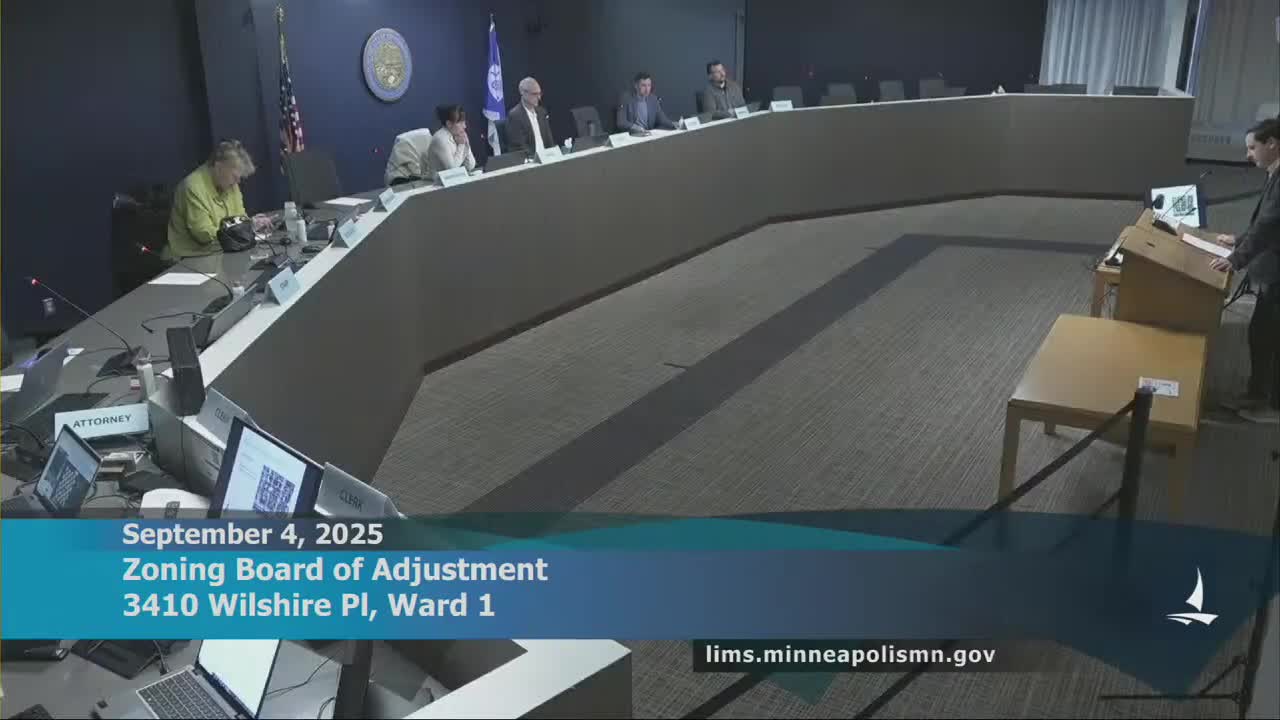
Summary
The Minneapolis Zoning Board of Adjustment voted 3-1 on Sept. 4, 2025, to deny a variance that would have allowed a curb cut from Wilshire Place for a proposed single-family home, siding with staff findings that alley access should be used to protect pedestrian safety near Waite Park Elementary School.
The Minneapolis Zoning Board of Adjustment on Sept. 4, 2025, denied a variance request that would have allowed a curb cut from Wilshire Place for a proposed single-family dwelling, voting to adopt staff findings recommending denial by a 3-1 margin. Matt Perry, chair of the Zoning Board of Adjustment, presided over the hearing and called for the vote after public testimony and board discussion.
Staff told the board the property is an undeveloped interior lot of about 8,351 square feet served by an alley and that the zoning code generally prohibits curb cuts where alley access exists. "Staff finds that the proposal does not meet the required findings for approval and recommends denial of the variance request to allow curb cut where the property has access from an alley," Nicholas, city staff, told the board during his presentation. He described a vertical change of roughly 7 feet over the rear 50 feet of the lot (about a 14% slope on the existing grade) and said staff concluded the applicant could design or grade an approach from the alley.
The applicants, represented by Bonnie Veil, said steep topography concentrated at the rear of the lot created practical difficulties for alley access and that grading for an alley approach would be impractical and unsafe. "If we were to provide access from the alley... it's closer to 16%," Bonnie Veil said, describing an 8-foot elevation change over roughly 48.8 feet in the applicants' proposed grading. She and other family members described a desire for a multigenerational arrangement and said winter conditions and vehicle clearance made alley access unsafe for their household, which includes two small children and family members who expect to age in place at the site.
Builder Dan Brown told the board that, in standard practice, driveways generally should not exceed about 10% slope and said the applicants had limited options given front-yard setback constraints. Neighbors submitted written support and the applicants said the nearby neighborhood council endorsed the proposal.
Board discussion focused on the three required findings for a variance. Several board members indicated they could find unique circumstances and that the proposal would fit neighborhood character, but they could not reach the required finding related to public safety and pedestrian impacts. One board member summarized the difficulty: while findings 1 and 2 could be supported, "I haven't come up with anything" to meet finding 3 given concerns about pedestrian safety near the school, the member said.
The motion before the board was to adopt staff findings recommending denial. The clerk recorded a roll-call vote: Board member Eichholtz — aye; Board member Grama Korsch — no; Board member Ingram — aye; Board member Wayne — aye. The tally was 3 ayes, 1 no. The board instructed staff to advise the applicants about next steps; staff told the applicants the application could be revisited after they discuss options with planning staff.
During the meeting several board members asked staff to present a clearer slope threshold for driveway grading to policymakers. Nicholas and other staff said the city does not maintain a single, numeric citywide slope threshold outside shoreland areas and that driveway slope is typically handled through building-code and design decisions; staff noted it could be raised with policy makers.
The board’s denial leaves the applicants with the option to consult staff about redesigning the site to use alley access or to return with revised plans; staff advised the applicants to discuss grading options with city planners.