
Hunt County officials debate $7 million shortfall in proposed FY2026 budget; judge signals likely tax-rate increase to cover sheriff request
Get AI-powered insights, summaries, and transcripts
Subscribe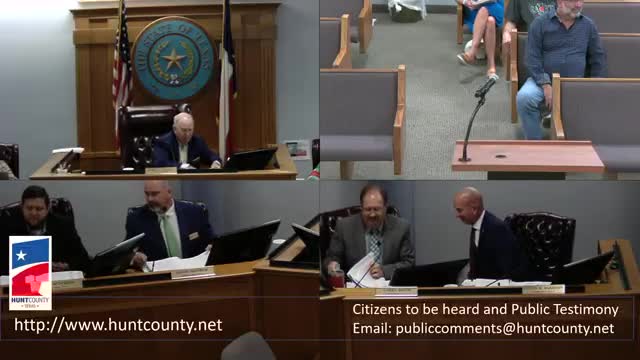
Summary
Judge Stovall presiding over the Hunt County Commissioners Court said the county faces a projected deficit of $7,047,019 in a no-new-revenue FY2026 budget and that he likely will file a higher proposed tax rate Friday to avoid service cuts.
Judge Stovall presiding over the Hunt County Commissioners Court said the county faces a projected deficit of $7,047,019 in a no-new-revenue FY2026 budget and that he likely will file a higher proposed tax rate Friday to avoid service cuts.
The judge said the shortfall is driven primarily by higher requests and carryover costs in several departments and by amounts pushed forward from last year. “We have to catch up the $2,000,000,” he said, referring to overspending that carried into the current budget cycle, and added that he would probably file a proposed rate that covers the sheriff’s request so “our deputies and law enforcement people [are] safe.”
The discussion matters because the court must file a proposed budget and tax-rate notice this week; the judge said publication rules limit raising a rate later, so he may propose a higher rate now and reduce it if cuts are found.
Most important figures and drivers
- Projected deficit under a no-new-revenue calculation: $7,047,019 (as stated by the judge). - Major upward budget movements identified in the meeting: elections (roughly a $100,000 increase driven by equipment purchases), facilities (about $640,000 higher than last year, including roughly $360,000 in courthouse repairs), utilities (current-year use already above budget: $662,000 spent against a $600,000 budget), and sheriff operations (reported as $1,540,000 larger than last year to fund new deputies and equipment). - The judge said he placed a placeholder of $1,000 in contingency and proposed removing $200,000 from enterprise purchases to reduce pressure on the bottom line.
Sheriff’s staffing plea and court response
Sheriff (unnamed) told the court that call volumes and response times have grown and warned of public-safety risk if staffing does not increase. He described longer backup times on violent incidents and said, “I have wore a black band around my badge more in the last 2 years than I have ever worn in 30 something years of law enforcement.” He urged the court to consider the human and safety costs of under-staffing.
Court members discussed options: shifting funds from capital projects, asking departments for targeted cuts (the judge observed about 20 departments had smaller budgets and about 20 were higher than last year), and a possible small tax-rate increase. Several commissioners signaled willingness to defer or reduce Road & Bridge capital or to accept temporary reductions. The judge said he expects to file a proposed budget that may include a rate increase and to work with commissioners and staff to reduce it after filing.
Process, deadlines and next steps
Judge Stovall said the proposed budget must be filed by Friday and that several public notices and hearings will follow. The judge asked staff to confirm whether publishing a proposed rate and later raising it would require republishing notices; county counsel and the auditor were tasked with clarifying the legal steps. The judge asked the sheriff to update his revised staffing figures quickly and asked David and Bernice (staff) to provide adjustments to the draft by Thursday if possible.
The court did not take a formal vote on a final tax rate during the session; the judge said he will likely file a higher proposed rate to preserve flexibility, then work to lower it as cuts are identified. Public hearings and required tax-rate notices will follow the filing.
Why this matters to residents
If the court files a higher rate to cover the shortfall, property owners could see an increase in their county portion of property taxes. The judge gave a rough example: a one-cent change in the tax rate would raise about $1.576 million and would increase taxes on an average-valued home (quoted around $280,000 in the meeting) by roughly $28 a year.
What remains unresolved
The court did not finalize cuts or adopt a tax rate at the meeting. Staff and elected officials were asked to produce updated numbers and to continue negotiations; the judge said the court will continue work after filing the proposed budget so the number can be adjusted downward if feasible.