Get Full Government Meeting Transcripts, Videos, & Alerts Forever!
Get email alerts on the Pfas Treatment topic
No spam. Unsubscribe anytime.
Connecticut Water details PFAS treatment plan, seeks WQTA cost-recovery review from PURA
Summary
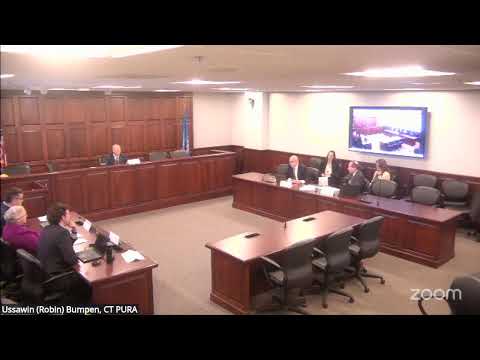
Connecticut Water Company presented its 2025 water quality and treatment assessment (WQTA) at a Public Utilities Regulatory Authority technical meeting to outline a program of proposed projects and a cost‑recovery process aimed at meeting federal PFAS requirements by the current compliance date of April 2029.
Connecticut Water Company presented its 2025 water quality and treatment assessment (WQTA) at a Public Utilities Regulatory Authority technical meeting to outline a program of proposed projects and a cost‑recovery process aimed at meeting federal PFAS requirements by the current compliance date of April 2029.
The company told Authority staff the submission lists 35 potential projects, organized in four priority tiers, with 26 in the top two tiers that the company views as near‑term priorities. Connecticut Water estimated the collective program as “roughly $200 million” in capital spending and said it plans annual WQTA surcharge filings for recovery while continuing to refine project scope and design.
Why it matters: EPA’s PFAS regulation establishes a maximum contaminant level (MCL) of 4 parts per trillion (ppt) measured at the point of entry to the distribution system, based on a running annual average. Connecticut Water and Authority staff discussed how that rule, sampling frequency, and site‑specific data will determine which sources require treatment and when the company must act.
Company and staff said the federal regulation went into effect in April 2024 and that initial monitoring is underway. David Pilling, Connecticut Water’s vice president of engineering and operations, summarized the compliance framework: “The regulation for PFAS went into effect in 2024…there’s a 3 year period from ’24 to 2027 [for monitoring], and then from 2027 to 2029 for full compliance.” He added that the company is collecting point‑of‑entry samples and that the running annual average is the determinative metric.
PFAS testing and detection limits Connecticut Water told PURA staff it has preliminary samples for nearly every routinely used source and expects initial compliance sampling (a 12‑month set that produces the running annual average) to be complete for primary sources in early 2026. Pilling noted laboratories’ practical detection capability, saying the lab detection limit is about 2 ppt and that the MCL is 4 ppt.
Staff and company speakers discussed a quirk of the running annual average calculation: under the current regulatory interpretation, any sample result below the 4 ppt threshold is treated as zero for the running annual average calculation. Pilling illustrated the effect: several quarterly values above 4 ppt and one below 4 can lower the annual average beneath the MCL because the below‑MCL result counts as zero for averaging.
Treatment technologies and operational questions Connecticut Water identified the two primary, accepted treatment technologies the company expects to rely on: ion exchange (IX) and granular activated carbon (GAC). Company witnesses described tradeoffs: IX media are often proprietary, fit smaller footprints and can be cost‑competitive at low flow rates; GAC is nonproprietary, common for larger plant capacities and typically requires backwash operations and periodic regeneration.
The company said it used a consultant to evaluate site‑level factors — water chemistry, treated flow, footprint and permitting constraints — and then selected a recommended treatment approach for each location as a first cut. “Water quality and size and space constraints seem to be the driving factors for us,” Pilling said.
On disposal and vendor responsibility, Connecticut Water said it expects vendors to manage spent media disposal under chain‑of‑custody arrangements and that the company has not planned to perform independent inspections of vendor disposal operations. On backwash handling, the company said backwash would follow the site’s normal disposal route (municipal sewer, lagoon or drying bed) and that literature and lab detection limits point to little or no meaningful PFAS in backwash effluent.
Priorities, tiers and program scope The filing groups projects into four tiers intended to prioritize the program so construction workload and contractor capacity can be managed. The company said 26 of the 35 listed projects are in tiers 1 and 2 (near‑term priorities) and nine are in tier 3 (closer calls that may move up or down as compliance sampling completes). Tier 4 projects were not submitted because the company judged them unlikely to require treatment based on current data.
Company witnesses told staff the submitted list is an initial, living set of projects that can change as additional compliance sampling becomes available. “The 1 through 4 set of projects represents the broader potential range for us,” one company speaker said. The company acknowledged some sites will need property‑right work or parcel acquisition and that most construction work will be contractor‑led; some small, retrofit installations may be performed in‑house.
Cost, rate recovery and SRF funding Company witnesses described the WQTA surcharge process and how cost recovery will interact with other funding sources. They said the statute governing the WQTA differs from the existing WICAA process in several ways, including the basis for recovery (the company described WQTA recovery as tied to capital spending on an annual basis, rather than completed‑in‑service work) and different surcharge caps than WICAA. The company noted a higher recovery cap in the WQTA statute compared with WICAA and said it will calculate recovery on a project‑by‑project basis when State Revolving Fund (SRF) loans or subsidies apply.
The company confirmed it has applied for SRF funding where eligible and said any SRF subsidy or lower interest rate will be reflected in subsequent WQTA filings so that ratepayers benefit from lower financing costs for subsidized projects. The company also said depreciation and property‑tax expense for a project will typically appear later (after completion and placed in service) and that AFUDC would be adjusted once surcharge recovery begins.
Timeline and next steps Connecticut Water told staff it aims to have an approved assessment report before the end of the year and to submit a first surcharge filing in January 2026 for an effective date of April 1, 2026 (the company said that is its target timetable). Company witnesses asked PURA staff whether additional, consolidated forms (an enhanced RUU‑4/summary schedule) could capture incremental annual spend, SRF versus non‑SRF buckets and the changes from filing to filing; PURA staff said illustrative schedules would be helpful and invited submission of examples.
PURA staff closed the meeting saying the docket schedule remains in progress and that staff will circulate updates. The company said it will provide updated/redlined assessment reports with each annual filing and to work on illustrative schedules to show the incremental accounting and rate‑recovery calculations discussed.
Ending PURA staff and Connecticut Water agreed the WQTA document will be a living plan updated annually; the company will proceed with monitoring, design and targeted project launches to meet federal compliance obligations and will supply additional documentation to staff and intervenors as PURA’s process advances.