Get Full Government Meeting Transcripts, Videos, & Alerts Forever!
Get email alerts on the Franchise Fee topic
No spam. Unsubscribe anytime.
Council opens discussion of a natural‑gas franchise fee to fund climate and efficiency programs
Summary
City staff on Sept. 8 presented options for a natural‑gas franchise fee, including a flat monthly account charge, a per‑therm charge or a percentage of utility revenue, and described potential uses such as weatherization grants and electrification pilots.
City staff presented options on Sept. 8 for a potential natural‑gas franchise fee and how proceeds could be used to support environmental stewardship and energy efficiency in Rochester. The briefing identified three common fee structures: a flat monthly account fee, a per‑therm charge tied to natural gas consumption, or a percentage of utility revenue. Staff estimated the potential range of revenue for illustrative fee levels and described programmatic options for investments.
Staff framed franchise fees as a charge for use of the public right of way and emphasized the city already receives similar payments (pilots) from some utilities. The briefing noted natural gas differs from other franchise arrangements because it currently does not carry a municipal franchise fee in Rochester. As examples, staff said a modest flat fee could generate roughly $1 million, a per‑therm charge at approximately $0.015/therm could generate about $1.52 million, and a small percentage of provider revenue (for example 5%) could yield around $2.4 million, depending on consumption and provider revenue.
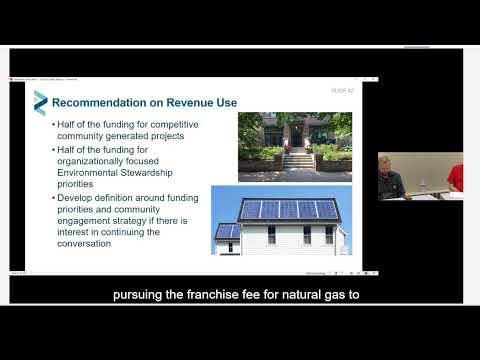
Staff proposed an implementation approach that could start with a simpler flat fee for one to three years while the city socializes a PerTherm model tied to consumption and energy‑reduction incentives. Proposed uses included a split between community‑facing, competitive grants for weatherization and programmatic subsidies and organizational investments such as fleet electrification, green infrastructure and tree planting. Staff recommended using 50% for community competitive projects and 50% for internal environmental priorities as an initial working idea.
Council members reacted with a range of views. Some members, including Miller and Doran, supported continuing the discussion as a way to raise funds for weatherization and emissions reduction and to avoid increasing the property tax levy. Others, including Council Member Wall, expressed concern about adding a regressive monthly charge on residents at a time of multiple rate increases on utilities; he opposed instituting a new fee now. Several members asked staff to return with a more detailed public engagement and implementation plan that addresses equity, exemptions (for low‑income households or city utilities), effect on bills and legal requirements for franchise processes.
Administrator Zelms and staff reminded the council that franchise implementation is not quick and may not affect the 2026 budget but could be considered for 2027 or later after engagement and legal process.