
Financial certification form requires two signers to attest to accuracy, auditor staff say
Get AI-powered insights, summaries, and transcripts
Subscribe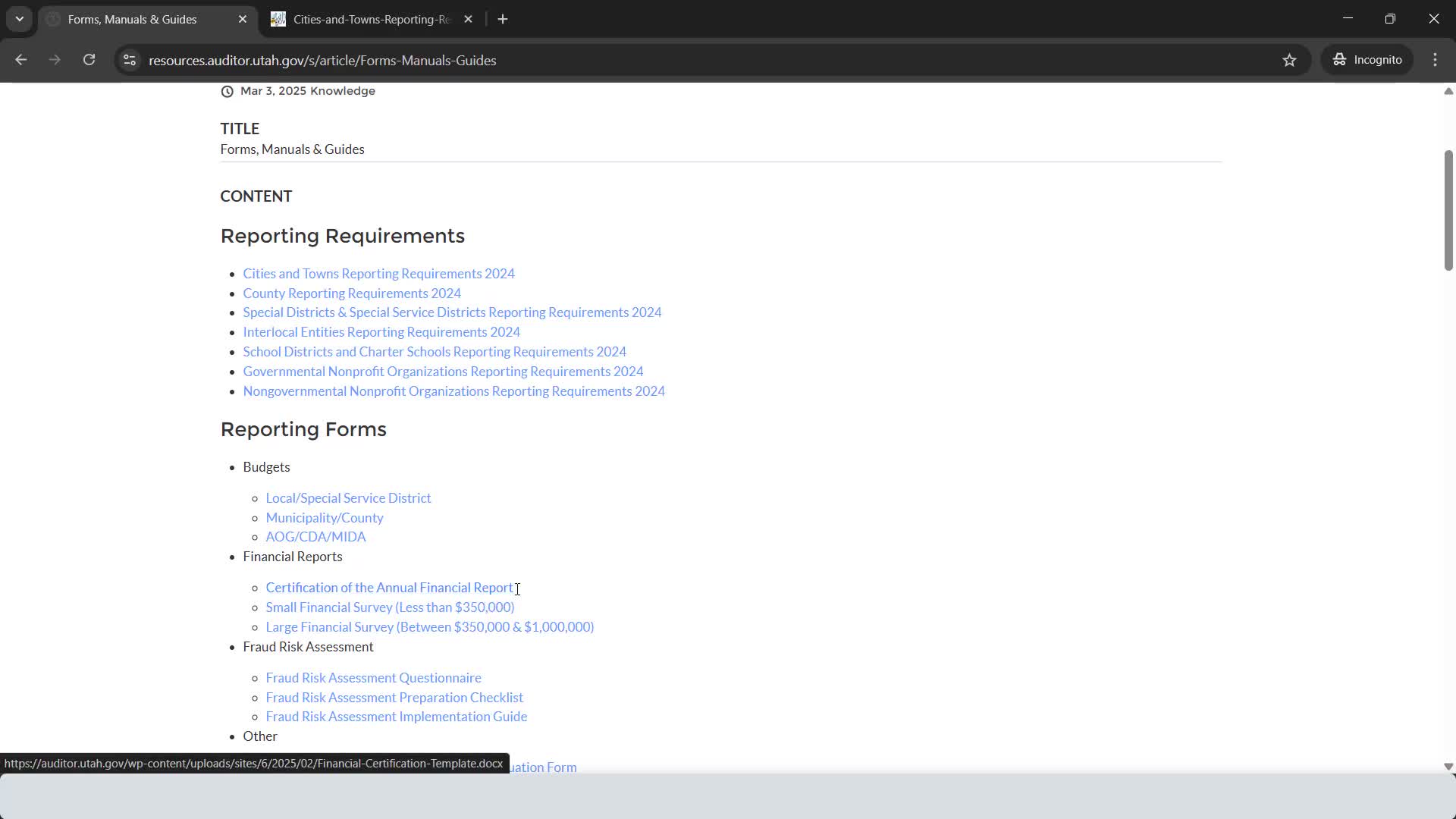
Summary
Utah State Auditor's Office staff reviewed the annual financial certification: the template requires signatures of a chief administrative officer and chief financial officer and conveys a certification that the filer believes the report is correct.
Attendees at the auditor's compliance training were shown the office's financial certification template and told that the printed form requires signatures from both a chief administrative officer and a chief financial officer (or their designees) attesting that the submitted financial report is correct to the signers' best knowledge.
"Everything in yellow, you need to fill in, and then it does require signatures of both the CAO and CFO," the presenter said while showing the certification template. The presenter explained that entities define who serves as CAO and CFO: in some small entities the clerk or treasurer may take one of those roles; in other places it might be a mayor or finance director.
The training included an example in which a newly seated mayor declined to sign the certification because she believed prior financial reports contained fraud; the presenter used that example to emphasize that signers take responsibility for the assertion that the report is accurate. "So if you do sign this, ... the 2 people who have signed this are certifying that the financial report that's been submitted is correct to the best of your knowledge," the presenter said.
Participants asked about making the certification electronic. Staff said recent and pending legislative changes make electronic submission more feasible, but the template and its required language have previously been constrained by office practice. Staff said the document may be converted to an electronic-signature workflow once statutory and template changes are finalized.
Ending: Staff recommended entities be deliberate about who signs the certification, to ensure signers are satisfied with the accuracy of the underlying report, and offered follow-up assistance via the state reporting system and office contacts.