
Committee reviews 2026 police and dispatch budget shifts, uniform and IT costs
Get AI-powered insights, summaries, and transcripts
Subscribe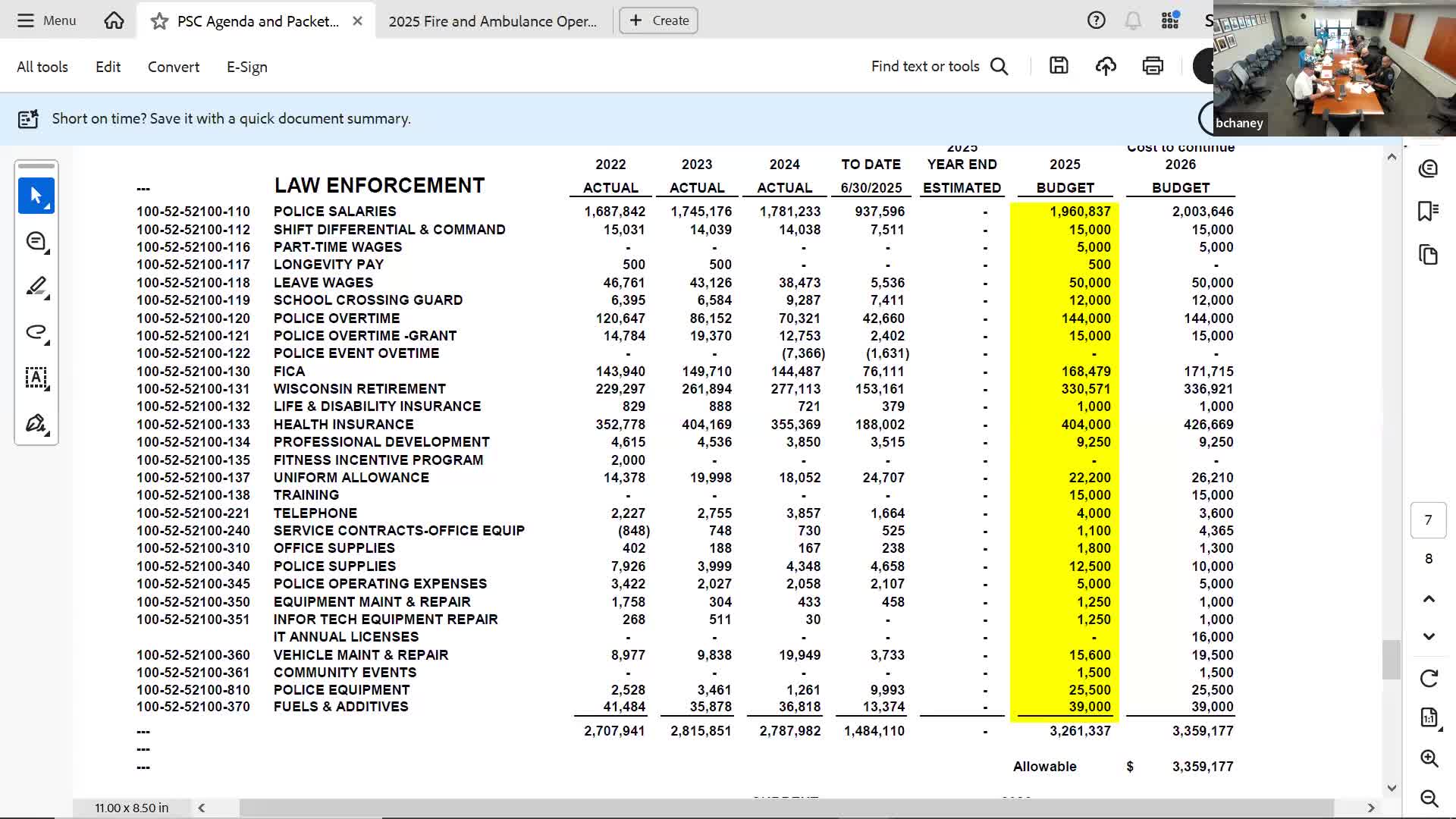
Summary
At the Aug. 27 meeting, the Public Safety Committee heard a first reading of police and emergency communications operating budget proposals for 2026, describing how the department would use a 3% levy-guideline increase and internal reallocations to cover rising uniform, equipment and licensing costs.
At the Aug. 27 meeting, the Public Safety Committee heard a first reading of the police and emergency communications operating budget proposals for 2026, describing how the department would use a 3% levy-guideline increase and internal reallocations to cover rising uniform, equipment and licensing costs. The Police Chief said professional-development funding remains in place alongside $15,000 in referendum training funds, and that the department is shifting more law-enforcement-specific office and equipment costs from the dispatch budget into the police operating budget so dispatch — which has a tighter margin — is not overburdened. “We were using dispatch funding for things that were primarily law enforcement. So we're doing sort of a switch,” the Police Chief said. Why it matters: the proposed reallocations and operating increases affect patrol unit readiness, vehicle maintenance planning and recurring software/licensing costs that will otherwise have been requested as capital expenditures. Key points - Uniform and equipment increases: The police presentation described substantial price increases for uniform items and safety equipment (vests, shirts, pants). The chief said the uniform allowance is being raised from about $22,200 to $26,210 and noted some of that increase is tied to contractual obligations with the department’s labor agreement. - IT licensing reclassification: The finance director and department staff recommended moving the annual software/license cost for in-car video and body-worn camera software from the capital budget to operating, priced in the presentation at roughly $16,000. Staff said the mayor’s forthcoming capital proposal may treat the expense differently, but the operating budget currently includes that amount. - Vehicle maintenance and fleet rotation: The police presentation said vehicle maintenance costs will increase because the department anticipates keeping patrol squads longer than the typical five-year rotation amid citywide efforts to reduce borrowing. Staff said extended retention beyond warranty will raise maintenance costs. - Dispatch and shared services: The presentation described the city’s participation in an intergovernmental records and RMS consortium that provides shared analytics and a crime analyst; staff said adding one suburban partner slightly reduces per-agency cost but warned that expanding membership further could reduce agency control and possibly raise costs. Discussion vs. decision - Discussion only: Committee members discussed uniform allowances, reallocation of dispatch-billed items, vehicle maintenance projections and IT licensing placement. Staff said the changes are intended to keep the department within the 3% guidance while addressing rising costs. - Direction/assignment: Staff and the finance director will continue to coordinate with the mayor’s office on whether the $16,000 license expense remains an operating cost or returns to capital requests during the broader budget process. - Formal action: None on budget approval; the materials were presented for first reading only. Ending: Staff asked the committee to treat the presentation as the first read and said the department will return with final budget documents and any clarifications on dispatch cost allocations.