Get Full Government Meeting Transcripts, Videos, & Alerts Forever!
Get email alerts on the Setbacks Conditional Use Infill topic
No spam. Unsubscribe anytime.
Nampa planning commission approves reduced rear-yard setback at 523 Sunny Lane to allow lot split
Summary
The Nampa Planning and Zoning Commission approved a conditional use permit to reduce the rear-yard setback for a single lot at 523 Sunny Lane, allowing a property boundary adjustment and potential lot split while imposing standard conditions and an appeal period.
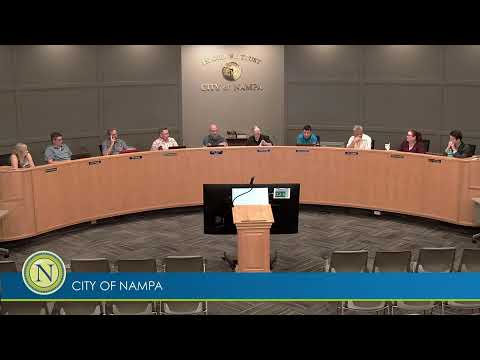
The Nampa Planning and Zoning Commission on Aug. 12 approved a conditional use permit to reduce the rear-yard setback at 523 Sunny Lane, allowing a property boundary adjustment intended to divide the existing parcel and create a second buildable lot. The action followed an applicant presentation, staff findings, a brief public hearing with no public speakers, and an 8-0 vote to approve the permit.
The applicant, Michael Underwood, identified himself as the property owner and described the existing parcel as “0.28 of an acre” and “just over 12,000 square feet.” He said the request was meant to create a more “uniform, consistent layout for the lots” and to retain an existing large tree at the rear of the property. “The intention is not whether I can or can't split the lot,” Underwood said; he added the proposal would provide “a much better buildable space” for the rear lot and allow the tree to remain unimpeded.
City staff recommended approval. Damian Snodgrass, associate planner, told commissioners the parcel is designated medium-density residential on the Nampa comprehensive plan and zoned RS-6; he summarized applicable standards and agency comments and said staff found the proposal met code criteria for a CUP that reduces a single rear-yard setback. Snodgrass summarized agency comments from Nampa Fire District (public access and water-supply notes), the building department (drainage and International Residential Code considerations), and engineering (utility easement and legal-description requirements). He read the proposed conditions of approval, including compliance with city codes and recording any required utility and access easements prior to boundary adjustment.
Commission discussion focused on the scope and permanence of using a CUP for setback reduction, the differences between a CUP and a variance, and whether revocation of a CUP could leave a parcel undevelopable. Rodney Ashley, planning and zoning director, explained those concerns in part: if an approval were later revoked, “they'd have to come in and go through the process again” to reestablish entitlement for development. Commissioners also discussed that the code specifically allows this single-rear-setback reduction to proceed through the conditional-use route rather than requiring a variance.
A commissioner noted preservation of the large rear tree as an objective; Underwood said the new dwelling “would naturally sit in the back right corner” so “the tree can remain unimpeded.” The commission voted to approve the CUP with the staff-recommended conditions and findings; the motion passed with all voting members present in favor. The written decision and reasons will be provided to the applicant, and the CUP becomes effective 15 calendar days after that delivery unless an appeal is filed with the planning and zoning department. The applicant must confirm with staff whether any appeals were filed before taking action on the CUP.
Discussion vs. decision: Commissioners debated policy and procedural questions (discussion only); staff were directed to ensure the condition language and easement descriptions are recorded as required (direction/assignment); and the commission issued a formal approval subject to the written decision and standard conditions (formal action).