Get Full Government Meeting Transcripts, Videos, & Alerts Forever!
Get email alerts on the Taxes And Budget topic
No spam. Unsubscribe anytime.
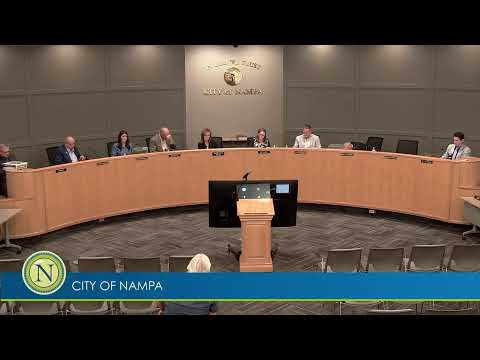
Nampa council rejects levy override to cover Ford Idaho Center shortfalls
Summary
After a three-hour public discussion, the Nampa City Council voted unanimously to deny placing a property-tax levy override on the November ballot to address deferred maintenance and operating shortfalls at the Ford Idaho Center, while directing staff to continue exploring other funding and transfer options.
The Nampa City Council voted unanimously Monday to deny putting a property-tax levy override on the November ballot to address deferred maintenance and operating shortfalls at the Ford Idaho Center. The action follows hours of public comment and more than an hour of council debate over whether to ask voters to fund repairs and ongoing operations.
Council and staff framed the options: council legal counsel reviewed Idaho law for levy overrides, and the city’s CFO presented sample tax calculations for different levy amounts. A levy override could be placed on the ballot as a temporary two‑year measure, which requires a simple majority (50% plus one), or as a permanent measure that would trigger a higher approval threshold (60%) depending on the levy rate. Legal counsel reminded the council that Idaho code requires a stated purpose for any override and identified an August 29 filing deadline for resolutions related to a November election.
Why it matters: The Ford Idaho Center is a large city-owned venue the council says needs substantial capital work and operational support. Council members and the public expressed strong attachment to the venue but differed on who should pay for repairs and how large a tax increase the community can bear. Staff said legislative changes to state tax law (cited as House Bill 389 and House Bill 673) reduced the city’s expected revenue growth by roughly $5.8 million over recent years, bringing the funding gap into sharper relief.
Legal and financial briefing: City legal counsel (Preston) gave a procedural overview of levy overrides under Idaho code, saying the council must narrow and state the purpose of any levy because that language is binding. CFO Doug Racine provided a tabletop example of taxpayer impact: “If we were to select a $1,000,000 override, we can calculate that per $100,000 of taxable home value. That will be $5.99.” He used a $450,000 taxable value (after exemptions) to illustrate that a $1,000,000 override would cost that homeowner about $26.96 per year; the numbers scale linearly for larger measures.
Council debate: Councilman Reynolds argued a small, two‑year levy would not raise enough to do the needed work and said, “We need $10,000,000 at the minimum and probably, you know, more like 15,000,000 to get us out of the gate.” Councilman Griffin said he would not support a permanent levy and favored a temporary measure if the council moved forward: “I would not be supportive of a vote for any kind of permanent levy.” Other council members raised alternatives including fee increases on tickets and other user charges at the Ford Idaho Center, additional sponsorship or partnership arrangements with third parties (discussed: OVG/Live Nation proposals), reallocating existing general‑fund priorities, and exploration of the local auditorium district and other revenue sources.
Public reaction and equity concerns: Several public commenters and council members noted the burden a property‑tax increase would place on fixed‑income residents. Councilmembers repeatedly framed the levy question as allowing voters to decide whether to fund the facility: if placed on the ballot, “the voters have the final say,” one councilmember said during debate.
Decision and next steps: Councilman Reynolds moved to deny placing a levy override on the November ballot; the motion carried unanimously. The council also directed staff to continue discussions about other options, including further study of a potential conveyance or lease arrangement for the Ford Idaho Center (for example discussions mentioned with the College of Western Idaho and private operators), and to return to council with refined proposals in September. The council left open further administrative steps but concluded the levy route would not go forward for November.
Ending: Council members said they would continue analyzing capital priorities, fee changes, partnership proposals and the possibility of a transfer to reduce the city’s financial exposure while protecting the facility’s use.