
Ceremonial signing in Oklahoma advances bills on gender-related conduct, prison residency, gun-industry protections, commercial-driver language and foster care
Get AI-powered insights, summaries, and transcripts
Subscribe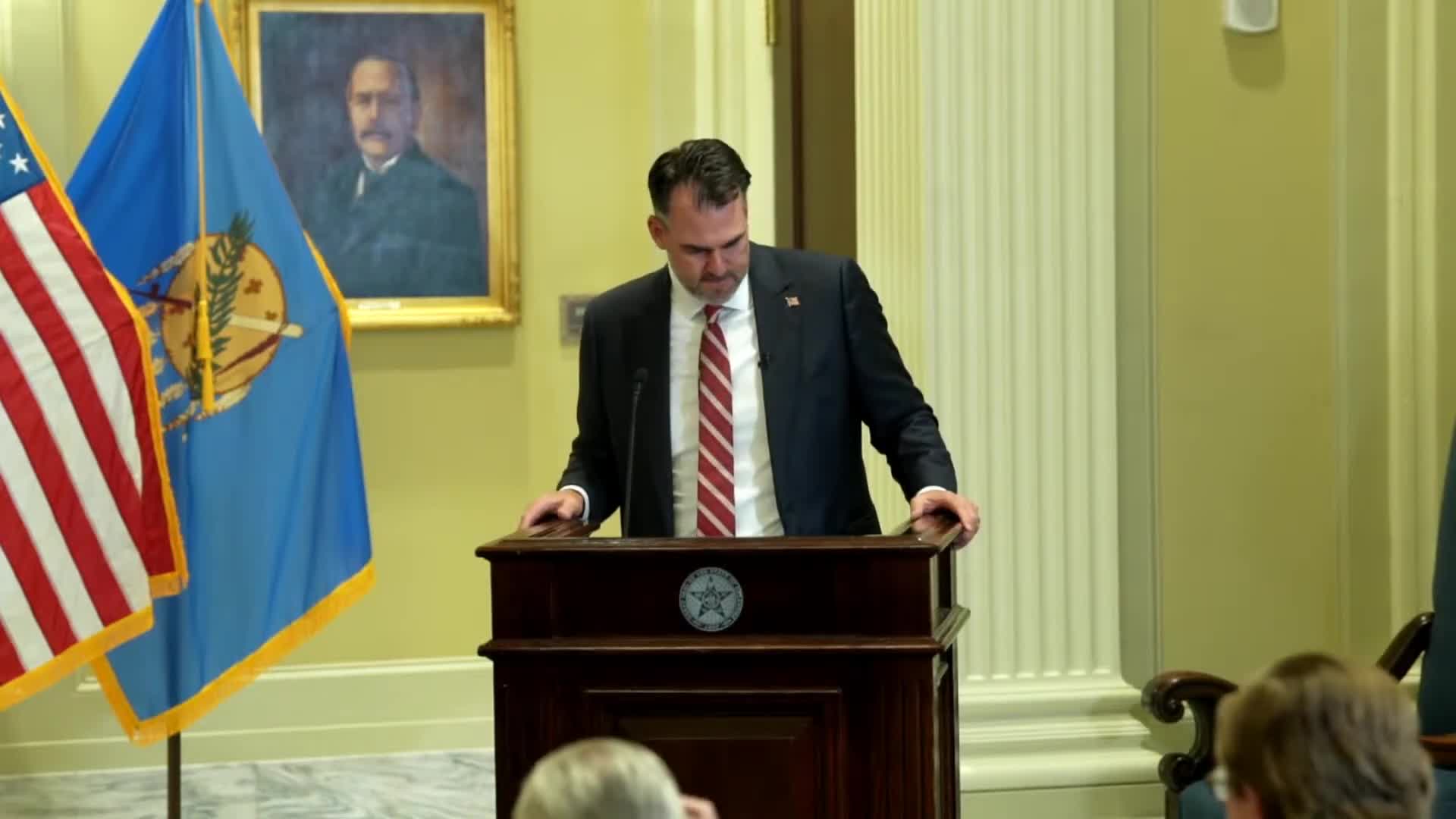
Summary
An official at a ceremonial bill-signing event in Oklahoma said they signed multiple bills aimed at restricting certain public performances, defining prison residency by sex, shielding the gun industry from financial discrimination, requiring English-language ability for commercial drivers, and promoting foster-family protections.
An official at a ceremonial bill-signing event in Oklahoma said they signed multiple bills aimed at restricting certain public performances, defining prison residency by sex, shielding the gun industry from financial discrimination, requiring English-language ability for commercial drivers, and promoting foster-family protections.
The official described the measures as reflecting Oklahoma values and emphasized economic growth in the state, saying the state finished the fiscal year about $250,000,000 above revenue estimates and that “when you look at our 5%, we only spend 95% of our revenue,” which the official said resulted in “another 750,000,000 that went in.”
The official identified several bills by name during the ceremony and summarized each briefly. The official said, “I—m proud to sign legislation, house bill 12 17,” which the official described as protecting “our kids from radical gender ideology, obscene performances” in public places where children are present and added, “we're not gonna allow that to be done in public places where kids are present.” The official characterized the measure as “pretty common sense.”
On corrections policy, the official said, “senate bill 4 18 ensures that only biological women will reside in women—s prisons,” framing the bill as protecting women—s spaces. On public safety policy the official described “senate bill 20” as a requirement that people driving with commercial driver—s licenses must be able to read and speak English, saying, “we want our roads safe.”
The official also described “senate bill 500” as protecting the Oklahoma gun industry from what the official called “political discrimination” by banks. The official cited a contemporaneous federal action, saying, “President Trump also just signed an EO on this exact same matter,” and announced an industrial investment the official said was attracted to the state: “we landed CBC… they—re gonna be spending about $350,000,000.” The official added that the company “also own[s] Taurus” and “they're 25% owner of Colt.”
The official said two bills “house bill 26 10 and senate bill 6 58” protect and promote foster families and said the measures aim to prevent discrimination against faith-based families seeking to foster children. The official urged Oklahomans to consider fostering and thanked lawmakers for advancing the bills.
Toward the end of the signing the official named another item that had not been mentioned earlier: “hospital pricing transparency,” noting the omission from the earlier remarks and acknowledging a legislator who could not attend, saying, “Cynthia Bishop says hello. Sorry. She couldn't be here.”
The event was ceremonial and consisted of the signing remarks and passing pens to attendees; the transcript contains no roll-call votes or legislative debate details. The transcript records the official—s statements and several brief, informal exchanges with attendees and named individuals during the signing.
What was enacted at the ceremony is reported here based on the official—s statements in the event; the article does not infer legislative intent beyond the official—s descriptions or add information about bill text, effective dates, or implementation steps that were not stated at the event.