
Corcoran council asks consultant to include fire-service analysis in civic campus space-needs study
Get AI-powered insights, summaries, and transcripts
Subscribe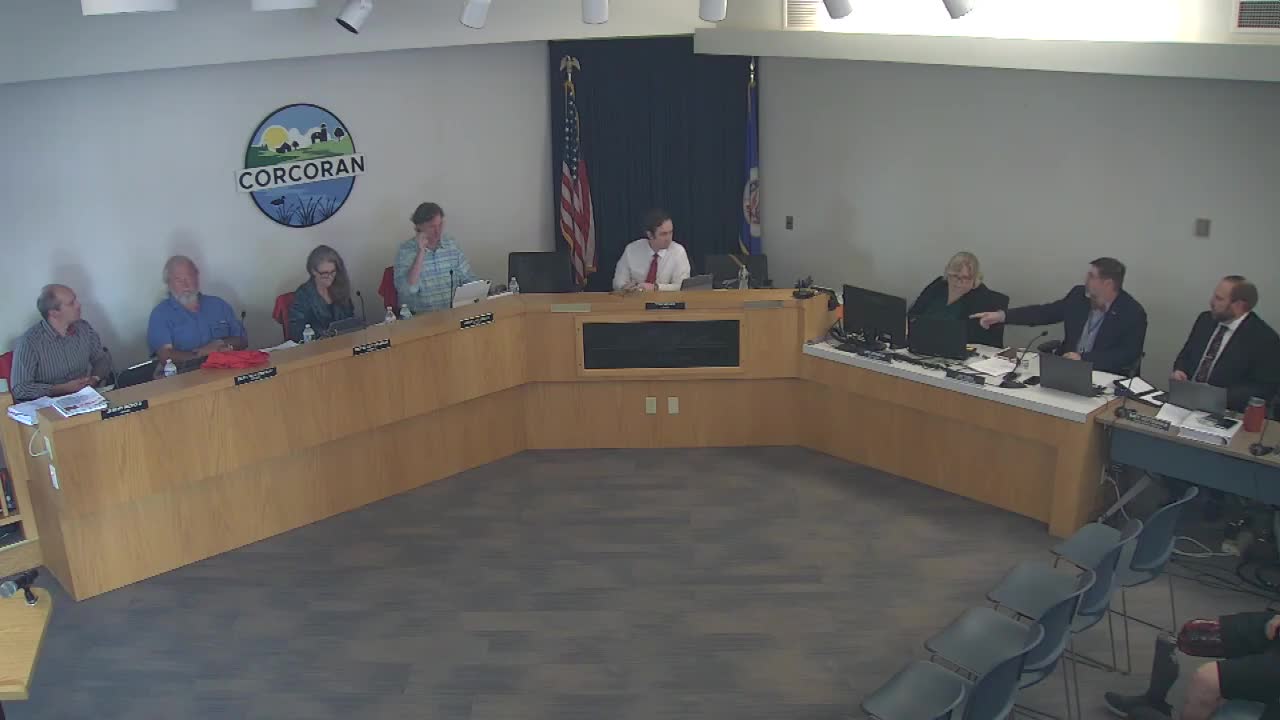
Summary
Corcoran City Council members on Tuesday instructed staff to include a fire-service component in the city's space-needs (civic campus) study and invited the three contracted fire departments to participate in data collection and planning.
Corcoran City Council members on Tuesday directed staff to include a fire-service component in the city's ongoing space-needs (civic campus) study and invited the city's three contracted fire departments to participate in the consultant-led analysis.
The council's decision follows a review of a 2018 ESCI fire-service study and a 2019 subcommittee report that validated many of ESCI's findings, including an identified response-time “gap” in the city's central-east area. City staff told the council the consultant under contract will evaluate five candidate properties, estimate space and cost needs, and deliver a draft in October with public engagement to follow through mid-2026.
Why it matters: The ESCI report recommended constructing a staffed fire station within roughly two years of its June 2018 findings; city staff and the subcommittee concluded growth has occurred faster than ESCI projected and that delaying a response could raise costs and complicate partnership options. The analysis will aim to show whether and how a new facility — or alternative tactics such as duty crews or other partner arrangements — would address the identified service gap and meet the city's response-time goals.
City staff and council members emphasized that the inclusion is a needs assessment, not a commitment to build or to change service contracts. A city staff member told the council, “there is at this time no desire or intention for Corcoran to have its own fire department,” and added that the study is meant to identify space and operational requirements so elected officials can decide next steps.
What the study will cover and timeline - Scope: The consultant will gather current response and demand data, estimate square footage and program needs (dormitories for duty crews, apparatus bays, administrative space, public-works storage, etc.), and produce cost estimates tied to those program elements. Staff said the contractor plans to deliver results by October; Phase 2 engagement with residents and other stakeholders is expected in 2026. - Candidate sites: Staff identified five properties for the space-needs analysis, including the existing city building, the old Cane Road building, two city-owned parcels near Upland and one larger northern parcel adjacent to the planned park (the Rockford Schools parcel). Staff said two of the five would materially affect the feasibility of addressing the central-east service gap. - Partners: The three contracted departments — West Suburban, Hanover and Rogers — were invited to participate in the consultant meetings and data collection. Chiefs from those departments joined the council meeting to describe operational constraints and to confirm interest in working with the city on the study.
Background and policy context - ESCI study (June 2018): A national consultant concluded in 2018 that, applying a standard station-deployment matrix, Corcoran would need a permanent staffed station to sustain target (80th-percentile) response performance; ESCI suggested a roughly two-year timeframe based on then-projections. - Subcommittee (December 12, 2019): A council-appointed subcommittee of two council members and the three contracted chiefs reviewed ESCI's findings, validated many recommendations, and recommended integrating facility planning into civic campus planning. The council adopted a work plan reflecting those recommendations in 2021. - City finances and timing: Staff noted the city's long-term financial plan currently includes a $50 million placeholder in the 2027 window for a major civic project; staff emphasized the study is intended to clarify needs before funding or siting decisions are made.
Operational issues raised by council and chiefs Councilors and chiefs stressed several immediate operational concerns that the study and follow-up work will need to address: - Growth and demand: City staff said population and development have grown faster than ESCI anticipated; staff cited projected population figures in ESCI (about 8,900 by 2030) and noted Corcoran had reached roughly 9,000 residents by 2025 — a signal that demand may have outpaced earlier projections. - Call volume: Staff said Corcoran’s combined 2024 call volume places the city in the top quartile of Minnesota jurisdictions by calls-per-community, indicating a high load on partner departments. - Emergency medical services (EMS): Council members and chiefs described ambulance response gaps and lengthy transport waits in some incidents, and said those gaps are increasing strain on fire and police resources because first responders may remain on scene while waiting for transport. - Staffing and volunteers: Chiefs noted volunteer recruitment and retention are strained regionally; volunteers in some departments reported averaging roughly 12–15 hours per week on duty, and training pipelines can take many months. Council members discussed duty-crew models as an operational alternative to new construction. - Cost inflation: Councilors highlighted rapidly rising capital costs; staff noted an example that earlier station estimates in the mid-2010s were in the low millions, while recent new regional facilities have come in at tens of millions.
Council direction and near-term steps Council members expressed a shared interest in moving forward with the space-needs contractor including a fire-service component, while stopping short of committing to a site, funding source, or new municipal fire department. Staff summarized the informal council guidance as: include fire-service needs in the consultant's scope, coordinate scheduling so fire chiefs can participate, and return to council with the consultant’s October deliverable and a public engagement plan for 2026.
The council also asked staff to reach out to neighboring jurisdictions (including Maple Grove) to test interest in collaboration or to learn how their ongoing studies may align with Corcoran’s planning; staff said they would report back on those outreach efforts.
What the council did not do The council did not adopt any ordinance, enter into new contracts, set a construction timetable, or vote on financing during the meeting. No formal motion to build or to change provider contracts was made; the action taken was direction to include fire-service analysis in the consultant's scope and to convene partner chiefs for data collection.
Next steps and public engagement Staff said they will provide the council and partner chiefs a detailed consultant schedule (to be shared with chiefs next week), aim to deliver a draft analysis in October and then begin a public engagement phase in 2026 to refine priorities and funding approaches. The city will present the consultant findings and recommended next steps to the council for decisions on siting, scope and funding.
Ending Council members thanked the volunteer and career firefighters who attend and urged clear, transparent communication with residents while the study proceeds. No further council business was taken at the meeting; the council adjourned following the discussion.