Get Full Government Meeting Transcripts, Videos, & Alerts Forever!
Get email alerts on the Education Wasda General Assembly topic
No spam. Unsubscribe anytime.
Kennewick board sets preliminary WASDA votes, debates levy protections, mental‑health language and hiring a lobbyist
Summary
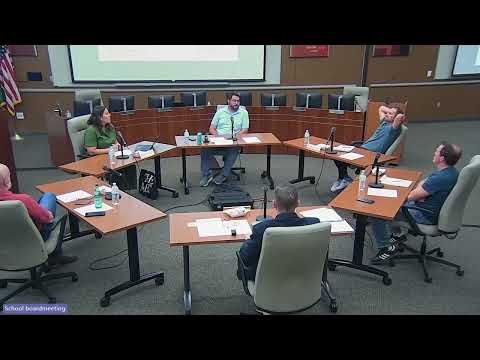
At a study session, the Kennewick School District Board of Directors reviewed proposals for the Washington State School Directors Association General Assembly and recorded preliminary positions on many items while asking staff for follow‑up on complex funding and advocacy issues.
At a study session, the Kennewick School District Board of Directors reviewed proposals for the Washington State School Directors Association General Assembly and recorded preliminary positions on many items while asking staff for follow‑up on complex funding and advocacy issues.
The review matters because the board’s positions will guide the votes cast at the statewide WASDA meeting and shape what the statewide association lobbies the Legislature to pursue, including whether levy authority or budget‑distribution practices should be changed.
Board staff member Britney said the meeting was intended to align district votes with board opinion: “I want to make sure that the votes I enter during the general assembly are reflective of our board opinion.” Board members then worked through 28 proposals, stating preliminary yes/no positions or asking for more education on several items.
The board debated a proposed WASDA bylaw amendment (Article 14) to lengthen the submission deadline for proposals from 90 days to 180 days before the General Assembly. Several board members questioned whether doubling the lead time would prevent districts from bringing time‑sensitive resolutions later in the year; others said the change could allow more time for district review. The board discussed a possible middle ground (for example, a 120‑day deadline) but did not adopt a formal amendment at the study session.
Funding stability and levy authority drew extended discussion. Board members described the policy concern as protecting districts from sudden funding “cliffs” if assessed values or enrollment drop sharply mid‑year. One staff speaker explained the idea as using averaging to avoid abrupt drops in levy authority that could leave districts unable to meet contractual obligations; participants gave the concept tentative support while noting it would not guarantee unchanged total funding.
The board also debated the timing of state apportionment or levy distributions. Several members said it would be more useful for districts to receive a larger share of funds earlier in the school year rather than concentrated at the end, and they favored up‑front distributions with a year‑end true‑up rather than late withholding.
Members discussed several proposals that would consolidate multiple categorical positions (for example, combining separate categorical statements for pre‑K, bilingual education, mental‑health services, and substance‑abuse prevention into single, broader positions). Some board members expressed concern that lumping discrete categories together could make it harder to track line‑item funding and to lobby for specific programs; others said consolidation could simplify positions without changing reporting requirements. On the separate but related proposal to consolidate statements on student mental health and suicide prevention, several board members said they support mental‑health services in principle but warned against state mandates that would require services without secure funding.
On specific recorded positions the board stated during the session (preliminary and subject to change): proposal 2 — yes; 3 — yes; 4 — yes after discussion; 6 — yes; 7 — yes; 9 — yes; 10 — yes; 11 — yes; 12 — yes; 13 — yes with some board members noting an amendment (13a) that would distribute apportionment payments evenly through the year prompted hesitation; 14 — yes; 16 — yes; 17 — yes; 18 — no; 22 — no; 24 — yes; 25 and 25a — yes; 26 — no; 27 — yes. Several other items (notably proposal 8 and parts of 15 and 13a) were left for additional clarification or education before a final position is recorded.
Board members also discussed whether the district should hire its own lobbyist or join a shared lobbyist with neighboring districts (Richland, Pasco were discussed as examples). A staff member offered to research options and bring proposals back to the board, including solo hires, shared arrangements, likely costs, and potential tradeoffs. The board asked staff to return recommendations and to identify partners and estimated costs so members could consider whether to pursue dedicated lobbying capacity beyond WASDA advocacy.
Administratively, staff said the WASDA packet for this year contains 28 proposals (down from 47 the previous year) and reminded the board that only districts in attendance vote — for example, there are 95 districts statewide but only a subset typically votes in person. Staff also noted they had consolidated internal cabinet objectives from roughly 71 items to about 31 to make objectives more actionable; those objectives and proposed board priorities will be presented at the board’s Sept. 24 meeting for further review.
Next steps: staff will prepare a follow‑up briefing that (1) identifies outstanding technical questions about specific WASDA proposals, (2) lays out options and costs for hiring or sharing a lobbyist, and (3) clarifies funding‑distribution models the board discussed. The study session concluded with the board set to reconvene for a business session at 5:30 p.m.