
State water plan team holds Southeast Utah listening session, outlines drought, monitoring and ag programs
Get AI-powered insights, summaries, and transcripts
Subscribe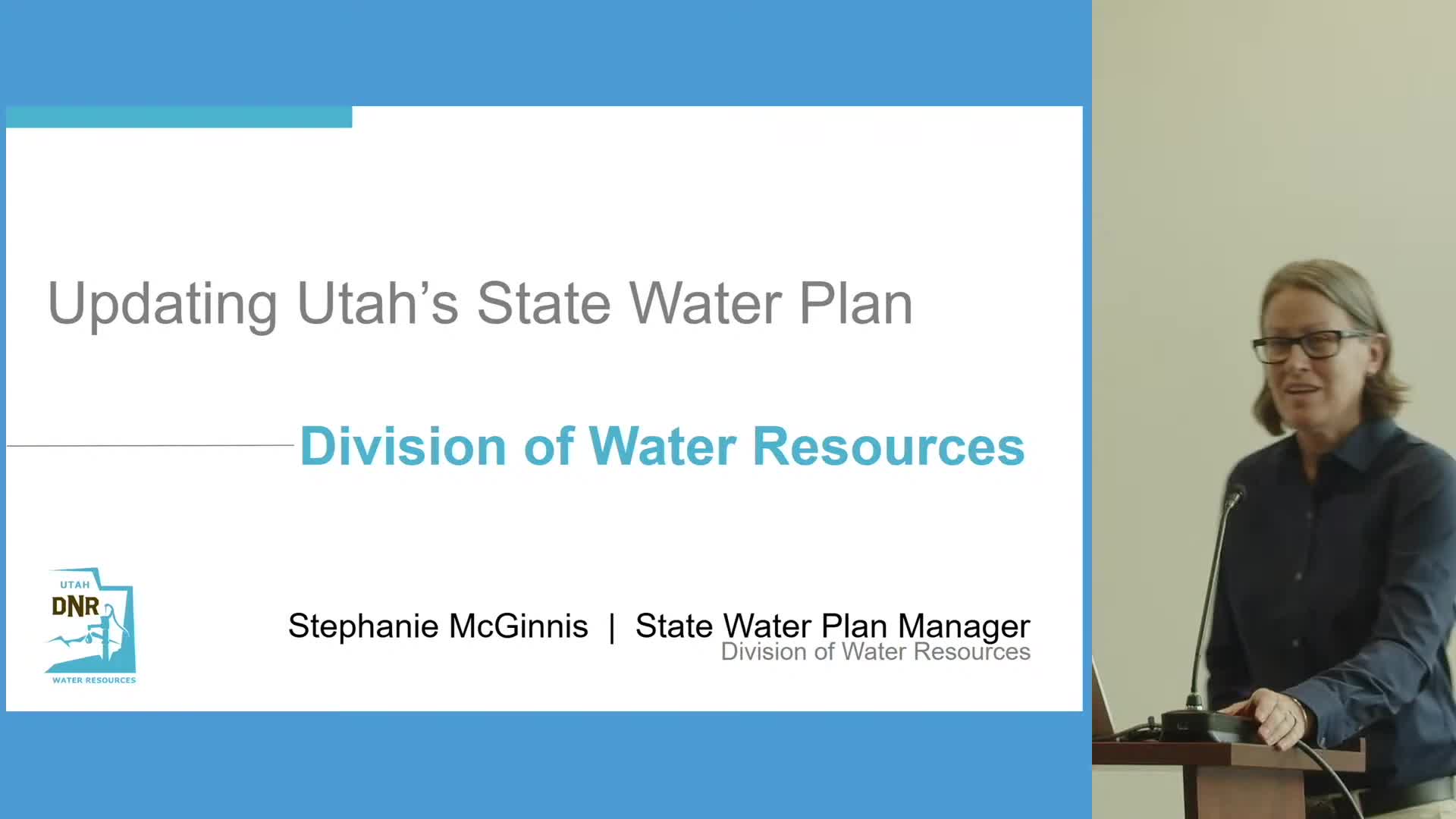
Summary
Stephanie McGinnis, state water plan manager for the Utah Division of Water Resources, presented an update on the agency’s next State Water Plan at a public “water talk” held at The Hideout in Southeastern Utah and hosted with the Southeastern Utah Watershed Council.
Stephanie McGinnis, state water plan manager for the Utah Division of Water Resources, presented an update on the agency’s next State Water Plan at a public “water talk” held at The Hideout in Southeastern Utah and hosted with the Southeastern Utah Watershed Council. The session was a presentation followed by about an hour of public listening and feedback; McGinnis said the team will use local input to inform a draft that will be opened for formal public comment next summer and published in December 2026.
Why it matters: Utah faces recurring drought, shifting long‑term weather patterns and declining storage in the Colorado River Basin that affect municipal water, irrigation, recreation and ecosystems. McGinnis told the audience the plan is intended as “a strategic framework to support informed decision making by those who are shaping, managing, or depending on Utah's water resources,” and she urged local residents to provide feedback through an online survey and watershed council meetings.
McGinnis opened by describing the plan’s purpose and scope: the document will cover nine chapters, including chapters on the state’s water constraints (supply and uses), drivers of change such as climate and population, and how water is administered at state, regional and local levels. She said chapters 5–7 will address watershed health, community water infrastructure and productive agriculture, and the plan will include basin‑level sections for each of Utah’s 11 basins.
On drought and storage, McGinnis cited several data points presented during the talk: a U.S. Drought Monitor analysis showing Utah experienced drought conditions roughly 40–50% of weeks between 2000 and 2019; Lake Powell levels that she noted were at about 29% of full pool at the time of the presentation; and record low levels at the Great Salt Lake. She said those trends make planning and adaptation important for both supply and demand management.
The presentation highlighted monitoring and technical tools that the Division is using or evaluating. McGinnis described the Airborne Snow Observatory (ASO), which conducts aerial surveys to measure snow depth and snow water equivalent (the amount of water contained in the snowpack), and contrasted ASO’s basin‑scale measurements with point measurements from the existing SNOTEL (snow telemetry) network. She said the division is participating in a multiyear pilot study to evaluate whether ASO can improve spring runoff forecasting.
On water administration and coordination, McGinnis said the plan will summarize roles across state agencies, local irrigation companies and other entities, and will note key legal and administrative constraints such as interstate compacts, relevant court decrees and federally reserved water rights (including tribal rights). She also discussed the state’s Unified Water Infrastructure Plan (UWIP) as an innovation intended to improve coordination and funding for water infrastructure projects.
Agriculture and funding: McGinnis described the Agriculture Water Optimization Program, which provides competitive grants for modernizing agricultural water systems. She said funding in that program is divided primarily into two categories—on‑farm projects and canal/irrigation company projects—to address efficiency at multiple scales. The presentation also referenced voluntary conservation programs administered by the Utah Department of Agriculture and Food (UDAF), conservation easements to protect agricultural land and habitat, and incentive‑based best management practices (BMPs) for producers.
McGinnis stressed what the plan is not: “I wish it were, but it is not a guarantee of water, and it’s also not a regulatory document,” she said. She added that the division is not a regulatory agency, though recommendations in prior plans have sometimes been adopted and roughly 80% of goals and objectives from the previous plan had been completed, according to her remarks.
Next steps and public engagement: the team will hold similar basin meetings across all 11 basins through late October, spend the winter drafting the plan, and open a public comment period next summer before final publication in December 2026. McGinnis invited attendees to complete a short online survey (she said it would take about five to ten minutes), sign up for email updates via a QR code, or engage with local watershed council meetings. The session included a 20–30 minute presentation followed by a planned one‑hour listening session; no formal actions or votes were taken at the meeting.
The Division introduced staff present to take part in the listening session, including Becca (state water plan specialist), Jack (senior GIS analyst) and Richard (senior engineer); Carly Payne (watershed council coordinator), Michael Sanchez (public information officer) and Paul (meeting facilitator) also were identified at the meeting. Mac McDonald was acknowledged for arranging the venue through the Southeastern Utah Watershed Council.
Public comments and any substantive suggestions offered in the listening session will be recorded, McGinnis said, and used to refine the draft plan. She encouraged local residents, producers and water managers to participate in the scheduled basin meetings, the online survey and the formal public comment period next summer.
No formal decisions, motions or budget approvals were made at this outreach meeting. The presentation and listening session were part of the Division of Water Resources’ statewide engagement to develop the next State Water Plan.