Pennsylvania details RISE PA industrial decarbonization grant program, application deadlines and award structure
Summary
The Pennsylvania Department of Environmental Protection outlined the RISE PA grant program to fund industrial decarbonization projects, describing eligibility, award tracks, bonuses, timelines and evaluation criteria and answering applicant questions during a public webinar.
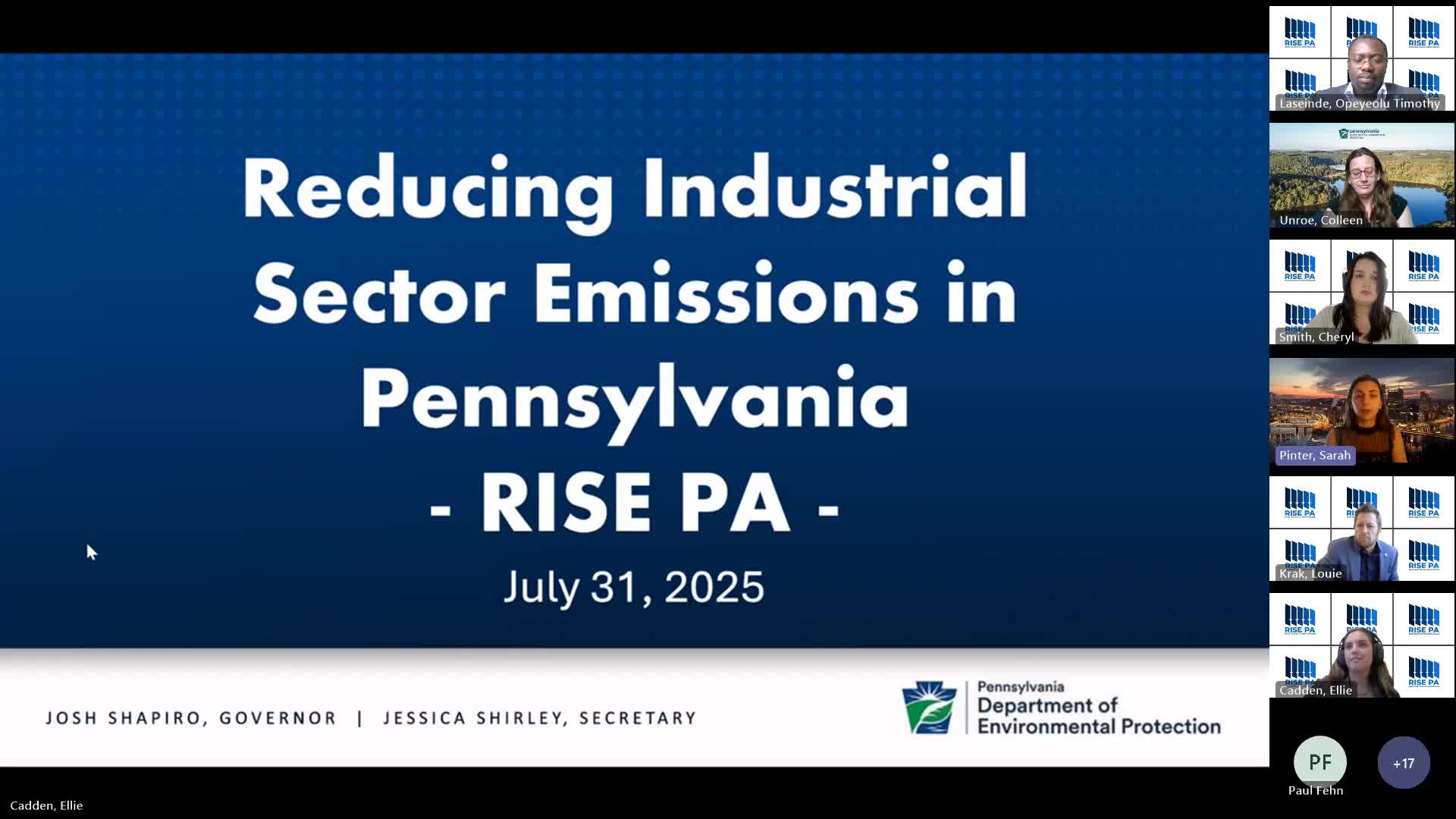
HARRISBURG, Pa. — The Pennsylvania Department of Environmental Protection on a public webinar described RISE PA, a competitive grant program to fund industrial decarbonization projects across the commonwealth and help industrial facilities cut greenhouse gas and co-pollutant emissions.
The program "stands for reducing industrial sector emissions in Pennsylvania," said Ellie Caden, energy program specialist at DEP, who led the presentation. DEP and partner organizations described eligibility, deadlines, award sizes, required cost shares, bonus award opportunities and the application evaluation process.
RISE PA is funded through the U.S. Environmental Protection Agency’s Climate Pollution Reduction Grant program, Caden said. Presentation slides and discussion gave two related figures for total funding: Caden described RISE PA as a "$396,000,000 statewide industrial decarbonization grant program," while program materials presented later in the webinar and the detailed guidance document describe $360,000,000 allocated across the program’s three award tracks.
DEP staff said the program will support a wide range of decarbonization projects, including energy-efficiency upgrades, electrification of process heat, fuel switching, on-site renewables, carbon capture, fugitive-emissions controls and other technologies. "There really is no one size fits all for decarbonizing industry," Caden said.
Tim Lesende, medium- and large-scale award track coordinator at DEP, said the program focuses on emissions from Pennsylvania’s industrial sector, which the department’s greenhouse gas inventory showed at just over 80 million metric tons of carbon dioxide equivalent in 2021. Applicants must demonstrate reductions in scope 1 (direct) and scope 2 (purchased electricity/steam) emissions within the facility boundary they define for the project.
RISE PA’s award structure, as presented, includes three tracks: a small-scale track administered by PennTAP at Penn State, with $40 million available and awards ranging from $25,000 to $500,000 (50% applicant cost share); a medium-scale track with $100 million available and awards from $300,000 to $20 million (70% cost share); and a large-scale track with $220 million available and awards from $20 million to $110 million (70% cost share). DEP staff said projects with total costs above $66,700,000 fall in the large-scale track and those at $1,000,000 or less fall in the small-scale track. The speakers described these figures using the program guidance posted on the RISE PA website.
DEP staff explained bonus award opportunities that can increase grant size and reduce the applicant cost share. The community benefits bonus (up to 10% of total project cost) is available across all tracks for projects with public community benefits plans that identify measurable milestones benefiting low-income or disadvantaged communities. The fair labor bonus (up to 10%) rewards commitments beyond prevailing-wage requirements, such as good-neighbor hiring plans, collective-bargaining or participation in the Commonwealth workforce transformation program; small projects must meet one of these components, medium projects two, and large projects all three to qualify. Medium and large projects may also earn an incremental greenhouse-gas reduction bonus (up to 10%) for reducing facility emissions well above the 20% minimum, with the maximum bonus described for projects that can demonstrate 41% or more reductions.
Eligibility, the presenters said, is determined by facility type and NAICS codes. DEP listed eligible applicants as industrial facility owners or operators, owners/operators of active or abandoned coal mines and of natural gas and oil systems, energy-as-a-service providers, sustainability-as-a-service providers and landlords of industrial facilities when the project is located at an eligible industrial facility.
For medium- and large-scale award tracks, projects must achieve a minimum 20% reduction in combined scope 1 and scope 2 emissions at the facility boundary defined in the application. "You will be responsible for showing a baseline emissions calculation for scope 1 and scope 2," Lesende said. The program guidance and an EPA simplified greenhouse-gas calculator and emissions-factor hub are listed in the guidance document, which DEP staff said applicants should consult for baseline and savings calculations.
DEP staff outlined eligible costs including labor, capital equipment, materials, software that contributes to emissions reduction, construction, retrofitting and tools. Measurement, monitoring and verification expenses are eligible up to 1% of total project cost or $70,000, whichever applies, the presenters said. They also cautioned that costs incurred prior to a fully executed grant agreement may not be reimbursed, although the guidance document notes some costs from Oct. 1, 2024, may be considered for reimbursement.
Deadlines and logistics given on the call: small-scale PennTAP applications for an initial round close Aug. 15 (multiple small-track rounds were described, with subsequent rounds in September–December and in 2026); medium and large-scale applications are due by 11:59 p.m. Aug. 29, 2025. DEP staff said awards for medium and large projects will be announced in the fall and that the department currently anticipates grant awards in December, with performance periods typically 6–24 months and a hard completion/MMV date of April 1, 2029. DEP noted it may consider requests for extensions for complex projects up to three years in limited cases.
On evaluation, Lesende described application review factors that include technical feasibility, greenhouse-gas and co-pollutant reductions, commercial and financial viability, innovation and community benefits. Quality factors include sufficiency of technical detail, risk identification, clarity of roles and responsibilities, team qualifications and baseline metrics and milestones. DEP said it will perform a multi-phase review that includes DEP staff, third-party technical and financial reviewers and an executive committee to finalize awards.
During Q&A, staff directed applicants to the RISE PA guidance document and FAQs on the DEP website and to example applications and budget templates on the PennTAP site. Staff invited applicants to schedule 30-minute calls for project-specific questions and said the FAQ will be updated weekly.
The webinar closed with contact information and an invitation to a future webinar on residential energy assessments. DEP staff encouraged prospective applicants to review the program guidance and reach out with questions.
Ending note: DEP emphasized applicants must not assume reimbursement for all pre-award costs and should follow the guidance for baseline calculations and eligible expenses. Applicants with multiple facilities must submit separate applications for each facility boundary, and the department said geographic diversity across the state is one factor it will consider when selecting awards.