
Bellevue council directs staff to proceed with updated Transportation Facilities Plan and extend horizon to 20 years
Get AI-powered insights, summaries, and transcripts
Subscribe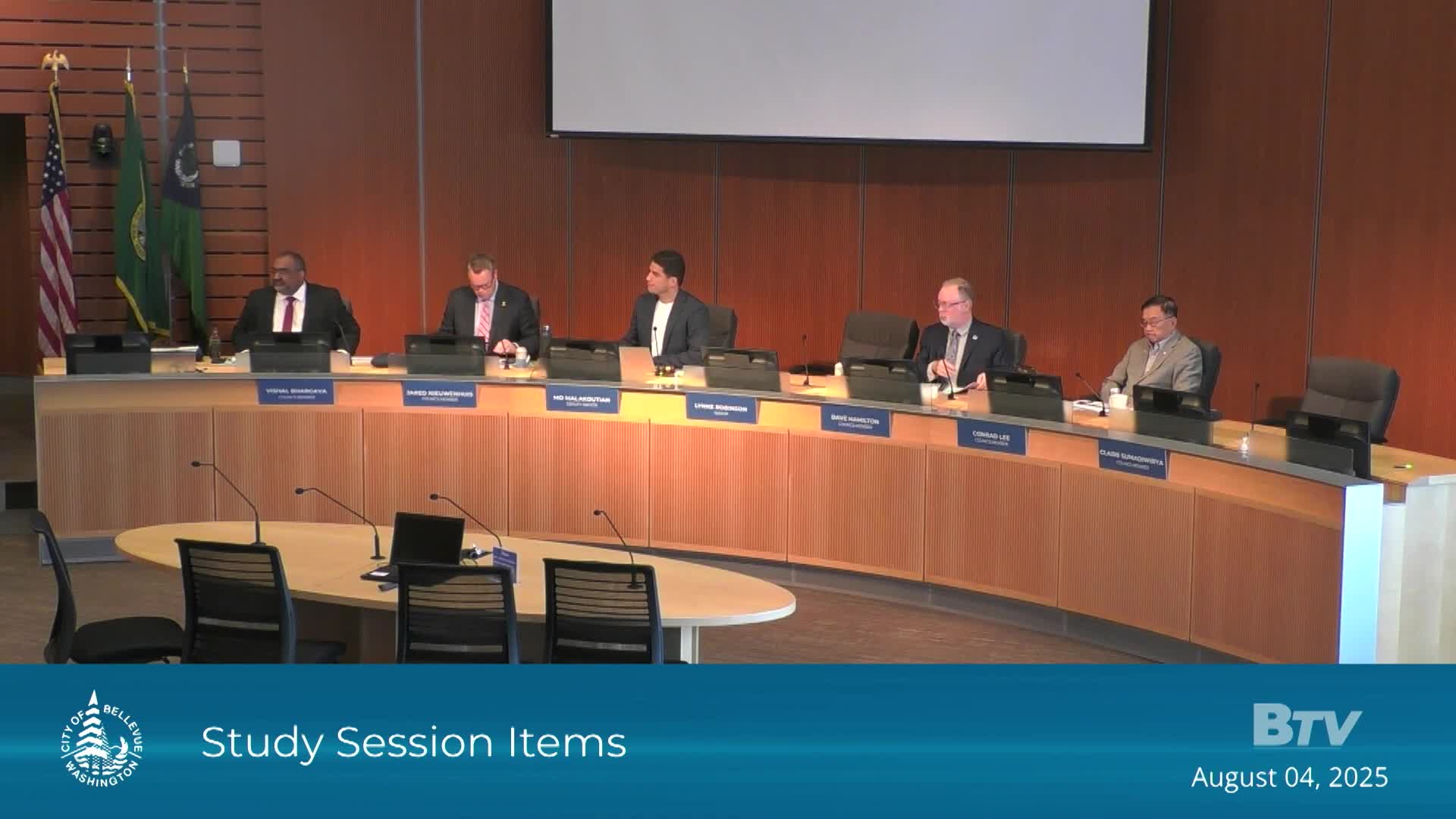
Summary
Bellevue City Council on Tuesday directed staff and the Transportation Commission to proceed with an updated Transportation Facilities Plan, order a SEPA checklist and updated impact-fee report, and prepare a city-code revision to extend the TFP horizon from 12 to 20 years amid constrained revenues.
Bellevue City Council on Tuesday directed the Transportation Commission and city staff to proceed with an updated Transportation Facilities Plan (TFP), including a State Environmental Policy Act (SEPA) checklist and an updated transportation impact-fee program report, and asked staff to prepare a revision to city code to extend the TFPplanning horizon from 12 to 20 years.
The motion, moved by Council member Newenhaus and seconded on the floor, passed by unanimous voice vote after presentations from Transportation Director Andrew Singalakis, Implementation Planning Manager Eric Miller, Chief Financial Officer John Risha and Transportation Commission Vice Chair Drew McGill.
The council and staff framed the 20-year extension as a response to tighter projected revenues that make the adopted 6-year capital improvement program (CIP) and a standard 12-year TFP infeasible without pushing some projects farther into the future. "Part of the reason that we're moving to a 20 year TFP is because we do not have enough projected revenues to accommodate all the projects that are in our current 6 year capital improvement program," Singalakis told the council.
Why it matters: the TFP is Bellevue's fiscally constrained, intermediate-range transportation plan and informs which projects can be included in future CIP budgets and the city's transportation impact-fee program. Keeping projects in the TFP preserves eligibility for city funding and, in some grant programs, is a prerequisite for competitive grant applications.
Key figures and constraints cited by staff - Projected 20-year revenue baseline used in the presentation: about $496 million (staff projection for the 20262045 horizon). (John Risha) - Debt service related to prior bonded and TIFIA-financed projects: roughly $15 million per year for the next 20+ years. (Risha) - Annual maintenance program moved from the CIP into the operating budget representing about $12 million per year. (Singalakis) - Staff conservatively estimated average grant revenue at about $5.6 million per year for the planning horizon due to uncertainty in the grant environment. (Risha) - The commission and staff estimated an approximate $157.5 million shortfall between the adopted CIP and realistically available funding for the six-year CIP window; after accounting for programs and contra lines staff estimated roughly $26.5 million remaining to allocate to non-CIP TFP projects over the extended horizon. (Eric Miller)
What the council asked staff and commission to do - Complete SEPA review (a SEPA checklist and modeling of the recommended project network against the comprehensive-plan horizon-year growth forecast) to identify where gaps will persist and which projects merit priority. (staff presentation) - Produce an updated impact-fee program report to reflect the recommended project list and the longer planning horizon, and return to the council with a proposed revision to city code to adopt the 20-year timeframe. (motion language) - Continue the public and stakeholder engagement and provide follow-up prioritization work (the council and staff discussed contracting a consultant to help consolidate and prioritize the CIP as a portfolio across modes).
Projects and list approach - The Transportation Commission recommended adding seven priority projects to the preliminary TFP list and identifying 37 additional projects as placeholders to be included should funding become available. Most projects on the preliminary list do not yet have specific funding allocations; two downtown projects (TFP-110 and TFP-219 in the staff packet) were called out as being funded in a way that ties them to the impact-fee program. - Commission vice chair Drew McGill described the project-selection process: staff and the Transportation Commission used the Mobility Implementation Plan (MIP) scoring system to score projects within modes (vehicular, pedestrian, bicycle) and then applied additional qualitative factors (extent of prior investment, collaboration opportunities, public comments and council priorities) to build the cross-mode preliminary list.
Council and public concerns recorded in debate - Several council members emphasized that the TFP must be multimodal and that keeping transit- and active-transportation projects on the list is strategically important to preserve eligibility for state and federal grants and to signal local commitment. Council member Bhargava asked staff whether including the Grand Connection (a proposed bicycle/pedestrian crossing of I-405) in the TFP would improve grant competitiveness; CFO Risha said including it in the plan does improve eligibility for some programs. - Multiple public commenters and advocacy organizations urged the council to retain transit-focused projects in the TFP and to prioritize quick-build multimodal safety projects. Complete Streets Bellevue and the Bellevue Mobility Coalition asked staff to keep specific transit speed-and-reliability projects (TFP projects 303through 309 referenced in a coalition letter) on the table. Staff told the council that adding those projects to the TFP would be neutral procedurally but that a transit master plan or targeted studies also could be used to keep those ideas ready for funding. - Council members repeatedly raised the need to examine new or additional revenue sources (for example, levy renewal, transportation benefit district, or other revenue mechanisms) during next year's funding planning cycle and to return with a consolidated, portfolio-based prioritization of CIP programs.
Process and next steps - Staff said they are negotiating a contract with a consultant to develop a portfolio approach to the CIP and to help consolidate program lists so the city can prioritize across vehicle capacity, bicycle, pedestrian and transit programs; staff hoped to have the consultant under contract in the coming weeks and initial work within three to four months. - SEPA modeling and the impact-fee report will follow; staff expect to reconvene with the Transportation Commission and return a final TFP and recommended code amendment to council later this year.
Decisions and motion (formal action) - Motion moved by: Council member Newenhaus. - Motion text (as moved on the floor): "I move to direct the Transportation Commission and staff to proceed with the TFP process, including the SEPA checklist and impact fee program report based on the project list included with the Transportation Commission transmittal memo and prepare a revision to the city code to extend the TFP time frame to 20 years." - Outcome: Passed unanimously by voice vote (all present council members said "aye").
Discussion-only items recorded - Staff characterized the TFP update and SEPA review as informational at this stage; no binding funding decisions were made beyond directing staff to proceed with the planning, modeling, and code revision steps.
Sources and attributions (selected) - Andrew Singalakis, Transportation Director (presentation and overview of TFP purpose and need for 20-year horizon). - Eric Miller, Implementation Planning Manager (presentation on project list, CIP interactions and programmatic assumptions). - John Risha, Chief Financial Officer (revenue forecast, debt-service figures and discussion of the financial waterfall). - Drew McGill, Transportation Commission Vice Chair (explanation of project selection and MIP scoring process). - Public commenters including representatives of Complete Streets Bellevue and Bellevue Mobility Coalition; speakers urged retention of transit and safety projects in the plan.
Ending note: the council's directive keeps a broad suite of projects on the planning table while shifting the citytoward a longer-phase, fiscally constrained implementation schedule; staff will return with technical SEPA results, an updated impact-fee program report and proposed city-code changes for council action later in the year.