
Camarillo council directs staff to work with county foundation on neighbor support fund after ICE raids; no funding approved tonight
Get AI-powered insights, summaries, and transcripts
Subscribe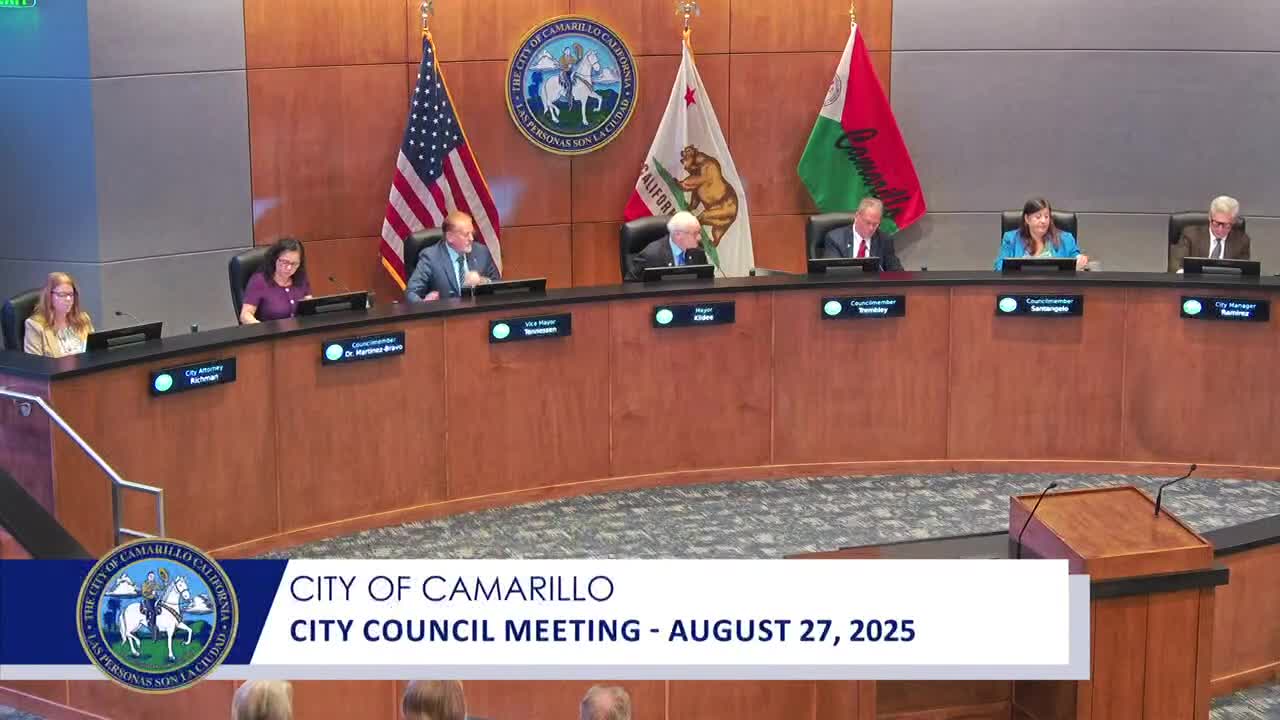
Summary
After hours of public comment about recent immigration enforcement actions, the Camarillo City Council directed the city manager to work with the Ventura County Community Foundation on a possible city contribution to the Ventura County Neighbors Support Fund and return to council with a report; council did not appropriate funds tonight.
The Camarillo City Council on Aug. 27 directed the city manager to work with the Ventura County Community Foundation to return to the council with a proposal for a potential city contribution to the Ventura County Neighbors Support Fund, with an initial negotiating cap of $50,000 and a stated emphasis on mental-health support for minors who live in ZIP codes 93010 and 93012.
The move follows weeks of community protests and local public comment after large-scale immigration enforcement operations in the region. Supporters at the meeting urged the council to provide immediate humanitarian assistance and legal aid; several speakers asked the council to allocate $100,000. Opponents warned of legal and fiscal risks and urged private donations instead.
Carmen Nichols, the city’s assistant city manager, told the council that the Ventura County Neighbors Support Fund is managed by the Ventura County Community Foundation and that ‘‘100% of the funds that have been donated, there is no we take no overhead at VCCF. Everything that comes in goes out,’’ according to Vanessa Bechtel, VCCF president and CEO, who appeared before the council. Bechtel said the fund had already provided cash assistance and other support to families through grants to local nonprofits and that Thousand Oaks had approved a $100,000 contribution the day before.
Public comment lasted more than two hours. Speakers described recent enforcement activity and pleaded for legal services, emergency cash and basic needs. ‘‘We need your support,’’ said Nicole Raden, a Camarillo resident, asking the council to ‘‘allocate $100,000 for humanitarian relief, as well as enter into a common-interest agreement with the ACLU in the Perdomo versus Nome lawsuit.’’ Joseph Dobzynski, an organizer with 805 UndocuFund, asked the city to ‘‘please fund these programs’’ and described families losing breadwinners after the raids.
Other speakers warned about accountability and legal exposure for municipal contributions to nongovernmental organizations. ‘‘I oppose public funds being given to NGOs or special-interest groups mainly because of lack of accountability,’’ said Brenda Shear, a longtime Camarillo resident. City staff and councilmembers repeatedly cited the city’s existing finance policies and the general legal principle that municipal gift-of-funds decisions should benefit the local community and be auditable.
Councilmembers asked the city attorney and finance director for legal guidance. City staff said the city’s policy requires a follow-up agenda item and that the city manager can commit up to $50,000 without further council action; larger appropriations would need a council vote. Councilmember Susan Santangelo proposed a $75,000 contribution; Mayor Kevin Kildee proposed directing the city manager to negotiate details with VCCF not to exceed $50,000 and return to council with a staff report specifying proposed eligibility (prioritizing 93010 and 93012 residents, with emphasis on minors’ mental-health services) and transparency/audit conditions.
Council members signaled support for bringing a formal proposal back for full council consideration rather than approving a grant at the same meeting. The direction to staff is not an appropriation: no funds were transferred or approved tonight. The matter will return to a future council meeting with details on proposed conditions, reporting and whether a special Camarillo-specific advisory process or committee will be used to allocate any city contribution.
Background: the Ventura County Neighbors Support Fund was created by local nonprofits and foundations after recent enforcement actions affecting agricultural workers and families in Ventura County. The county Board of Supervisors considered a $250,000 allocation for a legal defense fund and related measures but did not approve the proposal at its most recent meeting.
If the council approves a future appropriation, staff said they would propose written conditions to ensure contributions are directed to the local residents the council identifies and that the city receives audits or attestations documenting spending.
Details the council asked staff to address on return include: the precise use restrictions (for example, whether funds would be limited to mental-health and emergency basic needs vs. legal-defense services), eligibility rules to prioritize Camarillo ZIP codes 93010 and 93012, reporting and audit steps, and the governance structure for grant decisions. The council also asked staff to clarify whether a Camarillo-specific advisory panel could be used to recommend awards to local nonprofits. Ending: the council did not take a final funding vote and will revisit the matter after staff returns with the requested details and legal analysis.