
Carver County mental‑health advisory committee recommends countywide mental‑health first‑aid training and workforce pipeline
Get AI-powered insights, summaries, and transcripts
Sign Up Free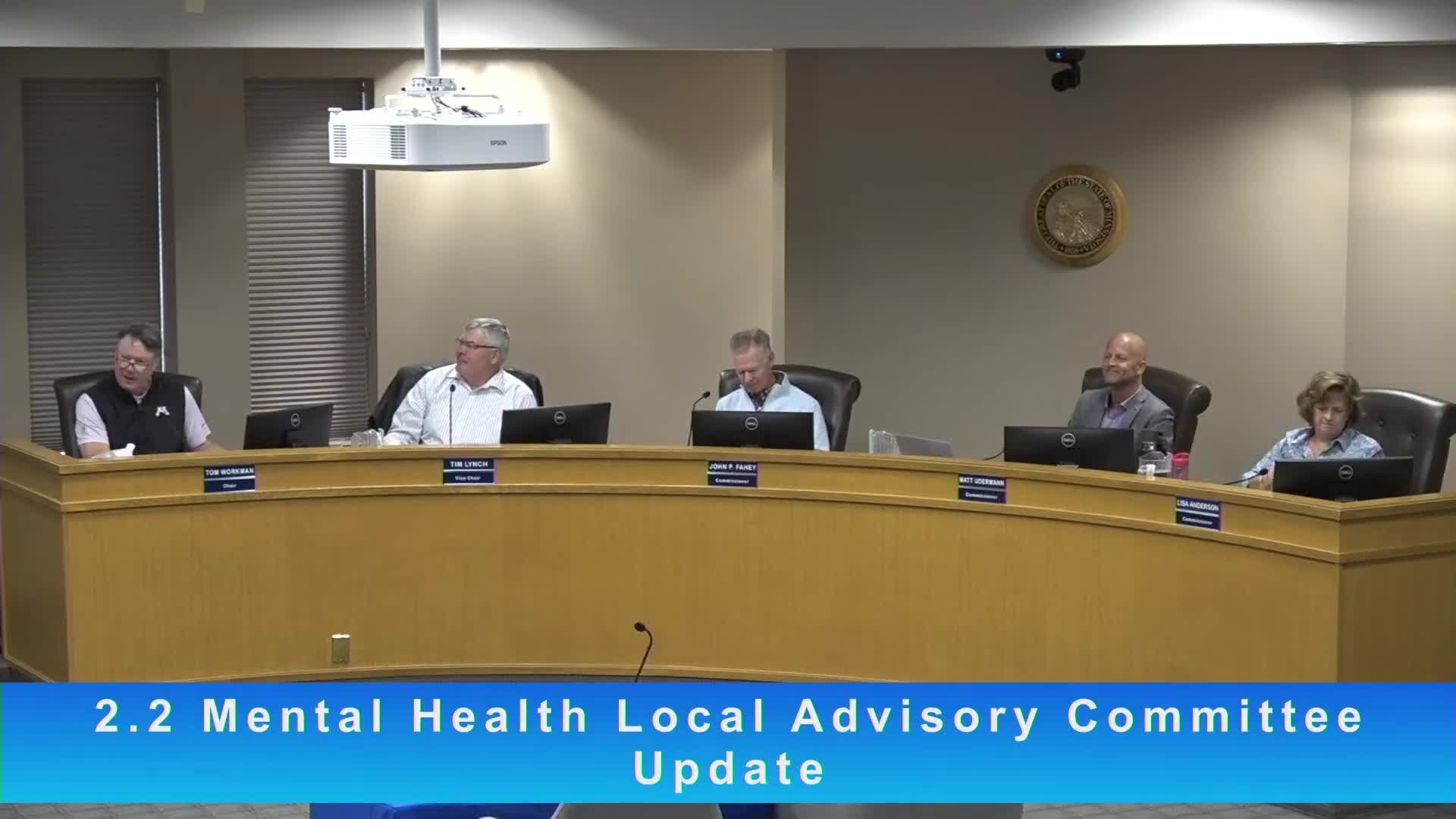
Summary
Kayla Pascoe, chair of the Carver County Mental Health Local Advisory Committee, presented a plan to expand Mental Health First Aid countywide and build a multi‑stage workforce pipeline to address chronic staffing shortages.
Kayla Pascoe, chair of the Carver County Mental Health Local Advisory Committee, presented the committee’s revised approach to the county board, proposing short‑ and long‑term actions to address unmet mental health needs. The committee recommended two near‑term priorities: train 1–2 additional certified Mental Health First Aid instructors to expand public and organizational trainings across the county, and develop patient‑facing materials that explain what happens when a resident calls dispatch for a mental‑health emergency. Pascoe said the first‑aid rollout is meant to reduce avoidable crises and lower costs tied to emergency response by enabling earlier, community‑level intervention. For longer‑term workforce shortages, the committee proposed a laddered pipeline: (1) high‑school “explorer” programs to expose youth to mental‑health careers, (2) paid internships and college trainee programs, (3) a formal clinical trainee (pre‑licensure supervised) position to allow residents to obtain licensure while remaining employed, and (4) postdoctoral fellowship positions to enhance recruitment and retention. The committee noted gaps in local capacity: Carver County struggles to recruit and retain licensed mental‑health professionals and has left positions open for extended periods. Pascoe and county staff also recommended pursuing a satellite clinic in Chaska to reduce travel barriers to care (current services are concentrated in Waconia), exploring residential and adult day‑treatment capacity as a long‑term goal, and reestablishing a NAMI (National Alliance on Mental Illness) county affiliation to expand community training options. Multiple commissioners, including Commissioner Anderson and Commissioner Wooten, voiced support for the committee’s emphasis on practical, implementable steps. Several speakers urged that internships should be paid and that recruiting should be started far in advance of expected hire dates; staff noted that unpaid internships have repeatedly failed to fill. The committee did not request formal budget action at the meeting; it sought board direction and support for implementing the training rollout, workforce pipeline development, and a small set of pilot initiatives that would run over 1–2 years.