
Board reviews Article 6 student policies; class‑size targets, concussion protocols and travel rules draw questions
Get AI-powered insights, summaries, and transcripts
Subscribe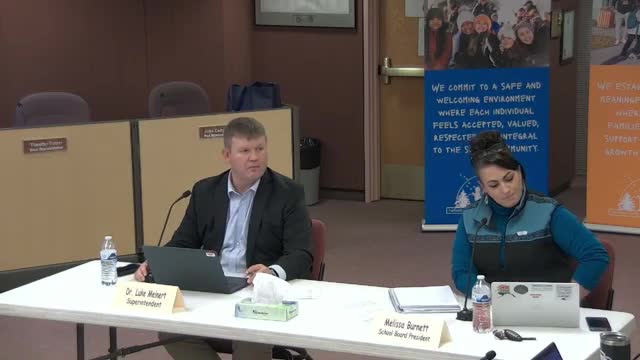
Summary
The Fairbanks North Star Borough School District Board of Education spent about an hour at its Aug. 25 work session reviewing proposed Article 6 policy language covering curriculum, extracurriculars, concussion protocols, class size, travel and credit options; staff were asked to return clarified text.
The Fairbanks North Star Borough School District Board of Education spent about an hour at its Aug. 25 work session reviewing proposed Article 6 policy language covering curriculum development, extracurricular and co‑curricular activities, sportsmanship, concussion protocols, class size, school‑sponsored travel, and several credit‑and‑assessment items. No policies were adopted on the floor; board members asked staff to clarify language and return revised text for consideration.
Student discipline and policy specialist Diana Dillard presented the package and identified where the district had adopted Alaska Association of School Boards (AASB) model language and where it kept or revised local wording. "So where we left off from last time, we'll be starting with policy 6141," Dillard said as the board began the curriculum item.
Several board members pressed for wording changes and cross references to administrative regulations. Mister Doran asked for precision about the phrase "will discuss" for community input on curriculum and suggested either deleting the sentence or replacing it with language that the board "will ensure a process for public participation prior to adopting a district‑wide curriculum." Dillard and other staff agreed to add clarifying language or delete redundancy.
Academic eligibility and extracurriculars: The board reviewed a consolidated extracurricular policy that pulls together nearly 15 prior policies. Dillard told the board the proposed change moves academic eligibility from a rule of "C average and no F's" to language aligned with AASB: "C average, or a C with course requirements," a shift she characterized as a procedural change that would be captured in administrative regulation.
Concussion policy and travel: The district presented a revised concussion policy that staff said follows Alaska School Activities Association (ASAA) protocols and updated administrative regulations. Board members pressed staff to clarify whether students under concussion protocol would be permitted to travel with teams even if they were not cleared to participate; a staff member said return‑to‑play and return‑to‑academics protocols are spelled out in the administrative regulation and that, in practice, students under concussion protocol do not travel with teams. Dillard said she would add an explicit cross‑reference to concussion ARs in the school‑sponsored travel policy as requested.
Class size and HB 57: A prolonged discussion centered on proposed class‑size language tied to House Bill 57. Doctor Meinert told the board "No. We're definitely over, the target limits here," and said the district cannot meet the new statutory targets without increased state funding. Board members quoted the draft targets aloud: "Class size is 26, 29, and 32 for our targets," the superintendent said. Members asked the policy be reworded to reflect statutory intent and the district's constraints, to add reporting or planning language for instances when targets cannot be met, and to consider whether reporting requirements called for by HB 57 should be referenced.
School‑sponsored travel: Staff proposed narrowing the board's travel‑approval role so the board would be required to approve only out‑of‑state travel for all grade levels; under current practice the approval thresholds vary by grade and destination. Mister Doran supported the change and asked staff to rephrase a section that disallows district support for travel organized by non‑district entities, suggesting the board adopt a positive phrasing that clarifies what district‑sponsored travel will receive administrative leave or excused‑absence status.
Alternative credit and reciprocity: The board accepted additions such as work‑experience credit (up to two high‑school elective credits) and asked clarifying edits (for example, adding the word "credits" after "electives" in policy text). Staff explained the purpose of prior approval for outside credit: to prevent students from unknowingly paying for coursework that will not count toward diplomas.
Other items reviewed included policies on religious expression cross‑references, controversial issues policy carried over unchanged, student publications, student organization equal access, reciprocity for graduation requirements, special‑education differential requirements, Alaska Reads Act intervention programs and early education programs. Board members asked staff to move some technical or lengthy statutory lists from policy into administrative regulation where appropriate.
No formal votes were taken on Article 6 during the work session. Staff were directed to return with clarified policy language and cross‑references to administrative regulations, to correct typographical issues flagged by board members, and to draft suggested reporting language for class‑size shortfalls tied to HB 57. The board will resume Article 6 policy review at a later meeting.