Bothell planning commission studies urban-forest update after analysis shows modest canopy decline
Summary
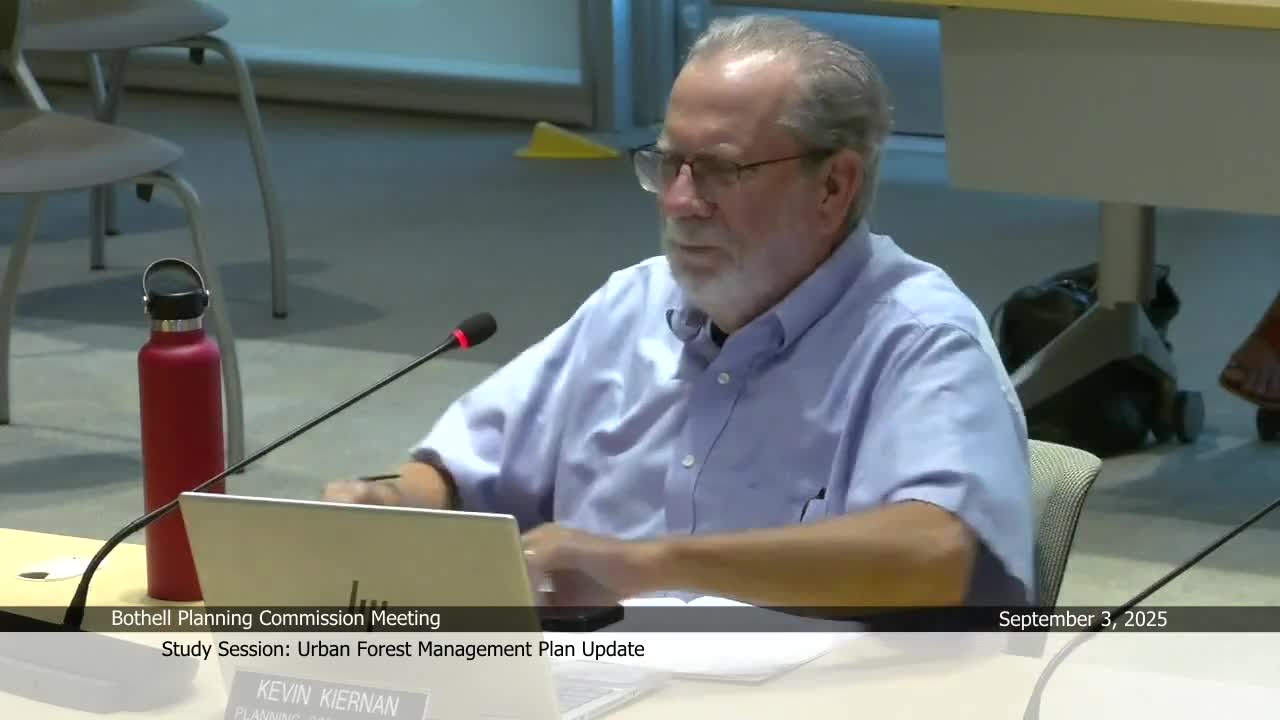
BOTHELL, Wash. — At a Sept. 3 study session, the Bothell Planning Commission heard consultants and city staff review findings from a citywide tree-canopy assessment and discussed possible policy directions to retain and grow the urban forest.
BOTHELL, Wash. — At a Sept. 3 study session, the Bothell Planning Commission heard consultants and city staff review findings from a citywide tree-canopy assessment and discussed possible policy directions to retain and grow the urban forest.
Senior planner Cameron Colvin and Matt Picone, senior landscape architect and project manager with Greenworks (working with consultant Planet Geo), presented analysis showing a modest net canopy loss over the past eight years and stressed that most canopy is on private property. “Bothell street canopy is estimated to be about $12,000,000 a year,” Picone said, citing a preliminary i-Tree analysis used to illustrate the value of tree-related ecosystem services.
Why it matters: the consultants and staff said large, mature trees produce most of the measurable benefits — from stormwater reduction to local cooling — and that those benefits work locally, so distribution matters as much as total coverage. The commission spent the session weighing incentives and regulatory options (heritage-tree protections, revised retention metrics, planting requirements for parking lots and street sections) and asked staff to refine recommendations and return with public engagement materials and a draft plan in October.
Key findings and options - Canopy change and ownership: Planet Geo’s analysis framed to the city boundary and urban growth boundary estimated current canopy at about 41% (within the project boundary) and a net decrease of roughly 1.4% over the last eight years, with most loss occurring on private property. Picone summarized planting and recovery potential as: public lands could yield about 1.3% canopy growth, street trees about 1.8%, and conserved public/private lands about 0.4% growth over the same frame of reference. - Distribution and equity: presenters emphasized that concentrating canopy in a small area does not deliver citywide benefits. Commission members discussed prioritizing plantings in areas with lower canopy and higher vulnerability and using Planet Geo’s prioritization maps (which combine canopy, demographic and socioeconomic data) as one tool to target efforts. - Policy levers discussed: heritage-tree designation (stronger protections or mitigation when very large trees are removed), revision of retention requirements (moving from relative percent-of-existing rules to coverage or total DBH goals by zone/lot size), a tree-removal permitting and tracking program, incentives for private retention (examples discussed: FAR/setback bonuses, setback reductions or other development incentives), and strengthening street-tree standards and soil-volume requirements so planted trees can mature. - Built-form and infrastructure opportunities: commissioners and consultants discussed using relaxed setbacks, alternative driveway/fire-access designs, parking-lot infill and redesigned street sections (medians, planting strips) to reduce impervious surface and create space for larger-canopy trees. - Maintenance and implementation: presenters recommended emphasizing quality over quantity (plant to mature trees that will survive), increasing maintenance capacity, and developing a “right tree, right place” guidance document. Commissioners suggested outreach programs such as subsidized street-tree programs or “adopt-a-tree” materials for adjacent property owners.
What was decided (and what was not) - No formal policy or ordinance was adopted at the Sept. 3 meeting. The session was a study and discussion item only. - The commission approved the July 16 minutes (motion by Commissioner West; second by Commissioner Jones; voice vote: ayes recorded) and later moved to adjourn (motion by Commissioner Lieber; second by Commissioner Gustafson; voice vote: ayes recorded). - Direction to staff: commissioners asked staff and consultants to refine recommendations, simplify public-facing materials (maps/graphics), prepare targeted outreach and return with draft recommendations for Planning Commission review in October. Staff indicated a public focus group in September, a public open house in October (coordinated with Arbor Day planning), two additional Planning Commission briefings in October and November, a City Council briefing in mid-November and possible adoption by year-end.
Substantive concerns and trade-offs raised Commissioners repeatedly noted trade-offs between tree retention and increased housing/development. Commissioner Westerbeck urged flexibility in setbacks and site design to save large trees, saying, “I would love to have the flexibility to put the buildings between the trees and just, you know, leave that beautiful fir or cedar.” Commissioner Jones urged explicit attention to climate adaptation as part of the plan. Commissioners also pushed for targeted outreach to ensure priorities reflect needs in low-canopy or vulnerable neighborhoods and for clearer discussion of probable costs and long-term staffing needs.
Next steps and timeline Staff and the consultant team will refine the recommendations and public materials, hold a public focus group in September and a public open house in October, return draft recommendations to the Planning Commission in October, and bring the plan to City Council for briefing in mid-November with possible adoption toward the end of 2025.
A formal vote on policy changes was not taken at the study session; any regulatory changes would return to the commission and City Council with appropriate public hearings and legal notices.
Ending note: The Planning Commission’s next regular meeting is Sept. 17; the urban-forest draft is expected for commission review in October.